
Table of Contents
A Flight Carrying More Than Diplomats
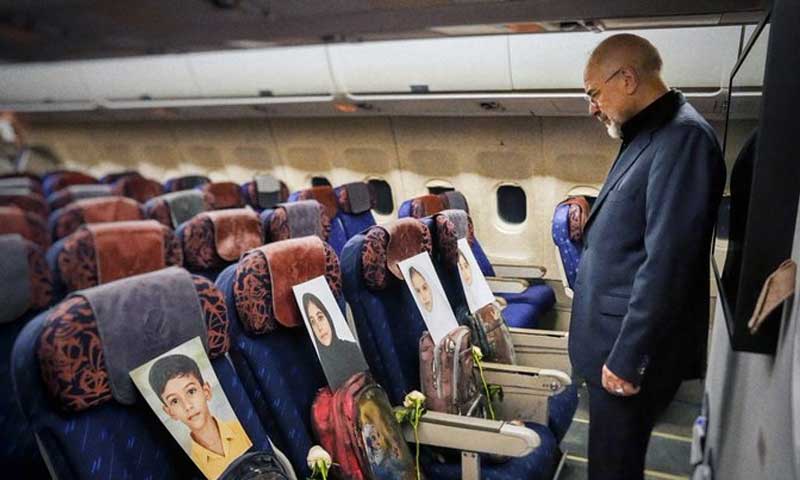
The Iranian delegation’s arrival in Islamabad for historic peace talks with the United States was itself a carefully crafted political statement . Inside the aircraft, rows of empty seats bore the belongings of victims from the February 28 Minab school strike—photographs, backpacks, and white roses .
As the plane touched down in the Pakistani capital, Parliament Speaker Mohammad Bagher Ghalibaf, the highest-ranking official leading the delegation, shared the image on X with a caption that captured Tehran’s state of mind heading into the negotiations: “My companions on this flight. We have goodwill but no trust” .
🕯️ ‘Minab 168’: The Tragedy Shaping the Talks
The delegation has named itself “Minab 168” in reference to the strike on an elementary school in southern Iran, which Tehran says killed at least 168 people, most of them children between the ages of 7 and 12 .
The United States has not officially acknowledged responsibility, though U.S. military investigators reportedly believe American forces were likely responsible, and a New York Times analysis suggested a Tomahawk missile—a weapon used exclusively by the U.S. in this conflict—may have struck the school due to a targeting error .
For Ghalibaf and the Iranian delegation, the memory of those children is not a side issue—it is central to their posture at the negotiating table. The empty seats were a reminder to the world of what Iran believes it has already lost in a war it did not start .
🎯 ‘Goodwill But No Trust’: Iran’s Opening Position
Ghalibaf’s words upon arrival captured Tehran’s calculated posture: “We have good intentions but we do not trust. Our experience in negotiating with the Americans has always been met with failure and breach of promise” .
The reference was pointed. Iran has not forgotten the 2015 nuclear deal, from which President Trump withdrew unilaterally in 2018. Tehran entered the Islamabad talks having already secured key preconditions from Washington: a ceasefire in Lebanon and the release of frozen Iranian assets, estimated between $100 billion and $120 billion .
Ghalibaf confirmed that while both conditions had been accepted in principle, neither had yet been fully implemented. “These two matters must be fulfilled before negotiations begin,” he said .
🏛️ A Delegation Built for Hard Bargaining
Ghalibaf’s presence leading the delegation signals Tehran’s hardline posture. A veteran of the Iran-Iraq War who lost a brother in that conflict, he embodies the revolutionary establishment’s distrust of the West . At his side is Foreign Minister Abbas Araghchi, a seasoned negotiator who helped craft the 2015 nuclear deal and has written extensively on the art of diplomatic leverage .
The delegation is structured for efficiency: senior officials assigned to dedicated committees covering military, economic, legal, and political matters, allowing decisions to be made on the spot rather than referred back to Tehran at every turn .
⚔️ The Leverage Beneath the Table
Iran’s greatest card remains the Strait of Hormuz, through which roughly one-fifth of the world’s oil passes . Tehran’s ability to choke off maritime traffic has put it at the center of global economic anxieties—a fact neither Washington nor its allies can ignore.
At the table, Iranian negotiators are expected to adopt what officials have called a “market style”—unhurried, persistent, and grinding . The Strait’s reopening will be a central issue, though Tehran has signaled it will not relinquish this leverage without significant concessions.
🇺🇸 Vance Leads the American Delegation
The U.S. delegation is led by Vice President JD Vance, the highest-ranking American official to negotiate directly with Iran since the 1979 hostage crisis . He is joined by special envoy Steve Witkoff and Jared Kushner.
Vance, who was reportedly reluctant about the military campaign during its early stages, is an interesting choice for Tehran. His hesitancy may lend him credibility in Iranian eyes—someone genuinely wary of escalation might actually mean what he says. But that cuts both ways: any deal perceived as too generous could wound him politically at home .
“If the Iranians are willing to negotiate in good faith, we’re certainly willing to extend the open hand,” Vance said before departing. “But if they’re going to try to play us, then they’re going to find the negotiating team is not that receptive” .
🤝 The ‘Make or Break’ Moment
Pakistani Prime Minister Shehbaz Sharif, whose country has emerged as the conflict’s indispensable mediator, described the moment in stark terms. “A temporary ceasefire has been announced, but now an even more difficult stage lies ahead: the stage of achieving a lasting ceasefire, of resolving complicated issues through negotiations,” he said. “This is that stage which, in English, is called the equivalent of ‘make or break'” .
The world is watching.
