
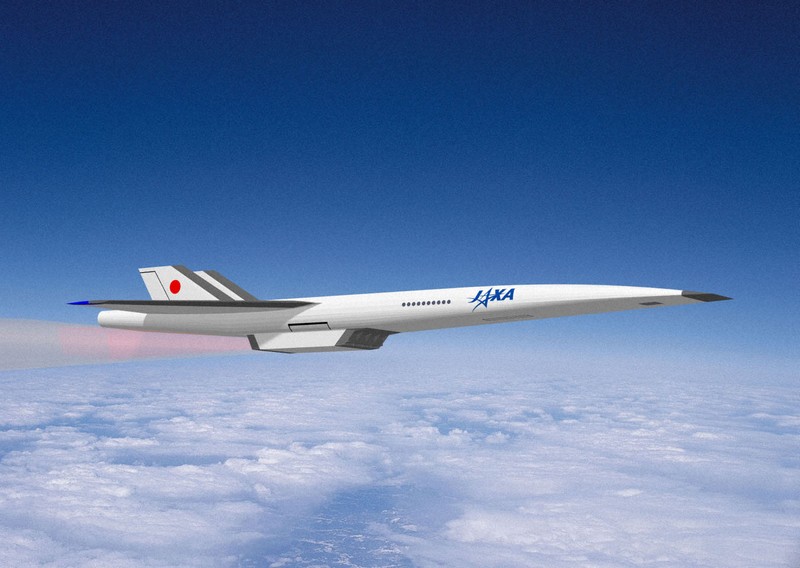
TOKYO: A Japanese research team has conducted the country’s first successful combustion test of a ramjet engine for an experimental Mach 5 aircraft, marking a significant milestone in hypersonic aviation technology.
Revolutionary Travel Times
The demonstration, conducted in April, advances technology aimed at realizing two-hour travel times between Japan and the United States on a plane that could also take passengers from airports into space. The team, including researchers from Waseda University in Tokyo and the Japan Aerospace Exploration Agency (JAXA), said it aims to get the technology into practical use in the 2040s.
Overseas, the supersonic Concorde passenger jet operated until 2003, but its speed topped out at about Mach 2. A Mach 5 hypersonic passenger plane would fly at an altitude of 25 kilometers—more than double that of a conventional aircraft—and at about 5,400 kilometers per hour, roughly six times faster than a normal plane. If equipped with a rocket engine, it could also reach space at an altitude of 100 kilometers. Because it would take off and land horizontally, it could use ordinary runways.
Technical Challenges Overcome
However, shock waves form around the aircraft, making it necessary to keep the engine operating stably even in complex airflow. Parts of the aircraft would face temperatures of about 1,000 degrees Celsius as air is compressed, requiring advanced heat resistance.
The research team began designing the experimental aircraft in 2013. In the latest test at JAXA’s Kakuda Space Center in Miyagi Prefecture, it simulated conditions equivalent to flying at Mach 5 at an altitude of 25 kilometers, where atmospheric pressure is one-hundredth that at sea level. Using a 2-meter-long experimental craft—about one-fiftieth the length of the passenger plane being planned—the team confirmed that the engine’s operation and heat-resistance performance worked almost exactly as designed.
Next Steps
Tetsuya Sato, a professor at Waseda University, said, “This result is still only a first step. Our dream is to connect it to a flight demonstration.” Hideyuki Taguchi of Tokyo University of Science noted that hypersonic development could take about 20 years, with two stages of demonstration before a passenger aircraft becomes a reality.
