
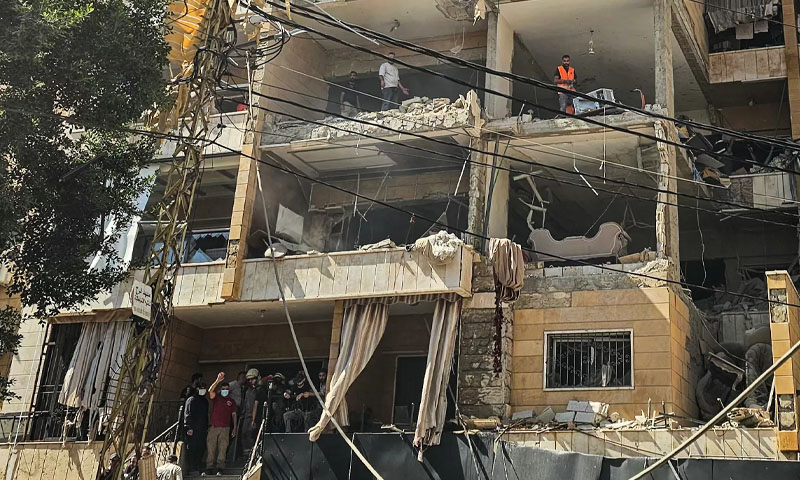
TEHRAN/JERUSALEM: Iran has launched multiple waves of missiles toward Israel, marking the first such direct attack since a fragile ceasefire took effect in early April. The Iranian strikes came in retaliation for Israeli airstrikes on Beirut’s southern suburbs that killed at least two people and injured 20 others, according to Lebanon’s health ministry.
The Islamic Revolutionary Guard Corps (IRGC) confirmed it targeted Israel’s Ramat David Airbase with ballistic missiles, warning that the Israeli military “must stop its attacks on Lebanon.” IRGC Commander Ali Abdollahi stated that if Israel expands its operations in Lebanon or responds to Iran’s actions, it will face “more crushing and regret-inducing blows.”
Israel’s military said its air defense systems intercepted all missiles fired from Iran. However, the attack triggered air raid sirens across northern Israel and prompted the Home Front Command to impose strict civil defense restrictions, banning large gatherings and closing schools and beaches.
Following the Iranian barrage, Israel’s far-right National Security Minister Itamar Ben-Gvir posted on social media that “Tehran must burn,” while Israeli military officials warned that Iran had made “a grave mistake” and that plans for retaliation were being prepared.
US President Donald Trump, reacting to the escalation, urged Iran to return to negotiations: “What I would suggest to Iran: You’ve shot your missiles, that’s enough. Get back to the table and make a deal.” Trump added that he was “close to a deal” with Iran and expressed frustration with the Israeli strike on Beirut, stating, “I’m not happy about it.”
Iran’s parliament speaker and chief negotiator, Mohammad Bagher Ghalibaf, warned that US and Israeli assets in the region have become “legitimate targets,” accusing Washington of giving a “green light” for the Beirut attack.
The developments have cast serious doubt over ongoing diplomatic efforts mediated by Pakistan to finalize a permanent peace agreement between Iran and the United States. Regional airspace was temporarily closed, with Iran shutting its western skies indefinitely. Jordan and Iraq also closed their airspace as a precaution, and Iraq announced a 72-hour suspension of all flights. Hezbollah, the Iran-backed Lebanese militant group, was not party to the April truce and has continued cross-border fire, with Israel vowing to intensify its campaign against the group regardless of broader ceasefire efforts. The international community has urged restraint on all sides, but with both Iran and Israel exchanging threats of further retaliation, the fragile ceasefire appears increasingly untenable. The coming hours will determine whether diplomacy can reassert itself or the region plunges into a wider war with potentially catastrophic consequences for global energy supplies and regional stability. The people of Lebanon, already battered by economic collapse and political turmoil, now face the prospect of renewed full-scale conflict on their soil. Israeli civilians in the north remain on high alert, and the military has warned of further strikes on Hezbollah positions. Iran has signaled that its response was limited and defensive, but warned that any Israeli retaliation would be met with overwhelming force. The situation remains highly fluid, with the potential for rapid escalation. The world holds its breath. The time for diplomacy is now. The leaders must act before it is too late. The hope for peace must not be abandoned. The cost of failure is too high. The lives of millions depend on wise and courageous decisions in the hours ahead. The international community must do everything in its power to prevent a full-scale regional conflagration. The path to peace is narrow, but it is still there. The leaders must find it. The time is running out. The world is watching. The hope endures. Peace is still possible. The leaders must choose it. The alternative is too terrible. The time for action is now.
