
WASHINGTON: In a major diplomatic breakthrough that could reshape global geopolitics, the United States and Iran are reportedly closing in on a historic peace framework to end months of devastating military conflict.
Conflicting Signals on Timing
While US President Donald Trump and Pakistani Prime Minister Shehbaz Sharif have both predicted a landmark Sunday signing, contrasting signals from Tehran have thrown the exact timing of the memorandum of understanding (MoU) into intense speculation. Islamabad has emerged as the central diplomatic hub for the high-stakes peace process. PM Shehbaz Sharif earlier said that Pakistan is fully prepared to facilitate an electronic signing of the preliminary framework, which is expected to be followed by rigorous technical-level negotiations in the upcoming week.
Trump’s Announcement
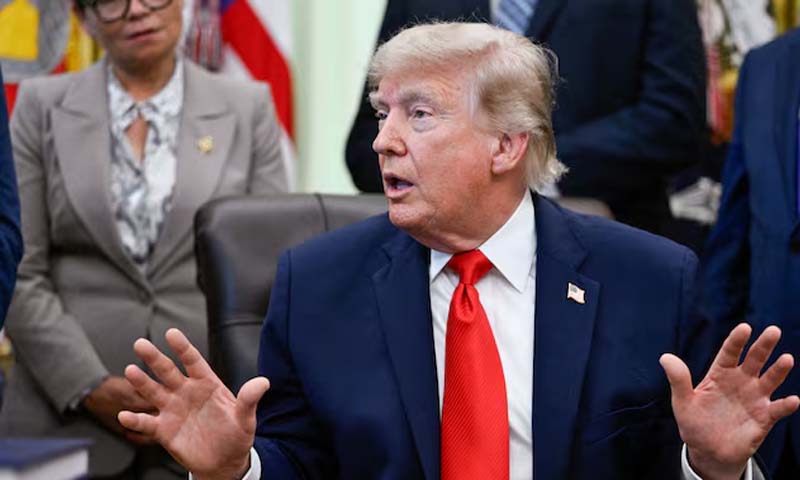
Taking to his social media platform, Truth Social, President Donald Trump announced that the peace accord with Iran is slated for a Sunday signing—aligning with his 80th birthday. Trump boldly claimed that the agreement would instantly resolve one of the conflict’s most critical economic chokeholds. “The Strait of Hormuz will immediately be open to all commercial vessels once the framework is finalized,” Trump said.
Tehran’s Caution
However, official channels in Tehran have introduced a note of cautious hesitation. Iranian Foreign Ministry Spokesperson Esmaeil Baghaei stated that the signing would “not be tomorrow” but could realistically materialise “in the coming days.” State-backed Fars News Agency also reported that expert panels are still micro-evaluating the complex legal, technical, and political components of the draft, meaning a final executive decision has yet to be rubber-stamped by Iran’s top leadership.
Qatari Mediation
In a frantic bid to bridge the remaining gaps, Qatari negotiators reportedly flew directly to Tehran early Sunday morning to push the agreement across the finish line.
Key Provisions of the Draft
According to diplomatic sources close to the secret negotiations, the comprehensive draft memorandum outlines key understandings across financial, maritime and nuclear areas. In the maritime and trade sector, the United States is said to have agreed to immediately lift the naval blockade on Iranian ports, while Iran would reopen the Strait of Hormuz to global shipping with zero tolls. Under financial arrangements, Washington would release $25 billion in frozen Iranian assets through cash lines and regional credit mechanisms and freeze the imposition of new sanctions, while Iran would benefit from temporary oil sanction waivers to restart its energy exports. On nuclear-related issues, the United States would allow the dilution of highly enriched uranium within Iranian territory, while Iran would pledge a complete halt to any nuclear weapons development and maintain a freeze on its nuclear programme.
Continued Clashes
Despite the frantic diplomatic maneuvering, the battlefield remains highly volatile. The US military confirmed it intercepted and shot down multiple Iranian attack drones targeting the Strait of Hormuz on Saturday, proving that the naval blockade remains active until a pen hits the paper. Concurrently, Israel has explicitly declared that it is not a party to the Washington-Tehran dialogue. Over the last 24 hours, Israeli forces launched heavy airstrikes hitting over 70 targets belonging to the Iranian-aligned Hezbollah group in Lebanon.
Domestic Backlash in Iran
The prospects of a truce have triggered sharp political divisions inside Iran. Massive pro-government rallies transformed into anti-compromise demonstrations across Iran on Saturday night. Under the proposed terms, both countries will enter a strict 60-day window immediately following the framework signing to negotiate the complex mechanics of dismantling Iran’s highly enriched uranium stockpiles and addressing the withdrawal of foreign military footprints from the region. The coming hours will determine whether the deal is signed as Trump predicts or whether further delays will occur. The world holds its breath. The hope for peace hangs by a thread. The leaders must act with wisdom and restraint. The cost of failure is too high. The lives of millions depend on the choices made in the coming days. The time for diplomacy is now. The alternative is too terrible. The world is watching. The hope endures. Peace is still possible. The leaders must choose it. The time for action is now. The attacks must stop. The negotiations must resume. The ceasefire must hold. The world demands it. The people deserve it. The leaders must deliver it. The hope is alive. The path is clear.
