
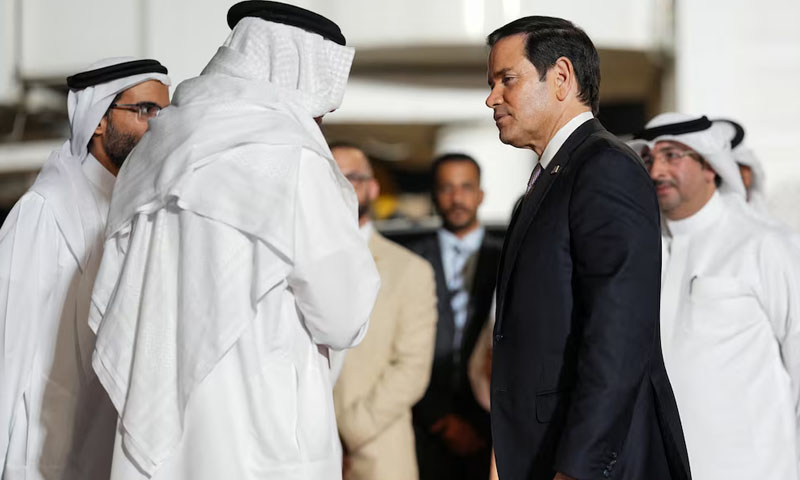
MANAMA: US Secretary of State Marco Rubio has landed in the Bahraini capital of Manama — home to the US Navy’s Fifth Fleet — to conclude a rapid three-day diplomatic sweep of the oil-rich Gulf region.
Rubio faces the uphill task of pitching the Trump administration’s preliminary peace deal to long-standing allies who fear that excessive concessions will embolden a financially liberated Tehran, tilting the Middle East’s security balance.
The tour follows previous high-level stops in the United Arab Emirates (UAE) and Kuwait. Throughout the trip, Rubio has repeatedly sought to douse fears that the White House is prioritizing normalization with Iran over the safety of its traditional partners.
“We’re not going to do anything that undermines the security of our allies, our longstanding allies in the region,” Rubio told journalists prior to his arrival in Bahrain.
Cracks in the US-Iran Framework
Despite Rubio’s assurances, the viability of the fragile peace deal remains under intense scrutiny due to conflicting accounts from Washington and Tehran:
- US President Donald Trump claimed Iran had agreed to nuclear inspections into “infinity,” a concession Tehran categorically denies making.
- The draft memorandum of understanding (MoU) hints at a massive $300 billion reconstruction fund. While the text suggests regional states might help foot the bill, Rubio clarified he is not currently asking Gulf allies for financial contributions.
- Strategic Vulnerabilities: The agreement lacks restrictions on Iran’s ballistic missile programs and grants Tehran significant leverage over the Strait of Hormuz, a critical choke point for global energy flows.
What Is at Stake for the GCC?
The six GCC nations—Saudi Arabia, the UAE, Qatar, Oman, Kuwait, and Bahrain—form the backbone of America’s military footprint in the Middle East. Having provided logistical support to the US during the recent conflict, several of these states faced direct Iranian airstrikes.
There is deep-seated concern among the Sunni-led monarchies regarding a resurgent, predominantly Shi’ite Iran. In Bahrain specifically, where a Sunni monarchy rules over a Shi’ite majority, officials are acutely worried that the lifting of sanctions could allow Tehran to actively foment domestic unrest.
Any shift in how these energy-rich nations view their security relationship with Washington could fundamentally reshape US military strategy in the region.
