
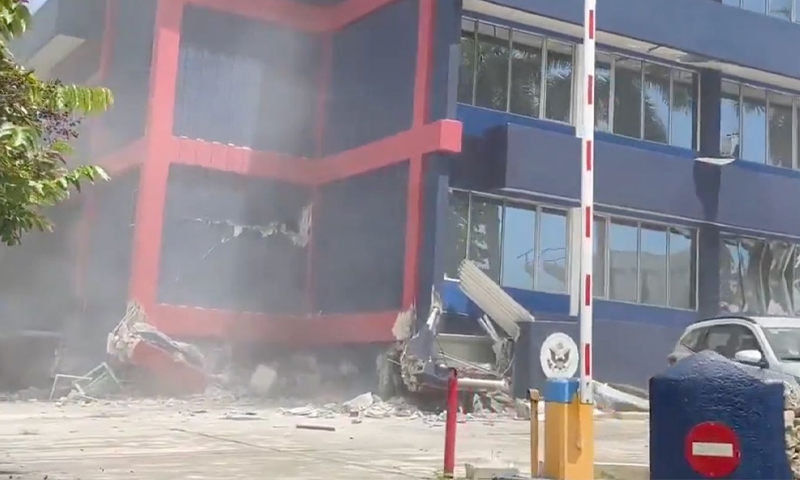
The United States embassy in Vanuatu has been closed after a powerful 7.3-magnitude earthquake struck the Pacific island nation on Tuesday, causing severe damage to the embassy building in Port Vila, the capital. According to a statement from the US embassy in Papua New Guinea, the embassy sustained significant structural damage, leading to its closure until further notice. In light of the destruction caused by the earthquake, the embassy expressed sympathy for the victims and their families, offering condolences to those affected.
Details of the Earthquake and Damage
The earthquake, which struck at 12:47 pm local time, hit off the coast of Efate, the main island of Vanuatu, at a depth of 57 kilometers. The tremor was felt across the region, including in neighboring countries, and left considerable destruction in its wake. The United States Geological Survey (USGS) confirmed that the earthquake’s epicenter was located approximately 30 kilometers from Efate’s coast.
Reports from the ground indicate that the ground floor of a building housing both the US and French embassies in Port Vila had been completely crushed under the weight of the upper floors. Michael Thompson, a resident of Vanuatu, described the scene of destruction to AFP via satellite phone. He stated that the building had collapsed entirely, and in the aftermath, there were reports of people trapped inside. Thompson reported seeing bodies near the collapsed building when he and others walked by the area, adding that there were signs of significant loss of life.
Impact on Infrastructure and Rescue Efforts
The devastation in Port Vila was not limited to the embassy building. Numerous other parts of the city were severely affected, including the collapse of at least two bridges. Thompson, who runs a zipline business in Vanuatu, mentioned that a landslide had blocked a road and trapped a bus beneath it, suggesting that there were more casualties. The damage to infrastructure has left the city’s mobile network systems inoperable, making it difficult to communicate with emergency services and coordinate rescue operations.
A series of rescue efforts are underway as local authorities and emergency teams begin to address the situation. Emergency vehicles and rescue teams are seen at the scene, as evidenced by footage shared by Thompson, who captured images of rescuers working on a collapsed building where the external roof had fallen onto parked vehicles. Streets in Port Vila were strewn with debris, including broken glass, from the damage to buildings.
As the rescue operations continue, the local authorities have emphasized the need for international support, particularly in terms of medical evacuations and skilled rescue teams. With limited infrastructure and a large number of people in need of assistance, experts with experience in earthquake response are critical to ensuring the swift recovery of the affected areas.
Tsunami Warning Issued and Lifted
Following the earthquake, a tsunami warning was issued for parts of Vanuatu, with predictions of waves reaching up to one meter (three feet) in some areas. Fortunately, the Pacific Tsunami Warning Center quickly lifted the warning after it became clear that the waves generated by the earthquake would not pose a significant threat. Smaller tsunami waves of less than 30 centimeters above the normal tidal levels were also predicted for neighboring Pacific island nations, including Fiji, New Caledonia, Tuvalu, Kiribati, and the Solomon Islands. While the immediate tsunami threat was mitigated, the tremor left many island nations on alert, highlighting the vulnerability of the Pacific region to natural disasters.
Vanuatu’s Vulnerability to Earthquakes and Other Natural Disasters
Vanuatu, a low-lying archipelago with a population of about 320,000 people, is located in the Pacific’s “Ring of Fire,” an area known for its high levels of seismic activity. Earthquakes are relatively common in this region, as it is situated at the convergence of multiple tectonic plates. The recent earthquake serves as a stark reminder of the vulnerability of countries in the Pacific to such natural disasters.
In addition to earthquakes, Vanuatu is frequently impacted by other types of natural disasters, such as storms, flooding, and tsunamis. The island nation is ranked among the most disaster-prone countries in the world, according to the annual World Risk Report. Due to its geographic location, Vanuatu faces the compounded risks of both seismic activity and extreme weather, making disaster preparedness and response a critical focus for the government and international organizations.
Humanitarian Response and Global Assistance
As Vanuatu works to recover from the earthquake, the international community is mobilizing to provide humanitarian assistance. The United States, through its embassy in Papua New Guinea and other partners in the Pacific region, has pledged support for the relief efforts. Foreign medical teams and rescue personnel are expected to arrive soon to assist with ongoing rescue and recovery efforts.
Aid organizations have also highlighted the urgent need for resources, including food, clean water, medical supplies, and shelter for the displaced population. Given Vanuatu’s vulnerability to natural disasters, the country often relies on international aid to bolster local efforts in times of crisis. The magnitude of the earthquake, along with its widespread impact on infrastructure and communities, will require a coordinated global response to help the nation rebuild and recover.
