
Table of Contents
A powerful suicide blast ripped through the area outside the District and Sessions Court in Islamabad’s G-11 sector on Tuesday afternoon, killing at least 12 people and injuring 36 others, officials confirmed. The attack struck at a time when the capital was hosting several major international events, including the Inter-Parliamentary Speakers’ Conference, the 6th Margalla Dialogue, and a cricket match between Pakistan and Sri Lanka in nearby Rawalpindi.
According to Interior Minister Mohsin Naqvi, the explosion occurred at 12:39 p.m. outside the court’s main entrance. Briefing the media at the scene, Naqvi described the incident as a “suicide blast”, saying the attacker had loitered outside the building for about 12 minutes before detonating his explosives.
“The attacker first attempted to enter the court premises but, when he was unable to do so, he targeted a nearby police vehicle,” Naqvi said. “He remained outside for several minutes, apparently assessing how to get inside before setting off the device.”
Naqvi confirmed that 12 people were killed and 27 were initially reported injured, though the toll later rose. Several police personnel were among the casualties, while the driver of the targeted police vehicle miraculously survived. A lawyer was also among the dead.
Casualties and Medical Response
The Pakistan Institute of Medical Sciences (PIMS) declared a full-scale emergency soon after the attack. Later in the day, PIMS spokesperson Dr. Mubahshir Daha stated that the death toll remained at 12 while the number of injured had increased to 36.
“Thirty-six injured people were brought to PIMS,” Daha said. “Eighteen have been discharged after initial treatment, fourteen are admitted in various wards, three are under observation in the emergency section, and one is undergoing surgery.”
“All hospital resources are being fully utilized to assist the injured,” he added, noting that doctors and paramedics were working round-the-clock.
Health Minister Mustafa Kamal visited the hospital later in the evening, assuring that the best medical facilities would be provided to the victims and their families.
Eyewitness Accounts and Scene of the Blast
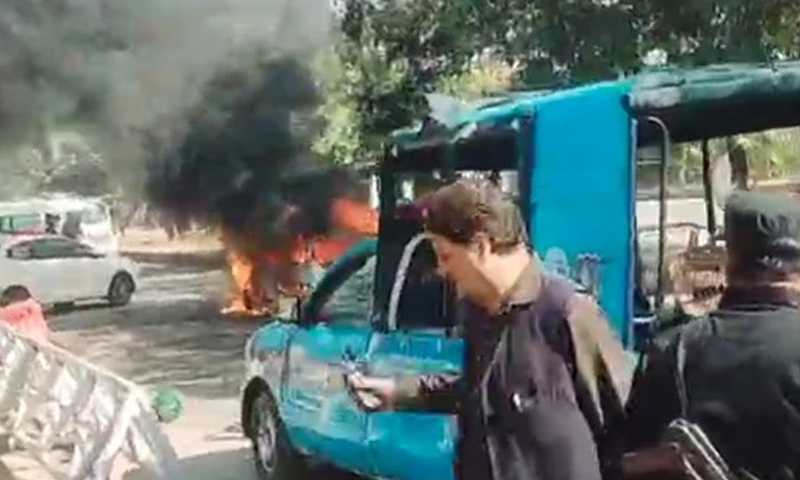
Videos shared on social media showed flames and thick black smoke billowing from a burnt-out vehicle behind a security barricade. The explosion shattered windows, scattered debris across the area, and sent panic through the usually busy court complex.
Lawyer Mohammed Shahzad Butt, who was present at the scene, told AFP: “It was a massive blast. Everyone started running in panic. I saw at least five bodies lying near the front gate.”
Another lawyer, Rustam Malik, said he heard a loud bang as he was entering the complex. “It was complete chaos — people were screaming and running. Two bodies were lying by the gate, and several cars were on fire,” he recalled.
Investigation and Security Measures
Interior Minister Naqvi said an investigation was underway and identifying the bomber was the government’s top priority. “We will identify him in the next few hours,” he promised. “We are linking this blast with other recent incidents, and in the coming hours or days, we will be very clear about the motives behind it.”
The minister emphasized that the attack was not being treated as an isolated incident. “We are not taking this blast as just another one,” he said, suggesting that the timing — coinciding with key international and political activities — was deliberate.
Naqvi also stated that law enforcement agencies, the army, and Rangers were working together to maintain security in the capital. As part of new measures, he directed the chief commissioner to ensure that no vehicle would be allowed to enter Islamabad without an e-tag after two weeks.
Police sources confirmed that security had been tightened around the Judicial Complex, adjoining courts, and other sensitive sites across the capital. Additional checkpoints were set up, and patrols were increased in high-risk areas.
Government Reaction and Accusations
Prime Minister Shehbaz Sharif strongly condemned the bombing, describing it as a “cowardly act of terrorism.” A statement issued by the federal government linked the attack to what it called “khawarij active with Indian support” and referred to the perpetrators as agents of “Fitna al-Hindustan.”
“The Prime Minister ordered a thorough investigation into the incident and directed that the injured be given the best possible treatment,” the statement said.
It further alleged that Indian-backed militants operating from Afghanistan were behind not only the Islamabad blast but also a recent attack on children in Wana, South Waziristan. “These are the worst examples of Indian state terrorism in the region,” the government claimed.
“We will continue the fight until the complete elimination of terrorism,” the statement concluded. “The perpetrators will bear the consequences.”
Public Assurance and Ongoing Probe
Minister Naqvi assured citizens that there was no specific security alert prior to the explosion and that routine security operations were in place. “There were many international activities in Islamabad today,” he said. “But our forces are vigilant, and we will not allow terrorists to disrupt the peace of our capital.”
As investigations continue, officials said forensic teams were examining CCTV footage and gathering evidence from the blast site to identify the network behind the attack. The tragedy has reignited concerns over a possible resurgence of terrorism in Pakistan’s major cities, especially amid regional instability.
