
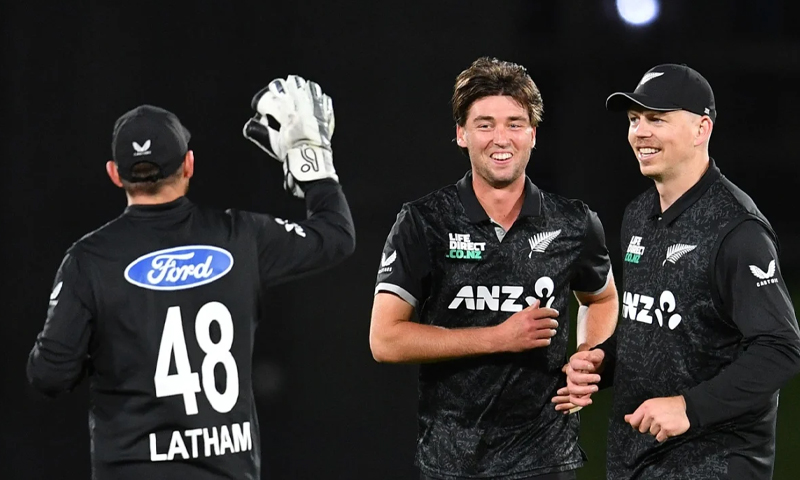
New Zealand battled their way to 269 for 7 in 50 overs before clinching a thrilling 7-run victory over the West Indies in Christchurch — a match defined by grit, discipline, and one unforgettable Daryl Mitchell masterclass.
Mitchell’s 119 was not just a century; it was an innings stitched together through pain, pressure, and pure determination. Early on, it appeared he would cruise to three figures, timing the ball sweetly while others struggled on a two-paced pitch. But as the innings wore on, and as the West Indies tightened their lines to a remarkable degree, even Mitchell found himself grinding through phases of uncertainty. Add to that a sudden injury scare late in his innings, and the achievement becomes even more monumental.
His celebration spoke volumes. Helmet off, arms stretched, roaring “YES!” with veins bulging — it was the kind of emotional outburst once associated with Black Caps greats like Kane Williamson or Ross Taylor. Yet in recent years, Mitchell has steadily climbed toward that elite bracket. This hundred, coming after four fifties in his last seven ODIs, only strengthens his credentials as New Zealand’s new middle-order talisman.
The pitch offered nibble throughout the innings and suited the West Indies bowlers perfectly after they won the toss and elected to field. They made five changes from their previous ODI in Bangladesh, swapping out their spinners for seamers. The move paid off instantly. Matthew Forde, the pick of their attack, was fierce and full of rhythm, finding early movement and rattling the hosts.
He struck twice in the seventh over, first removing Rachin Ravindra for 4 and then dismissing Will Young for a golden duck on his 50th ODI appearance. Suddenly New Zealand were 14 for 2, and the pressure was sky-high.
That was the moment Mitchell arrived — and immediately flipped the narrative.
While most New Zealand batters were glued to the crease, wary of the lateral movement, Mitchell took the bold route. He moved down the pitch, stepping into the line of the ball to neutralise Forde’s seam movement, trusting his eye against speeds hovering around 122 kph. For a brief period, West Indies responded by bringing the wicketkeeper up to the stumps, but it slowed him rather than stopping him.
Mitchell cruised to 33 off 37 and reached his fifty in just 24 more deliveries. New Zealand were 91 for 2 in the 18th over, but what followed was a long, draining slowdown. Only two of the next 16 overs went for a run-a-ball. Five of them were nearly maidens. West Indies, with disciplined lines and clever variations, dragged the scoring rate to a crawl.
Roston Chase, in particular, was exceptional. He exploited the strong breeze across Hagley Oval by bowling around the wicket and tossing the ball up just enough to let the wind take over. He deliberately reduced turn, releasing the ball with a perpendicular seam, tricking batters into playing for spin that never arrived. His length was immaculate — nothing too full, nothing hittable down the ground. Even Mitchell struggled to dominate him.
Chase deserved more than one wicket, but he could take pride in tormenting Michael Bracewell. Bracewell survived twice through DRS, enjoyed a missed stumping by Shai Hope, and watched John Campbell drop a catch at cover. Three of these chances came off Chase’s bowling. His frustration echoed through the stump mic: “Jeeesus,” he muttered after another chance went begging. Eventually, Bracewell fell for 35 off 52 — a relief for both Chase and the West Indies.
By the 42nd over, New Zealand were 192 for 5, and their hopes hung squarely on Mitchell — who suddenly pulled up mid-run, clutching his left leg. Limping and visibly in pain, he shifted from running hard singles to planting his feet and swinging with raw power. It worked. The big right-hander muscled his way to triple figures with punishing straight hits, refusing to walk off despite his injury.
He had slices of luck — dropped on 19 by Chase and again on 67 by Jayden Seales — but bravery and resilience defined his knock more than fortune. His seventh ODI hundred was an innings of phases: blistering start, tactical slowdown, injury battle, and a final surge of clean hitting.
Devon Conway played a crucial role too, grinding out 49 off 58 at the top despite never looking fully in rhythm. His knock provided early stability and bought Mitchell the time he needed.
In the end, New Zealand’s 269 proved just enough. Their bowlers held their nerve, defending the total to seal a tense 7-run win and cap off a fiercely contested match highlighted by one of Mitchell’s finest innings in national colours.
