
Table of Contents
On Tuesday morning, a powerful earthquake measuring 6.8 on the Richter scale rocked the northern foothills of the Himalayas, near Tibet’s revered city of Tingri. The earthquake struck at 9:05 AM local time, and its epicenter was located in the rural county of Tingri, approximately 80 kilometers (50 miles) north of Mount Everest. The quake’s epicenter was reported at a depth of 10 km (6.2 miles), according to China’s Earthquake Networks Centre. However, the US Geological Survey initially reported the magnitude as 7.1.
Impact on Tibet and Casualties
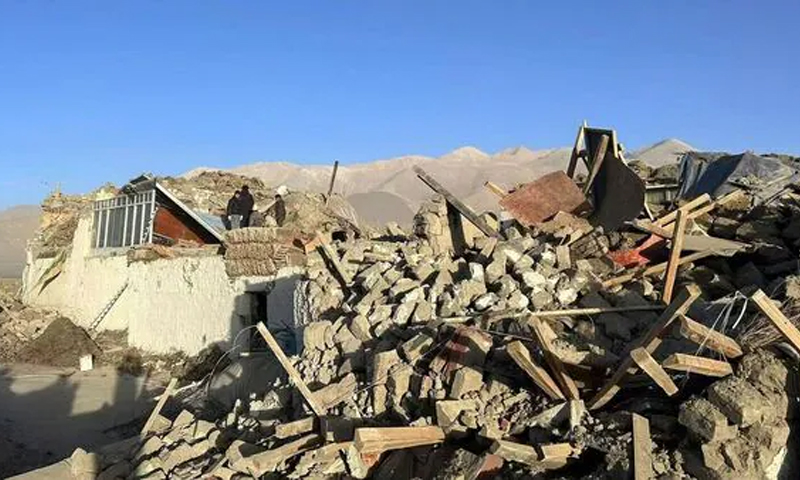
As of the latest reports, at least 95 people have been confirmed dead, with more than 130 injured, primarily on the Tibetan side of the border. The hardest-hit areas are in the Shigatse region, which has a population of approximately 800,000. The earthquake also caused significant destruction to infrastructure, with over 1,000 houses reported to have been damaged in towns and villages near the epicenter. The region, already challenging to reach due to its remote nature and high altitude, has further been impacted by dozens of aftershocks, some of which measured as high as 4.4 in magnitude.
Many villages in the area, such as those located in Tingri and Lhatse, are scattered across steep, mountainous terrain, making rescue operations difficult. These regions are sparsely populated, but the lack of accessible roads and challenging winter weather conditions add to the complexity of emergency response efforts. Rescue teams, including over 1,500 firefighters and emergency workers, have been mobilized to assist in the affected areas. Additionally, essential supplies, such as tents, cotton coats, and quilts, have been sent to provide relief to those affected by the disaster.
Damage to Infrastructure and Property
In the aftermath of the earthquake, videos circulating on social media showed extensive damage to infrastructure, particularly in Lhatse, where buildings had collapsed, and debris spilled onto the streets. Some of the damage was so severe that roads became blocked, further complicating rescue and relief efforts. Local authorities are working with nearby towns and regions to assess the full extent of the damage and ensure that necessary resources and aid reach the affected communities.
The earthquake also struck during the winter season, which has made relief efforts more challenging. The harsh weather conditions, coupled with the fragile infrastructure of the region, have posed serious obstacles for both survivors and rescue teams. Chinese President Xi Jinping has called for all-out efforts to search for survivors, minimize casualties, and ensure the proper resettlement of affected residents, particularly as the region braces for the winter.
Impact on Neighboring Countries: Nepal, Bhutan, and India
While Tibet bore the brunt of the quake’s effects, the tremors were felt across several neighboring countries, including Nepal, Bhutan, and northern India. In Nepal, which shares a long border with Tibet, the quake was felt in seven hill districts. Fortunately, no fatalities have been reported in Nepal, but at least one individual was injured when they jumped from the top of a building in Kathmandu during the tremors.
The capital of Bhutan, Thimphu, also experienced shaking, as did parts of India, particularly the state of Bihar, which borders Nepal. While authorities in both India and Bhutan have reported no significant damage or casualties, the tremors were felt as far as Kathmandu, located around 400 kilometers (250 miles) from the epicenter. The Nepalese capital’s residents experienced fear and panic, recalling the devastating 2015 earthquake that killed nearly 9,000 people in Nepal.
Earthquake History in the Region
The region has a long history of seismic activity, with many earthquakes being triggered by the ongoing collision between the Indian and Eurasian tectonic plates. These plates’ interaction creates immense pressure and is responsible for the frequent earthquakes in the Himalayan region. Since 1950, there have been 21 earthquakes of magnitude 6 or higher in Tibet’s Lhasa block alone. The largest of these was a 6.9-magnitude earthquake in 2017, which struck the Mainling region of Tibet.
The location of Tuesday’s quake, near the Lhasa block, falls within an area under intense north-south compression and west-east stress, as experts from China’s seismic research institutes have noted. These geological conditions are prone to seismic activity, especially along fault lines in the region.
Rescue and Recovery Efforts
Chinese President Xi Jinping has called for immediate efforts to aid the victims and stabilize the region. In addition to the mobilization of thousands of rescue personnel, the Chinese government has dispatched emergency supplies, including tens of thousands of items like folding beds, tents, and warm clothing, to provide immediate relief. The Chinese government is also focused on ensuring the safety and warmth of displaced individuals, particularly as the region enters the harsh winter months.
Given the proximity of the epicenter to Mount Everest, local authorities have temporarily closed the Everest region to tourists to ensure the safety of trekkers and climbers. Fortunately, the winter season sees fewer climbers on Everest, and a German mountaineer who had a permit to ascend the mountain had already left base camp after failing to reach the summit.
Global Support and Condolences
The earthquake has not only impacted China and its immediate neighbors but has also garnered international attention and support. Pakistan, in particular, has expressed deep condolences for the loss of life and property in Tibet. Pakistani President Asif Ali Zardari offered his heartfelt sympathies to the Chinese people and government, standing in solidarity with those affected by the earthquake. Other countries, including neighboring India and Nepal, have also extended their support for the ongoing relief efforts.
