
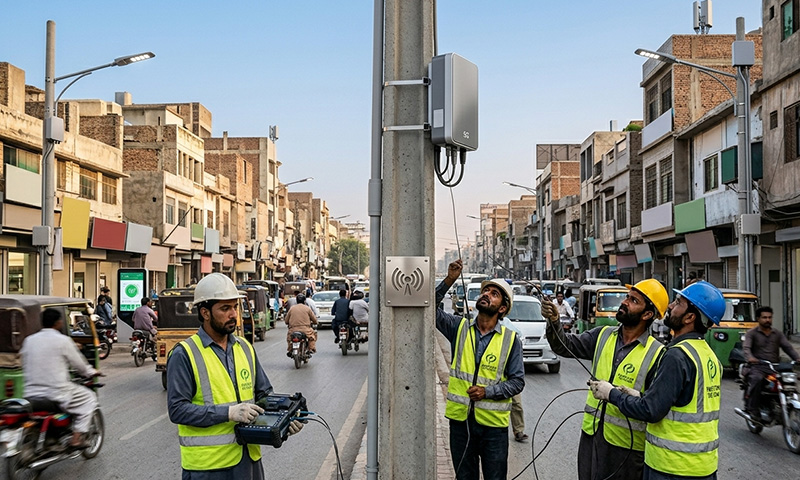
ISLAMABAD – Pakistan’s inadequate fibre optic infrastructure has emerged as the primary obstacle to nationwide 5G deployment, with industry experts warning that the country’s backhaul network remains far below the required threshold to support next-generation mobile broadband.
According to data from the Frequency Allocation Board, Pakistan’s fibre-to-node penetration stands at a mere 0.78, drastically trailing regional competitors such as Bangladesh at 5.0 and Thailand at 34.6 .
“The backhaul network is not ready for full-scale 5G deployment” a senior Pakistan Telecommunication Authority (PTA) official told Dawn, requesting anonymity as he was not authorized to speak publicly . The official noted that without dense fibre connectivity, 5G promises of ultra-low latency and massive bandwidth would remain largely unfulfilled .
PTA has targeted a 5G launch by July 2027, but industry insiders suggest this timeline may be unrealistic given current infrastructure deficits. The authority has allowed a 12-month testing period, yet even basic 5G coverage will be limited to major urban centres .
Spectrum pricing has also emerged as a major hurdle. The proposed reserve price for 5G spectrum is nearly four times higher than in Bangladesh, with operators arguing that high auction costs would restrict investment in fibre expansion – further slowing broader deployment .
Without adequate fibre backhaul, 5G would effectively function as “faster 4G” rather than delivering true next-generation capabilities. The technology’s full potential – including applications in autonomous transport, telemedicine, Industry 4.0, and smart city infrastructure – relies heavily on seamless fibre connectivity .
The PTA has invited public feedback on the proposed 5G auction framework, with a deadline of May 9, 2026 . Industry stakeholders are expected to push for lower spectrum pricing and a clear timeline for mandatory fibre rollout alongside spectrum awards .
