
Table of Contents
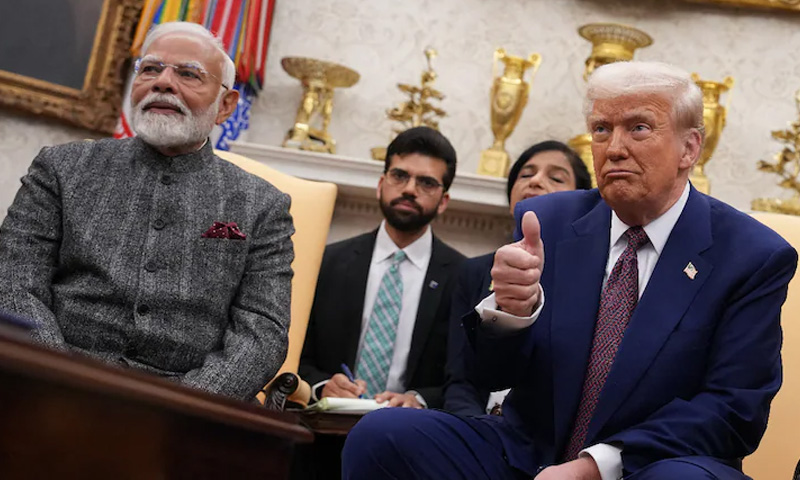
In a historic meeting between Indian Prime Minister Narendra Modi and U.S. President Donald Trump, the two countries have set an ambitious target to double their trade to $500 billion by 2030. The announcement came after a summit held in Washington, where both leaders discussed the future trajectory of India-U.S. relations.
Modi outlined that both nations would intensify efforts in areas such as artificial intelligence (AI), semiconductor manufacturing, and securing supply chains for critical minerals. These sectors are expected to be pivotal in reshaping global technological landscapes, and India and the U.S. plan to lead this transformation together.
Prime Minister Modi’s emphasis on boosting trade underlined India’s desire to become an even more integral part of the global economy, while also acknowledging the strategic importance of working with the U.S. on cutting-edge technologies. As both nations look to strengthen their economic ties, the focus will be on mutual benefit through a balanced trade agreement.
Strengthening Military Cooperation: U.S. Offers F-35 Jets
Military cooperation between India and the U.S. reached new heights during the summit, with President Trump announcing the U.S. would significantly boost military sales to India. In a groundbreaking move, Trump revealed that the U.S. is prepared to offer India one of its most advanced military assets—the F-35 stealth fighters. This is expected to be part of a broader strategy to deepen defense ties between the two nations.
Trump also stated that the U.S. would begin increasing military sales to India by billions of dollars, recognizing India’s growing importance as a strategic partner in the Indo-Pacific region. The sale of F-35s to India would mark a significant step in enhancing the military capabilities of the Indian Air Force, as well as deepening defense cooperation in countering growing threats from China.
Tariff Disputes and Trade Deficits: A Key Issue
Despite the progress made in several areas, the issue of tariffs remained a significant point of contention during the summit. President Trump expressed frustration over what he called India’s “unfair, very strong tariffs,” which he viewed as a barrier to trade expansion. In response, Modi acknowledged the issue and reassured Trump that both countries would engage in talks to address the trade imbalance, particularly focusing on oil and gas exports from India to the U.S.
While the two leaders remained committed to resolving the tariff issues, it became clear that both countries would need to find a mutually beneficial solution that balances each side’s economic interests. Trump’s announcement of reciprocal tariffs on countries, including India, raised concerns about the potential impact on trade, but the summit indicated a willingness to negotiate a resolution in the near future.
Elon Musk’s Role: A Symbol of Tech Collaboration
The summit also saw the presence of Elon Musk, the billionaire entrepreneur behind SpaceX and Tesla, who was a key figure in the meeting. Musk’s attendance underscored the growing focus on technology and innovation in the India-U.S. partnership. Modi met one-on-one with Musk, leading to speculations about whether the meeting was primarily official or driven by business interests.
The discussions between Modi and Musk were not limited to business but also centered around how India could further collaborate with Tesla and SpaceX, particularly in the electric vehicle sector and space exploration. Modi, a prolific user of Musk’s social media platform X, later shared images of his handshake with Musk, reinforcing the ongoing collaboration between India and global tech giants.
Extradition and Immigration: Addressing Global Challenges
On the topic of immigration, Modi and Trump discussed the ongoing issue of undocumented Indians in the U.S. Modi pledged India’s full cooperation in addressing the problem, stating that the country would take back any verified Indian national who is in the U.S. illegally. This commitment is part of India’s broader efforts to tackle human trafficking and ensure that its citizens are not vulnerable to exploitation.
Trump also announced the extradition of Tahawwur Hussain Rana, a key suspect in the 2008 Mumbai attacks, who had been convicted and sentenced to prison in the U.S. The extradition marked a significant moment in U.S.-India cooperation, as both countries continued to work together on counterterrorism efforts and strengthening security ties.
Shared Ideologies: Modi and Trump’s Strong Personal Bond
Throughout the summit, both Modi and Trump expressed a deep personal bond, with Modi referring to Trump as a friend. The two leaders share similar political ideologies, emphasizing nationalism, strong borders, and a focus on promoting their respective majority communities. This shared vision for their countries’ future was evident in their discussions and mutual admiration for each other’s leadership.
In 2020, Modi had invited Trump to India for a grand event at the world’s largest cricket stadium in Gujarat, symbolizing the close relationship between the two leaders. The personal chemistry between Modi and Trump, combined with shared strategic interests, has played a crucial role in advancing India-U.S. relations.
Future Prospects: A Quad Summit and More Cooperation
Looking ahead, the growing India-U.S. partnership is set to play a significant role in regional and global geopolitics. Trump indicated that he might visit India later this year for a summit of the Quad, a four-nation grouping of Australia, India, Japan, and the United States. The Quad is seen as an important strategic alliance aimed at countering China’s growing influence in the Indo-Pacific region.
In addition to defense and trade, the two nations are likely to deepen cooperation on global issues such as climate change, technological innovation, and counterterrorism. As Modi and Trump continue to strengthen their diplomatic relationship, it is clear that both leaders are committed to shaping a future of shared prosperity and global leadership.
