
Table of Contents
Microsoft celebrated its 50th anniversary on Friday with an event at its headquarters in Redmond, Washington, reflecting on the company’s remarkable journey from its early days to its current position as a major player in the tech industry. As part of the celebration, company leaders and staff recalled some of Microsoft’s most memorable moments while also unveiling a new vision for the future—one driven by artificial intelligence (AI) and personalized experiences.
The event was a nostalgic look back at Microsoft’s glory days, particularly when Yusuf Mehdi, now the company’s consumer chief marketing officer, remembered a time in the early 1990s when the audience in a conference hall swooned at the simple demonstration of a new feature in Excel—how to sum numbers with the click of a button. Mehdi compared the scene to a rock concert, with cheers of excitement and admiration echoing through the room, much like a Mick Jagger performance.
Copilot: The AI Revolution
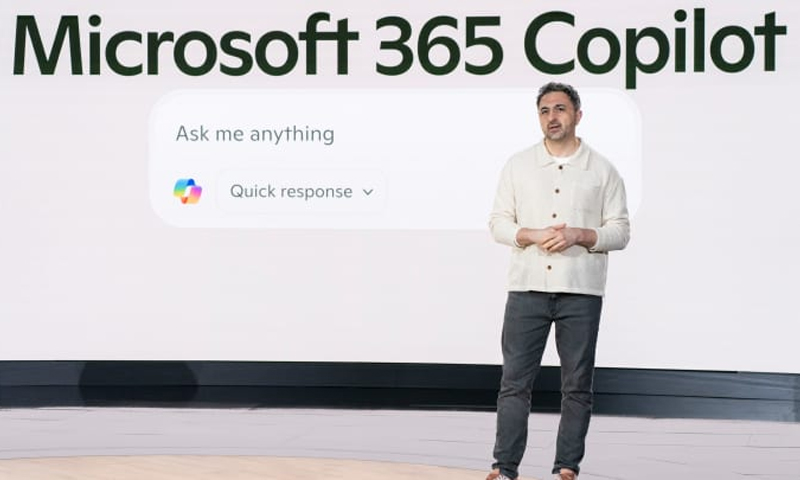
At the heart of Microsoft’s future-focused vision is Copilot, its AI assistant, which is rapidly gaining new capabilities. The company has begun integrating Copilot into its productivity suites for business, while also developing a consumer-focused version. Mehdi highlighted how the AI assistant is becoming more proactive, capable of remembering personal details about users, such as birthdays, upcoming presentations, and other important events. This personalization aims to make the AI experience more helpful by offering timely reminders and support without the need for constant user input.
In addition to remembering personal information, Copilot will also personalize podcasts, shopping recommendations, and even assist with tasks such as making reservations. According to Mehdi, this makes Copilot a tool that “frees you up,” allowing users to delegate mundane tasks to the AI while focusing on more important activities.
However, Microsoft is not alone in this AI push. Rivals like Alphabet and OpenAI, the creators of ChatGPT, have already made significant advancements in AI and “action-taking” software. But Mehdi emphasized that Microsoft’s AI would work best on popular platforms where the company has already established strong technical partnerships, such as with OpenTable and 1-800-Flowers.com.
A Storied Legacy: From Bill Gates to Satya Nadella
As Microsoft celebrates its 50 years, the event was marked by a rare public appearance of Bill Gates, Steve Ballmer, and current CEO Satya Nadella, who all reflected on the company’s extraordinary journey. Gates, who co-founded the company, spoke about the profound impact of technology over the past 50 years and expressed optimism about what lies ahead, stating that Microsoft is “on the verge of something even more profound” than the innovations that have defined the company’s history.
Satya Nadella, who took the helm as CEO and transformed Microsoft into a leader in cloud computing, echoed this sentiment. At the event, Nadella emphasized that the company is not just looking back but is focused on creating a future that empowers others to build innovative solutions with its tools and platforms. In a nod to Microsoft’s continual evolution, he posed the question to his executives: “How do we rethink the way that we build software?”
Ballmer, who famously rallied the Microsoft community with his “developers, developers, developers!” chant, reprised the chant at the event, underscoring the importance of software developers in the company’s future. His energy and enthusiasm were palpable, highlighting the passion that still drives the company’s commitment to innovation.
AI-Powered Future: A Personal Touch
In the world of AI, Microsoft’s Copilot stands out for its warmth and personality. While many users are finding it a valuable tool, Mehdi acknowledged that some have expressed concerns over its frequent inquiries. Despite this, he emphasized that as Microsoft continues to refine Copilot, the assistant will become smarter and more intuitive, allowing for deeper personalization and better support for users.
AI Adoption Leads to Short-Term Setbacks but Long-Term Gains for Manufacturers: ECB Study
“We’re partway through that journey,” Mehdi said. The company’s commitment to improving its chatbot technology is evident, especially in a competitive landscape that includes notable AI players like Elon Musk’s xAI and Anthropic. Microsoft’s approach focuses on making its AI more human-like, aiming to enhance user experiences by offering a level of personalization that feels more like a helpful assistant than a generic tool.
Microsoft’s Path Ahead: Copilot as a CEO?
As the company looks to its next 50 years, Microsoft’s leadership seems confident in the role AI will play. Gates humorously mused that he hoped Copilot would one day serve as Microsoft’s CEO—a sentiment that reflects the growing role AI will have in not just user interactions but also in leadership and decision-making processes within organizations.
With advancements in AI continuing to reshape the tech industry, Microsoft is positioning itself at the forefront of this revolution. Copilot, along with other AI tools, is expected to redefine how users interact with software and integrate technology into their daily lives. The goal is to build a future where AI plays a central role in making people’s lives easier, more productive, and more connected.
Looking to the Future
As Microsoft marks 50 years of innovation, the company’s continued focus on AI and productivity tools suggests that it is ready to build on its legacy and remain a key player in shaping the future of technology. Whether it’s through making everyday tasks more manageable with Copilot or redefining how people work and interact with technology, Microsoft is looking ahead with optimism. And with a bold vision for AI’s potential, the next 50 years might just be as groundbreaking as the first.
