
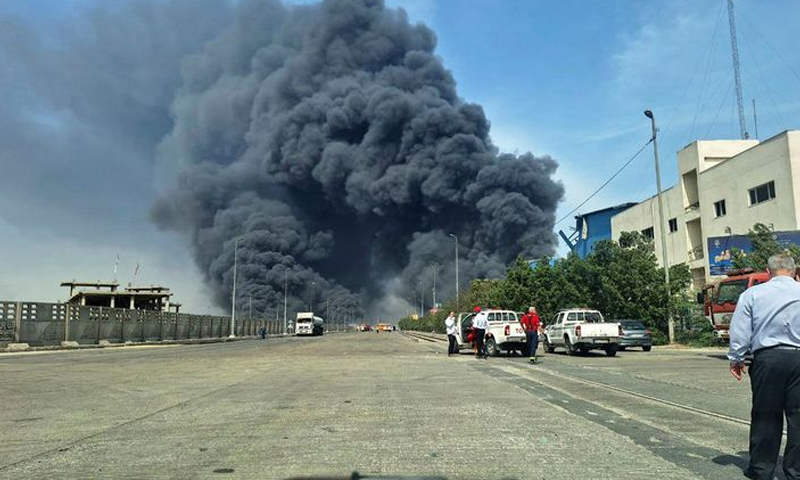
At least four people were killed and more than 500 injured in a powerful explosion that rocked Shahid Rajaee Port in southern Iran on Saturday, according to state media. The blast tore through the country’s busiest commercial port, sending plumes of thick black smoke into the sky and shaking buildings up to 50 kilometers away.
Babak Mahmoudi, head of the Red Crescent Society’s Relief and Rescue Organization, confirmed the fatalities and stated that rescue operations were ongoing. “Unfortunately, at least four deaths have been confirmed by rescuers,” he told state television.
The explosion occurred at the Shahid Rajaee port in Hormozgan province, near the strategic Strait of Hormuz. The port, located about 1,000 kilometers south of Tehran and 23 kilometers west of Bandar Abbas, handles a significant portion of Iran’s import and export trade. It is considered the most advanced container terminal in the country.
Footage broadcast on Iranian state television showed towering flames and heavy smoke billowing over the dock area, where numerous shipping containers are stored. Helicopters were deployed to douse the fire, while emergency teams worked to evacuate the injured.
State TV reported that at least 516 people were injured in the blast, with hundreds transferred to local hospitals. The number of injured was revised upward throughout the day as rescue efforts continued.
Esmaeil Malekizadeh, a regional port official, said the explosion happened on one section of the port’s wharf. “The explosion occurred in a part of the Shahid Rajaee port dock, and we are extinguishing the fire,” he told reporters.
“Trump Urges Calm as India-Pakistan Tensions Escalate”
According to a statement from the port’s customs office, the blast likely originated in a storage facility housing hazardous materials and chemical substances. Mehrdad Hassanzadeh, head of Hormozgan’s provincial crisis management authority, later confirmed that multiple containers exploded, causing extensive damage to port infrastructure.
“The shockwave was so strong that most of the port buildings were severely damaged,” reported Tasnim News Agency. The blast’s force was felt up to 50 kilometers away, with residents reporting that their windows rattled and the ground shook.
Despite initial concerns, the National Iranian Oil Products Distribution Company said the explosion did not affect refineries, pipelines, or oil distribution infrastructure. “Bandar Abbas oil facilities are currently operating without interruption,” the company said in a statement.
The incident comes at a tense time, as high-level delegations from Iran and the United States were reportedly holding nuclear talks in Oman. Although there is no evidence connecting the explosion to the diplomatic discussions, the timing has raised eyebrows both domestically and abroad.
Iranian President Masoud Pezeshkian issued a statement expressing condolences to the victims and their families. “While expressing deep regret and sympathy for the victims of the incident in Hormozgan Province, I issued an order to investigate the situation and the causes of the incident,” he wrote on X (formerly Twitter). The president has dispatched Interior Minister Eskandar Momeni to the scene to lead the investigation and oversee emergency response efforts.
Saturday’s explosion is one of the most serious industrial accidents Iran has faced in recent years. It follows a deadly coal mine blast in Tabas last September, which killed over 50 people and was attributed to a gas leak.
International reactions have begun to pour in. Pakistan was among the first countries to express solidarity with Iran. Prime Minister Shehbaz Sharif offered condolences and support, saying, “Pakistan stands with Iran in this time of grief.” In a separate statement, Pakistan’s ambassador to Iran, Muhammad Mudassir Tipu, said he was “deeply shocked” by the news and extended wishes for a speedy recovery for the injured.
The scale of the damage and the number of casualties have raised serious concerns about safety regulations at one of Iran’s most critical logistical hubs. As investigations continue, questions are likely to be asked about the storage and handling of hazardous materials at major industrial facilities.
For now, emergency teams remain on high alert, and authorities are working to determine the full extent of the damage. More updates are expected as the situation develops.
