
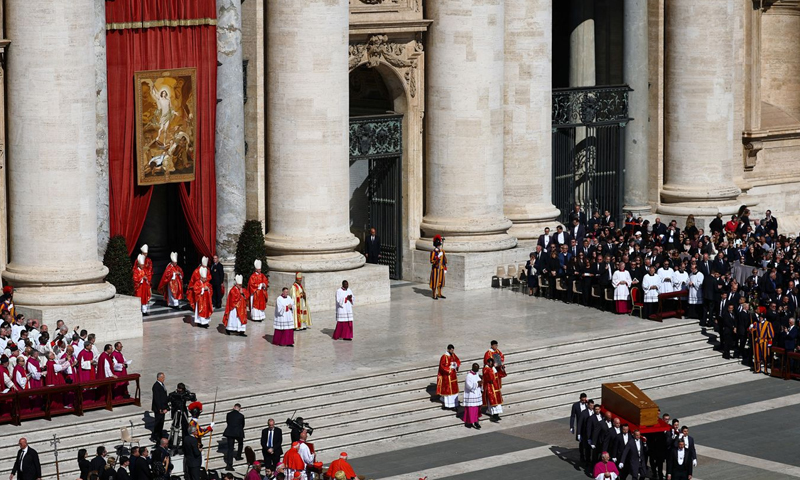
Presidents, royalty, cardinals, and ordinary mourners came together in St. Peter’s Square on Saturday to bid farewell to Pope Francis, the beloved Argentine pontiff who passed away at age 88 following a stroke. The emotional funeral, held under clear skies in the heart of Vatican City, marked the end of a 12-year papacy defined by humility, advocacy for the vulnerable, and bold reforms.
Italian Cardinal Giovanni Battista Re led the solemn Mass, offering a stirring tribute to Francis’ compassion and vision. “Rich in human warmth and deeply sensitive to today’s challenges, Pope Francis truly shared the anxieties, sufferings, and hopes of this time,” he said. Re made it clear that the Church should not regress from Francis’ progressive legacy.
The funeral drew over 250,000 mourners, with crowds flooding Vatican City and nearby streets. Aerial views of the ceremony showed a vibrant tapestry of color: dark formalwear from world leaders, red vestments worn by some 250 cardinals, purple robes of bishops, and the white of thousands of priests.
Among the dignitaries in attendance was U.S. President Donald Trump, whose past disagreements with Francis over climate change and migration drew significant global attention. Opposite Trump sat the cardinals who will soon convene in a secretive conclave to select the next pope — a decision that could shape the future direction of the Roman Catholic Church.
The ceremony took on a global tone, with Latin hymns and prayers in Italian, Spanish, Chinese, Portuguese, and Arabic, reflecting the diversity of the Church’s 1.4 billion members. The mood among the faithful was a mix of sorrow and reverence. “When I arrived at the square, tears of sadness and also joy came over me,” said French pilgrim Aurelie Andre. “I think I truly realised that Pope Francis had left us, and at the same time, there is joy for all he has done for the Church.”
Francis, the first non-European pope in over 1,200 years, left a legacy of reaching out to the poor, advocating for migrants, addressing climate change, and challenging conservative norms within the Church. A Latin summary of his papacy placed near his body described him as a symbol of “universal fatherhood and a holy life.”
In a break from papal tradition, Francis had rewritten his own funeral rites to reflect his commitment to simplicity. He declined the traditional triple casket and was buried in a single zinc-lined wooden coffin. His final resting place is the St. Mary Major Basilica in Rome, not inside the Vatican — making him the first pope in over a century to choose burial outside the Vatican walls. His tomb is marked simply with the Latin name “Franciscus” and adorned with a reproduction of the iron cross he wore around his neck.
Senior Russian General Killed in Car Bomb Blast Near Moscow
Following the Mass, as the great bells of St. Peter’s rang out, the coffin was carried on an open-top popemobile through the heart of Rome. The 5.5-kilometer route, lined by an estimated 150,000 mourners, passed by some of the city’s most iconic monuments, including the Colosseum. Many in the crowd tossed flowers, waved banners, and cried out, “Viva il papa!” and “Ciao, Francesco!”
During the funeral events, a notable meeting took place between President Trump and Ukrainian President Volodymyr Zelenskiy inside St. Peter’s Basilica. Their conversation, described by both sides as cordial and productive, marks a diplomatic development amid ongoing efforts to resolve the war in Ukraine. Their previous meeting had been notably tense, but this encounter offered a contrast of mutual respect and dialogue.
Heads of state from Argentina, France, Germany, the Philippines, Gabon, Poland, and the United Kingdom were also present, as were the king and queen of Spain and other royals, underscoring the global impact of Pope Francis’ death.
With the pontiff now laid to rest, attention turns to the future of the Catholic Church. The College of Cardinals will soon gather for a conclave — likely beginning after May 6 — to elect the next pope. In the days leading up to the vote, they will engage in closed-door meetings to discuss the challenges facing the Church, from internal divisions to financial pressures and calls for further reform.
As the world remembers a pope who brought the Church closer to the people, the next chapter remains uncertain. But the message from his funeral was clear: Pope Francis’ legacy of compassion, openness, and justice is not one the Church will easily forget.
