
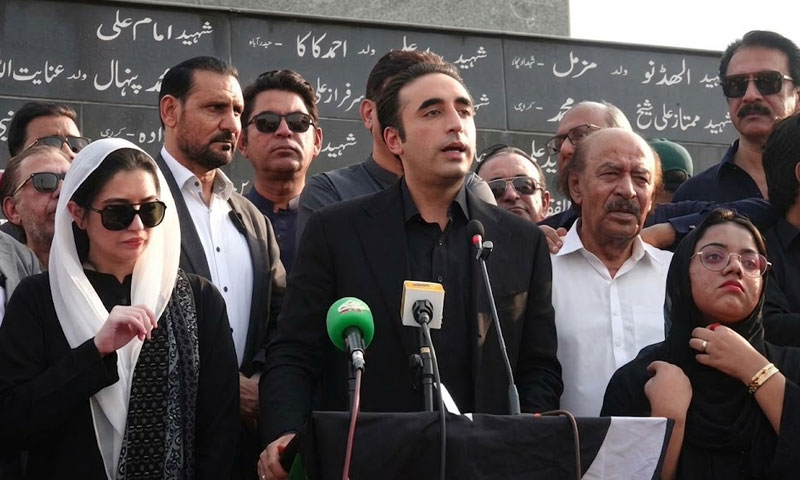
KARACHI – Pakistan People’s Party (PPP) Chairman Bilawal Bhutto-Zardari on Sunday defended the imposition of governor’s rule in Khyber Pakhtunkhwa, saying the move was aimed at tackling terrorism, and called for a new National Action Plan to counter the renewed threat.
Speaking to the media at Karsaz on the 19th anniversary of the 2007 bombing that targeted the homecoming procession of former prime minister Benazir Bhutto, Bilawal said Pakistan was paying the price for what he described as the decision by the country’s then rulers to allow militants to return from Afghanistan after a change of government there.
He said Pakistan had defeated terrorism in the past but was now facing renewed violence, adding that civilians, police personnel, armed forces personnel and journalists had all sacrificed their lives in the fight against terrorism. Bilawal, accompanied by his sister Aseefa Bhutto-Zardari, visited the Karsaz memorial to pay tribute to those killed in the attack.
Removing Pakistani flags
Bilawal said some forces were once again removing Pakistani flags from areas stretching from Malakand to Swat, warning that the country could not afford to repeat past mistakes. Referring to Khyber Pakhtunkhwa deposed Chief Minister Sohail Afridi, he claimed the provincial leader had taken an oath that he would not fight terrorists.
“If the KP chief minister was not prepared to confront terrorists, the PPP decided to step forward and fight them,” he said, explaining his party’s support for governor’s rule.
The federal government imposed emergency measures and governor’s rule in KP earlier this month, citing worsening security and the provincial government’s alleged failure to adequately tackle militancy. The Pakistan Tehreek-e-Insaf (PTI), which governed the province, has disputed the federal government’s justification for the move.
Bilawal said the fight against terrorism required a collective national response. He recalled that the PPP had worked to prepare society to confront the threat and cited the National Action Plan and reforms in state institutions as part of earlier counterterrorism efforts. He said the PPP supported the formulation of a new National Action Plan to address the renewed threat.
Defending the emergency in KP, Bilawal said it had been imposed through constitutional and legal means and out of necessity to counter terrorism. He urged Jamiat Ulema-e-Islam-Fazl (JUI-F) chief Maulana Fazlur Rehman to support the effort, noting that the politician and his party had also suffered losses because of terrorism.
Bilawal acknowledged Fazlur Rehman’s right to criticise the government as an opposition leader but said it would have been better if he had supported the fight against terrorism. He added that the JUI-F chief could play a role in ending the emergency if he wished to do so.
Compromise necessary for political progress
Bilawal said political compromises were necessary to achieve major reforms, citing the 18th Constitutional Amendment and the removal of a military ruler from power as examples. “Compromise is not a bad word. Politics and compromise go hand in hand,” he said, adding that Benazir Bhutto had also made compromises and that difficult decisions aimed at bringing about change sometimes required political accommodation. “We forced a dictator to take off his uniform through compromise. The 18th Amendment was also introduced through compromise,” he said.
Bilawal said the PPP was not part of the federal government but was pursuing politics within its own political space and working for its workers and the public.
Calls for political and economic reform
Turning to the economy, Bilawal said there was room for improvement but warned that the prevailing economic crisis could become more severe. He said the slogan “Benazir will return and bring employment” had been part of the PPP’s political message and that his party had tried to create employment opportunities whenever it came to power after Benazir Bhutto’s assassination.
Bilawal said a committee had been formed to propose reforms aimed at improving the democratic system and invited the opposition to participate in the process. “This is not the democracy or the Pakistan for which Shaheed Benazir Bhutto and the party workers made sacrifices,” he said.
New provinces
“If there is consensus on making Gilgit-Baltistan a province, then make it a province there,” he said, adding that provinces could be created where there was consensus and that the Constitution provided a clear framework for creating new provinces, including the requirement for resolutions by the respective provincial assemblies.
Remembering the Karsaz bombing
The PPP marked the 19th anniversary of the Karsaz bombing, one of the deadliest attacks in Pakistan’s political history. On October 18, 2007, two explosions struck Benazir Bhutto’s homecoming procession near Karsaz on Karachi’s Shahrah-e-Faisal. She had returned to Pakistan after eight years in exile and was travelling in a procession of supporters who had gathered to welcome her.
Benazir Bhutto survived the attack, but around 180 to 200 people were killed and more than 500 injured, according to historical accounts. Party workers reportedly tried to shield her after the first blast before the second explosion struck the procession. The attack came less than three months before Bhutto was assassinated in a gun-and-bomb attack following a public meeting in Rawalpindi on December 27, 2007.
Despite the passage of years, the perpetrators and masterminds of the Karsaz bombing have not been brought to justice. Several inquiry committees had been formed to investigate the attack, but the investigations had not produced a conclusive outcome. The PPP observes the anniversary each year to honour the party workers and supporters killed in the attack and reaffirm its commitment to Benazir Bhutto’s political legacy.
