
Table of Contents
United Nations climate negotiations collapsed on Sunday after the European Union and several other countries rejected a final draft agreement presented by the COP31 presidencies of Turkey and Australia, arguing that the proposed deal failed to deliver meaningful action against global warming.
The breakdown followed more than two weeks of negotiations in Antalya, Turkey, which continued for two additional days beyond the scheduled deadline. The prolonged discussions made COP31 the longest climate conference on record.
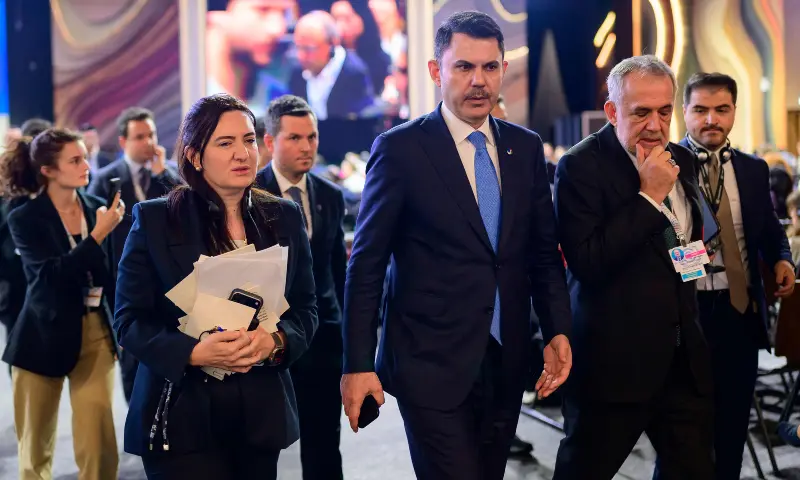
At the closing plenary, Turkish conference president Murat Kurum acknowledged that countries had failed to reach a consensus and confirmed that no revised agreement would be presented.
“There is nothing to do, we did all that we could,” Kurum told delegates, adding that there would be no new text.
He later left the stage while representatives of different countries were still delivering their statements.
Australia’s COP31 President of Negotiations, Chris Bowen, described the outcome as “very disappointing”, identifying disagreements over fossil fuels and climate finance as the main obstacles to an agreement.
The collapse highlights the growing difficulty of securing international cooperation on climate change as wars, economic pressures and other global crises compete for governments’ attention.
The last time UN climate negotiations failed to secure an agreement adopted by all participating countries was at the Copenhagen summit in 2009.
EU rejects deal over absence of fossil fuel commitments
Ireland’s Environment Minister Darragh O’Brien, speaking on behalf of the European Union, said the bloc could not support an agreement that made no direct reference to fossil fuels.
He argued that a climate agreement without a commitment addressing the use of coal, oil and gas failed to reflect the scientific evidence behind global warming.
“It is unconscionable that we would have a climate act that makes no reference to fossil fuel, no reference to transitioning away from fossil fuels,” O’Brien said.
Observers at the summit said Saudi Arabia and other major oil-producing countries had strongly opposed including explicit references to fossil fuels in the final text.
Panama also rejected the proposal, arguing that it did not reflect the seriousness and urgency of the climate crisis.
Belgium’s Climate Minister Jean-Luc Crucke described the failure as a difficult but necessary outcome, saying countries must have the courage to reject an inadequate agreement.
The collapse does not, however, cancel climate commitments made at previous UN conferences or remove the existing legal and technical frameworks governing international climate cooperation.
Dispute over carbon removal and climate finance
The proposed agreement acknowledged that global temperatures were on course to exceed the 1.5-degree Celsius threshold established under the 2015 Paris Agreement.
It also called for faster development of carbon-removal technologies to help reverse the expected temperature overshoot.
Scientists say removing carbon dioxide from the atmosphere could play an important role in limiting climate damage, but only alongside substantial reductions in greenhouse gas emissions.
Critics of the proposal warned that excessive reliance on carbon-removal technologies could allow countries to continue producing fossil fuels rather than rapidly reducing emissions.
A representative of the Saudi delegation defended the inclusion of carbon-removal technology, expressing surprise at opposition to what he described as a practical solution.
Climate finance was another major source of disagreement. Developing countries argued that the proposed agreement did not provide sufficient new funding to help vulnerable nations adapt to rising temperatures and increasingly severe weather events.
The draft called for a tripling of adaptation finance but did not clearly establish the baseline from which the increase would be calculated.
Electricity target also faces criticism
The proposed deal also included a Turkish initiative to increase electricity’s share of global final energy consumption to 35% by 2035, compared with approximately 23% at present.
Supporters argued that expanding electricity use could accelerate the transition away from fossil-fuel-powered vehicles, heating systems and industrial equipment.
However, critics warned that the target could impose additional costs on developing countries without providing a clear pathway for replacing fossil fuels with cleaner energy sources.
Global climate action faces growing pressure
COP conferences remain the primary international forum for coordinating government efforts to tackle climate change, reduce emissions and finance adaptation measures.
This year’s summit took place amid growing warnings that the world is on course to exceed the Paris Agreement’s 1.5-degree warming limit, beyond which the risks of extreme weather and other climate impacts are expected to intensify.
The failure to reach a comprehensive agreement in Antalya represents a setback for international climate cooperation. It also exposes deep divisions between countries seeking a faster transition away from fossil fuels and major energy producers resisting stronger commitments.
With disputes over fossil fuels, climate finance and carbon-removal technology unresolved, governments face renewed pressure to find common ground and turn existing climate promises into concrete action.
