

Trained in learning-based control and estimation at Tsinghua University, the UW-Milwaukee doctoral researcher now checks roadside-camera tracks of pedestrians and vehicles against RTK satellite positioning, and an outside engineering company reports putting the laboratory’s dataset into its regression tests.
Ask a roadside perception system where a pedestrian is, and it will return an answer. Muhammad Fahad works on the tools that ask the follow-up: how many meters off is that answer, and how long does the system hold on to the same person?
Fahad, a doctoral researcher in UWM’s Automated, Connected and Electric Mobility Systems (ACEMS) Laboratory, is first author of the two TRB papers that describe CrossTraj, the laboratory’s dataset and evaluation framework for pedestrian-vehicle interactions at a midblock crosswalk in Milwaukee. He integrated its end-to-end processing pipeline, maintains its public repository and handles requests for the data. In August 2025 an outside engineering company added CrossTraj to the acceptance and regression tests it uses for roadside deployments, where, its chief technology officer reports, it remains.
An estimation engineer turns to perception
Fahad came to computer vision through control and estimation. He holds a master’s degree in mechanical engineering from Tsinghua University, with research in automotive and robotics engineering, and worked there as a researcher until 2023. In Tsinghua’s State Key Laboratory of Automotive Safety and Energy he coauthored work on an extended Kalman filter that estimates wheel-cylinder pressure for anti-lock braking without a dedicated pressure sensor at each wheel, and on a clutch controller that uses a sliding-mode observer to estimate an unmeasured load torque.
He was first author and presenter of a 2018 paper at the 14th International Symposium on Advanced Vehicle Control on a method that let a plug-in hybrid vehicle learn from its own repeated routes by pairing iterative learning control with model predictive control. A 2023 review, one of whose authors is at Cummins Research and Technology, named the 2019 IEEE Access paper on the method, which Fahad coauthored, as the key publication for that approach in powertrain control.
He joined UWM in August 2024 and brought the estimator’s toolkit with him. CrossTraj keeps each road user’s identity across cameras with Kalman filtering and occlusion-aware smoothing, and his duties include directing perception evaluation and multi-camera trajectory modeling. On a Wisconsin Department of Transportation crosswalk-lighting project he also built the deep-learning analysis that reads, from driver-facing infrared video, the moment a driver recognizes a pedestrian, across 281 completed night test rounds.
A federal testing gap
In 2024, the National Highway Traffic Safety Administration reports, 7,080 pedestrians died on U.S. roads. Of those deaths, 76 percent came in the dark, and 73 percent happened away from intersections. The Milwaukee crossing in CrossTraj is one of those midblock locations.
Data for the U.S. Department of Transportation’s Intersection Safety Challenge were gathered on a closed course. The program’s Stage 1B report names nighttime and vehicle left turns as areas for improvement in intersection safety systems, and calls for more testing of whether they work reliably once deployed. A USDOT prototyping solicitation for such systems, with up to $17 million available, closed on July 20, 2026.
Fahad planned and carried out the CrossTraj field recording with other members of the laboratory: two one-hour sessions, one in winter and one in summer, from synchronized panoramic roadside cameras covering about 200 meters of road. Its pipeline finds and follows every road user, infers depth from a single camera, projects detections onto a common ground plane and stitches identities across overlapping cameras, yielding continuous, metric trajectories from approach through clearance of the crosswalk.
He checked the reconstructed tracks against real-time kinematic (RTK) GNSS ground truth. The companion framework, in his first-authored paper TRBAM-26-04323, scores a perception system on accuracy, robustness, latency and identity continuity, beyond precision and recall, and diagnoses distortions, synchronization mismatches, occlusions and mapping drift. The release carries the ground truth, calibration and homography files and evaluation scripts, so another team can score its own detector or tracker. Since August 1, 2025, the repository has carried the MIT License, and the laboratory releases the data package to teams that ask for it.
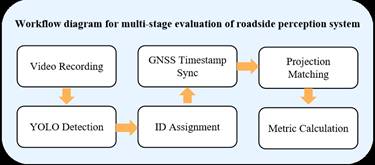
The multi-stage evaluation workflow in TRBAM-26-04323: video recording, YOLO detection, ID assignment, GNSS timestamp synchronization, projection matching and metric calculation.
Figure: Fahad et al., TRB paper TRBAM-26-04323
From conference podium to a company’s test suite
The Transportation Research Board (TRB) recommended the evaluation-framework paper for presentation after peer review, and both CrossTraj papers were on the program of TRB’s January 2026 Annual Meeting in Washington, D.C. The American Society of Civil Engineers’ 2026 International Conference on Transportation and Development (ICTD) chose a related abstract of his, on evaluating roadside perception with the CrossTraj data, for a podium presentation. TRB has since accepted TRBAM-27-06707, a paper he coauthored on trajectory extraction from panoramic roadside cameras, for its 2027 Annual Meeting.
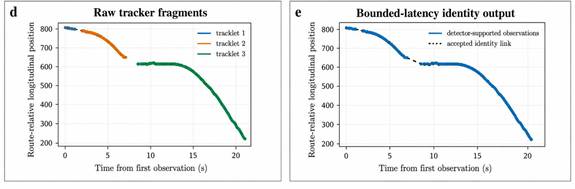
Repairing a broken track, from TRBAMLeft (d): one vehicle passage split by the tracker into three fragments, plotted as position along the route against time. Right (e): the same passage joined into one trajectory by accepted identity links.
Figure: Xiong, Fahad et al.,
A test from outside the university followed. Rapid Volt, an engineering company whose business includes camera-based roadside traffic monitoring, came across CrossTraj in August 2025. Two of its engineers ran the company’s perception stack against it, retuned synchronization and projection where the data exposed defects, and reran the benchmark. Pedestrian average precision (AP@0.5) rose from 67.0 to 74.0 percent, IDF1, which scores how consistently identities are kept, from 58.2 to 66.9 percent, and multiple object tracking accuracy (MOTA) from 46.0 to 55.0 percent, while the tracks’ RMS distance from the RTK reference shrank from 0.39 m to 0.24 m, according to the company’s chief technology officer.
“Once the scoring scripts carry a version number, one developer’s result can be set beside another’s,” Fahad said.
Fahad plans to turn CrossTraj into a written test, with versioned scoring scripts, under which agencies and developers score a candidate roadside perception system against the released ground truth on recorded pedestrian-vehicle interactions before relying on it. He intends to remain in UWM’s ACEMS Laboratory, directed by Prof. Xiaowei (Tom) Shi, once the doctorate is done.
