
Table of Contents
Parliament Approves Resolution on KP Emergency
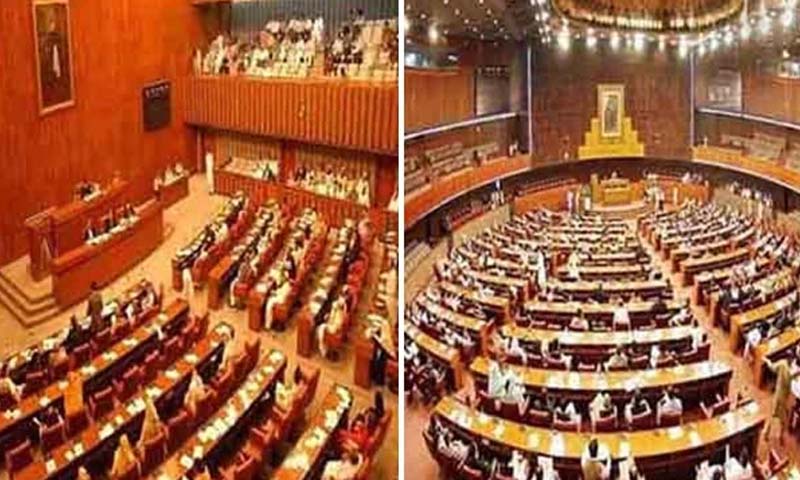
ISLAMABAD: The National Assembly and Senate on Wednesday approved resolutions supporting the imposition of emergency in Khyber Pakhtunkhwa, following a heated debate over the province’s security situation, counterterrorism efforts and political negotiations.
The resolutions were passed by majority votes amid protests from opposition lawmakers. The National Assembly subsequently adjourned its session until 11am on Friday.
Lawmakers from the treasury and opposition benches presented differing views on the federal government’s decision, with government representatives citing rising militant violence and opposition leaders questioning the need for emergency measures.
Tarar Defends Emergency, Cites Rising Terrorism
Opening the debate, Law Minister Azam Nazeer Tarar said Article 232 of the Constitution required an emergency proclamation to be presented to both houses of parliament for approval within 10 days.
He said the federal cabinet had reviewed information relating to terrorism during its October 11 meeting and advised Prime Minister Shehbaz Sharif to recommend the imposition of emergency.
According to figures presented by Tarar, Khyber Pakhtunkhwa recorded 2,911 terrorist incidents between 2021 and 2024, compared with 3,787 between October 15, 2025, and October 9, 2026.
The law minister also said casualties among security personnel and civilians had increased, accusing the provincial leadership of giving political priorities precedence over counterterrorism efforts.
Tarar argued that the security situation required cooperation between federal and provincial authorities rather than political confrontation. He also criticised PTI’s plans for political mobilisation in Islamabad.
Government Says Negotiations With PTI Broke Down
Tarar said the federal government had attempted to negotiate with Pakistan Tehreek-e-Insaf (PTI), with discussions involving representatives of the government, Pakistan Peoples Party (PPP) and opposition.
However, he claimed the process broke down after attention shifted towards demands for meetings with jailed PTI founder Imran Khan.
The law minister said a prisoner’s release was generally a matter for the courts, while the president had the constitutional power to grant a pardon under Article 45.
He maintained that the federal government had explored other options before deciding to impose emergency measures.
Bilawal Calls for National Counterterrorism Strategy
PPP Chairman Bilawal Bhutto-Zardari called for the formation of a parliamentary committee to develop a national strategy against terrorism.
He cited the National Action Plan as an example of a security framework developed through political consensus and urged PTI and other opposition parties to cooperate with the federal and provincial governments.
Bilawal said the PPP would support the federal government’s decision to impose emergency in Khyber Pakhtunkhwa, but stressed that the measure alone would not eliminate terrorism.
He said he would ask the prime minister to end the emergency if political and security conditions improved sufficiently to make it unnecessary.
Bilawal also alleged that India was supporting militant groups operating in Pakistan, including the Tehreek-e-Taliban Pakistan and separatist organisations. These allegations were presented as part of his argument for a unified response to security threats.
Khawaja Asif Criticises PTI’s Counterterrorism Record
Defence Minister Khawaja Asif criticised PTI’s past approach to counterterrorism, referring to meetings held during the party’s time in government at which, he said, its leaders supported bringing militants back to Pakistan.
Asif referred to former army chief General Qamar Javed Bajwa and former intelligence chief General Faiz Hameed, saying both had attended parliamentary meetings during the PTI government.
He also accused Imran Khan of previously praising the military leadership and argued that PTI’s past statements were inconsistent with its current political position.
The defence minister said the government had held negotiations with the opposition during the preceding week and that several points had been agreed upon before the process collapsed.
Asif cited figures that he said showed a sharp rise in deaths linked to the security situation, claiming that 2,700 people had been killed over three years compared with 3,900 deaths in 14 months.
He blamed the provincial leadership’s political priorities for worsening security conditions and alleged that PTI leaders had taken instructions from a person based in Afghanistan. These claims were made during the parliamentary debate.
Asif also criticised the provincial government’s performance in areas including health and mining.
Achakzai Demands Withdrawal of Emergency and Governor’s Rule
Opposition leader Mahmood Khan Achakzai strongly opposed the federal government’s decision, demanding the withdrawal of emergency and governor’s rule in Khyber Pakhtunkhwa.
He accused the government of attempting to retain power through force and warned that the measures could worsen political tensions.
Achakzai also cautioned that Sindh could be the next province to face governor’s rule and urged the government to reconsider its approach.
“There is still time. Withdraw these measures. For God’s sake, do not harass the people. This approach will lead to destruction,” he said.
He condemned the arrest of ousted Khyber Pakhtunkhwa Chief Minister Sohail Afridi and questioned the role of the establishment in political affairs.
Addressing the stalled negotiations between the government and PTI, Achakzai said the talks had faltered over the party’s request for its leaders to meet Imran Khan. He urged authorities to allow such meetings.
Farooq Sattar Questions KP’s Counterterrorism Efforts
Muttahida Qaumi Movement-Pakistan leader Farooq Sattar questioned the provincial government’s record on counterterrorism, saying political leaders should condemn militancy clearly and demonstrate their commitment through practical action.
Sattar questioned what measures had been taken to identify militant networks, uncover sleeper cells, arrest suspects and bring cases before anti-terrorism courts.
He also criticised the implementation of the National Action Plan, including measures related to forensic laboratories and witness protection, and called for a coordinated national response.
Sattar warned that militants fleeing Khyber Pakhtunkhwa could potentially seek refuge in existing networks in Karachi, creating further security concerns.
He called for an inclusive political effort involving all parties, arguing that an effective response required political consensus, implementation of agreed measures and measurable progress against militant violence.
Senate Resolution Passed Amid Opposition Protest
The Senate also approved the resolution by a majority, according to media reports.
PTI lawmakers protested against the measure and subsequently walked out of the session, reflecting the divisions between the government and opposition over the emergency decision.
The parliamentary debate highlighted competing positions: government representatives described emergency measures as a response to deteriorating security, while opposition leaders argued for their withdrawal and called for political negotiations.
The debate also featured calls for a broader national counterterrorism strategy, with lawmakers differing over the causes of rising violence and the effectiveness of the federal and provincial governments’ policies.
