
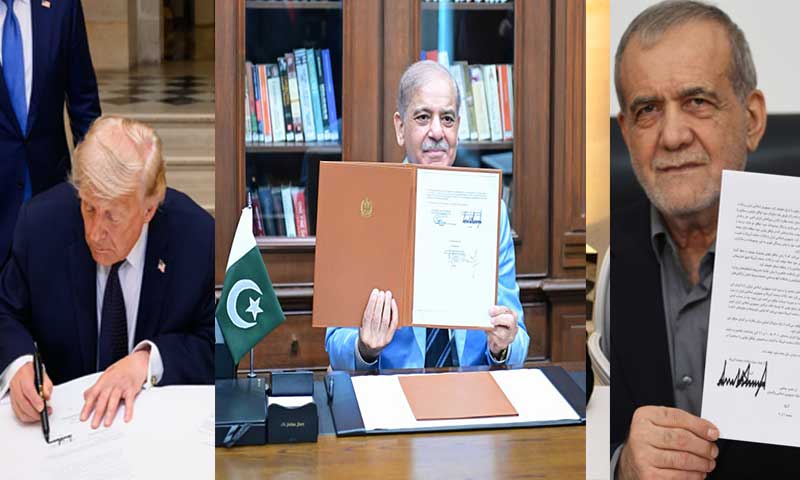
ISLAMABAD: Prime Minister Shehbaz Sharif and US Vice President JD Vance have cancelled their planned trips to Switzerland after the Islamabad Memorandum of Understanding (MoU) between the United States and Iran was signed remotely, eliminating the need for a formal signing ceremony.
Switzerland has also confirmed that planned talks between the United States and Iran, scheduled for Friday at the Burgenstock mountain resort, will no longer take place. The Swiss foreign ministry said the meeting, which was expected to focus on the implementation of the recently reached US-Iran agreement, has been called off, without providing further details on future arrangements.
The White House announced that Vice President JD Vance had postponed his planned trip to Switzerland. “The logistics of these negotiations have never been simple or predictable. As of now, the Vice President is not departing tonight,” a White House spokesperson said. The spokesperson stressed that Washington remained committed to advancing the diplomatic process. “We look forward to beginning technical talks as soon as possible,” the spokesperson added.
Deputy Prime Minister and Foreign Minister Ishaq Dar confirmed that the prime minister would no longer travel to Switzerland. Explaining the decision, Dar said the planned ceremony had become unnecessary after the agreement was electronically signed on Thursday by US President Donald Trump and Iranian President Masoud Pezeshkian, followed by Prime Minister Shehbaz Sharif in his role as mediator.
“As the signing has been completed remotely this morning after the US and Iranian presidents signed, followed by PM Shehbaz signing as mediator, tomorrow’s ceremony has been cancelled,” Dar said.
The text of the Pakistan-mediated MoU outlines a comprehensive framework for ending hostilities. Both sides commit to permanently halt military operations, respect sovereignty, and cease interference in internal affairs. The US will gradually lift its naval blockade on Iran within 30 days, while Iran will ensure safe passage through the Strait of Hormuz and waive transit fees for 60 days. The accord provides for immediate sanctions relief, the unfreezing of Iranian assets, and a proposed $300 billion reconstruction programme for Iran. It also reaffirms Iran’s commitment not to pursue nuclear weapons, with enriched material to remain under international monitoring. A joint mechanism will oversee implementation as both sides work toward a final treaty requiring UN Security Council approval.
Despite the cancellation, officials from the US, Iran, and mediating countries are expected to continue coordinating technical and diplomatic discussions in the coming weeks.
