
Table of Contents
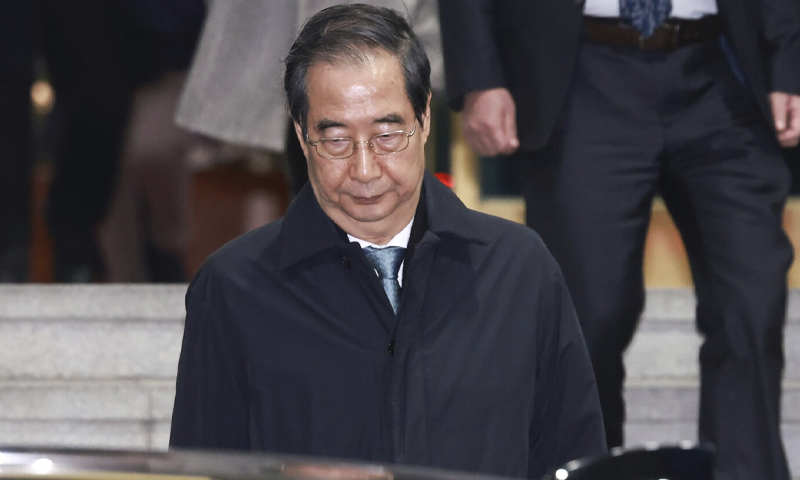
South Korea’s political landscape was thrust into further turmoil on Friday when the National Assembly voted to impeach Acting President Han Duck-soo. The impeachment motion, spearheaded by opposition parties, passed with 192 votes out of 300, marking a dramatic escalation in the country’s ongoing political crisis. The motion came in the wake of the impeachment of President Yoon Suk Yeol, who was removed from office on December 14 for declaring a short-lived martial law on December 3.
Impeachment of Han Duck-soo: A Deepening Political Crisis
Han Duck-soo had been serving as acting president since President Yoon was suspended following his martial law declaration, which triggered widespread protests and a major political scandal. The opposition-controlled National Assembly, led by the Democratic Party, pushed forward with the impeachment motion against Han, accusing him of undermining democracy and acting in an authoritarian manner.
The parliamentary session was chaotic, with members of the ruling People Power Party (PPP) vocally opposing the motion. PPP lawmakers surrounded the speaker’s podium, chanting that the vote was invalid and accusing the opposition of “tyranny.” Despite the protests, the motion to impeach Han passed, sending shockwaves through South Korea’s political system and deepening the crisis.
Opposition Leader Lee Jae-myung’s Fiery Call for Action
Ahead of the vote, opposition leader Lee Jae-myung delivered a fiery speech condemning Han’s actions and urging swift action to remove him from office. Lee, leader of the Democratic Party, argued that Han had “acted for insurrection” and that the country needed to rid itself of forces that threatened its democratic foundations. “The only way to normalize the country is to swiftly root out all the insurrection forces,” Lee said, referring to those he blamed for putting the nation at risk.
The impeachment vote came after widespread public support for Yoon’s removal following his controversial declaration of martial law. Opinion polls showed that many South Koreans viewed Yoon’s actions as an overreach and a threat to the country’s democracy, strengthening the opposition’s case for his impeachment and the removal of Han as acting president.
Constitutional Court to Review the Impeachment of Yoon
As the political crisis deepens, the Constitutional Court of South Korea is also moving quickly to review the impeachment of President Yoon. On the same day Han was impeached, the Constitutional Court held its first hearing regarding the legality of Yoon’s removal from office. The court will determine whether to uphold Yoon’s impeachment or to reinstate him to power. The court has a 180-day deadline to issue its ruling.
The proceedings at the Constitutional Court are seen as a critical moment for the future of South Korea’s democracy. If the court rules in favor of Yoon’s removal, it would signal a permanent shift in the country’s political structure, while reinstating him could bring an end to the current political chaos.
The Legal and Political Implications of Han’s Impeachment
The legal basis for Han Duck-soo’s impeachment stems from his refusal to appoint three justices to the Constitutional Court, which was seen as an obstruction of the court’s constitutional duties. Han defended his decision, arguing that appointing the justices would exceed the scope of his role as acting president. The opposition, however, viewed his refusal as a deliberate attempt to block necessary judicial appointments and further entrench his political power.
Following the impeachment vote, Han announced that he would step aside in order to avoid further chaos and allow for a resolution of the crisis. “I will await a Constitutional Court ruling on my impeachment,” Han said in a statement. Under South Korean law, Finance Minister Choi Sang-mok will now assume the role of acting president until a new leadership is decided.
Economic Concerns and Calls for Stability
The impeachment vote has raised concerns about the impact of the ongoing political instability on South Korea’s economy. Finance Minister Choi Sang-mok, who will take over as acting president, urged parliament to reconsider the impeachment motion, warning that it could harm the country’s financial stability. “The current political turmoil is already damaging the economy. Further instability would make it much worse,” Choi said, appealing to lawmakers to prioritize the national interest over political gamesmanship.
South Korea, a major global economy and key player in regional geopolitics, faces numerous challenges, including economic stagnation, tensions with North Korea, and a delicate relationship with neighboring countries like China and Japan. The political chaos could have serious repercussions for the country’s ability to navigate these challenges, especially if the leadership vacuum continues.
A Nation at a Crossroads
The impeachment of Han Duck-soo and the ongoing review of President Yoon’s removal signal a nation at a political crossroads. South Korea, once considered a beacon of democratic stability in Asia, now faces an uncertain future as its political institutions are tested like never before.
The public remains divided, with some supporting the impeachment efforts as a necessary step to preserve democracy, while others view the opposition’s actions as a dangerous overreach. As the Constitutional Court prepares to deliver its verdict on Yoon’s impeachment, the future of South Korea’s democratic system and political order hangs in the balance.
In the coming weeks, the situation in South Korea will likely remain volatile, with political factions jockeying for power and public opinion continuing to shift. What happens next will determine not only the fate of Han Duck-soo and Yoon Suk Yeol but also the future direction of South Korea’s democracy.
