
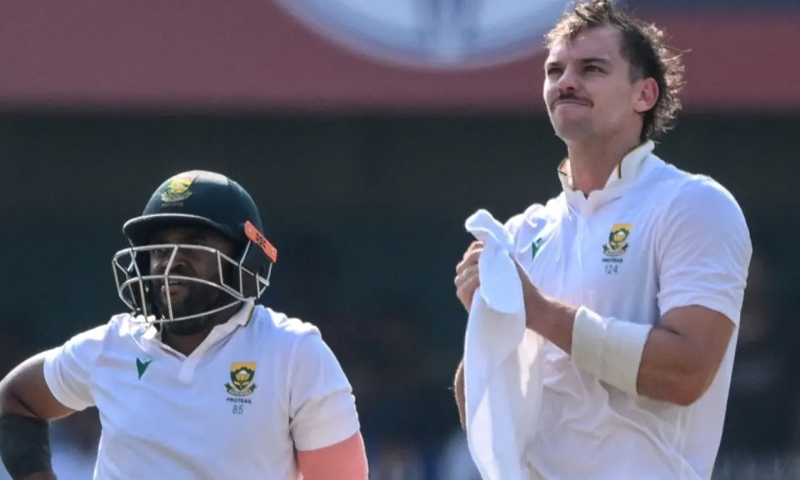
On a day when the shortest Ashes Test in more than a century concluded in Perth, Guwahati reminded the cricket world that Test matches can still simmer slowly and meaningfully. The Barsapara Cricket Stadium, hosting its debut Test, proved it could offer a surface worthy of the occasion. Unlike the unpredictable bounce seen at Eden Gardens earlier in the series, this pitch provided balance — enough assistance for bowlers but ultimately rewarding for batters willing to apply themselves.
South Africa, however, did not fully capitalise on those favourable conditions. For the first time in Test cricket history, all of their top four scored at least 35 but none pushed on to a fifty. Tristan Stubbs came closest with 49, and although he missed out on the milestone, he gained something more significant: clarity about his preferred role in the batting order.
In just 14 Test matches, Stubbs has been shuttled between No. 3 and No. 7 — an experience he freely admits has been “not the easiest” to navigate. Despite being formally assigned the No. 3 role last August, he occupied the position for only four-and-a-half Tests before it became a revolving door involving Ryan Rickelton, Wiaan Mulder and Tony de Zorzi. South Africa’s abundance of top-order options and Stubbs’ white-ball finishing reputation made him flexible by necessity. What the public did not know until now was how he felt about the uncertainty.
Speaking after stumps, Stubbs said bluntly that No. 3 is the position he “prefers more than anywhere else,” and that he has worked extremely hard to make it his own.
“It’s not the easiest moving around, but whatever the coach asks I’ll do. I’m just happy to be in the team,” he said. “I’ve worked a lot on my defence. Coming in as a white-ball player and then being asked to bat No. 3, I had to graft hard. You can afford to be a little more defensive at three, whereas at five or six you have to take the game on much earlier.”
For Stubbs, the adjustment has been more mental than technical. He explained that he has focused on tightening his game plan, especially early on when the ball is doing a bit, and being more selective about scoring options. That mindset explains his recent cautious starts. Against Pakistan in Rawalpindi, he crawled to 13 off 60 balls before eventually making 76 off 205. Here in Guwahati, against a tougher attack, he was similarly cautious, reaching 13 off 37 before finally stepping out to Kuldeep Yadav and launching him for a straight six — one of only six attacking strokes in an otherwise measured innings.
Stubbs frequently got forward to smother spin and later stood firm against Jasprit Bumrah. He faced 32 balls from Bumrah, 25 of them dots, and was beaten only once. His bat swung compactly, his pad offered no gaps, and his footwork seemed assured. What he lacked was scoring momentum — partly because India bowled with impressive discipline, and partly because Stubbs is still learning the tempo of long-format batting.
“You can bat time, but you look up and the scoreboard’s sort of gone nowhere,” he said. “Their seamers bowled straight, attacking the stumps all day.”
His partnership with Temba Bavuma — an 84-run stand, the highest of the series but the slowest of the match at 2.77 runs per over — showcased the guidance Stubbs can benefit from when batting alongside an experienced top-order player. Bavuma was unusually proactive, rotated strike effectively, and even ran to the danger end at one point to inject energy into the innings. Stubbs, who has played only 30 first-class matches (nearly half of them Tests), has had limited opportunities to build long stands with such seasoned partners. Bavuma, with 178 first-class appearances, offered a masterclass in innings construction that could accelerate Stubbs’ growth.
Although neither batter converted their start, the lessons for Stubbs — and for South Africa — may prove vital. With no Test cricket for almost 11 months after this series, there is no guarantee he will still be batting at No. 3, but this innings suggested he has the temperament and technique to succeed there.
For South Africa, the more immediate question is how they recover the early initiative they surrendered. Five of the top six perished to pressure-induced shots, and Stubbs did not shy away from acknowledging that failing.
“All of us had opportunities and no one kicked on, so we take that on ourselves,” he said. “When you get in, you don’t want to give it away. Ideally, one or two go on to make big hundreds. If you ask any of the batters, scoring only 30 or 40 never feels good.”
While all of South Africa’s specialist batters are back in the pavilion, their lower order is capable. Senuran Muthusamy and Kyle Verreynne — the current pair — both have strong subcontinent credentials. Muthusamy’s career-best 89* came in Pakistan, while Verreynne has a century in Bangladesh. On a pitch expected to deteriorate, Stubbs believes South Africa will need something substantial from them because, as he put it, “first-innings runs are gold.”
