
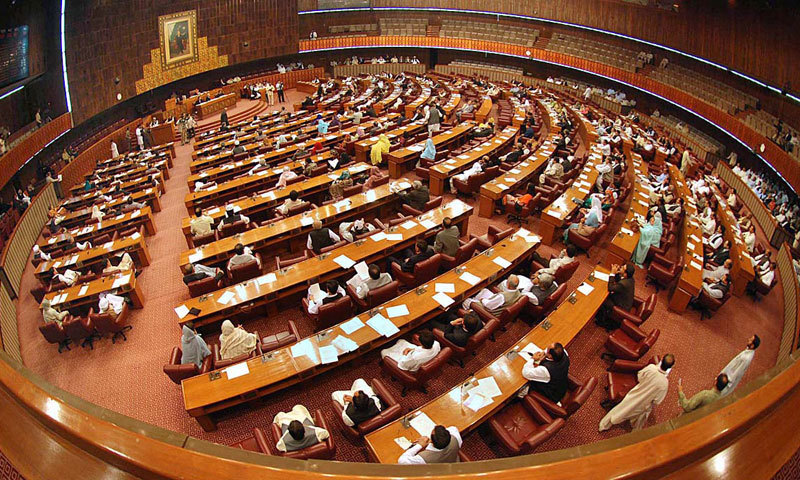
SLAMABAD: The National Assembly on Sunday approved demands for grants for various ministries and divisions under the federal budget 2026-27, as the government secured passage of allocations worth trillions of rupees through majority vote.
The session, chaired by NA Speaker Sardar Ayaz Sadiq, saw approval of 89 demands for grants for 29 ministries and divisions, amounting to over Rs40.48 trillion. Lawmakers approved the expenditures through majority vote as the House moved through the budgetary schedule ministry by ministry.
Among key allocations, the Defence Division secured over Rs30.67 trillion through five demands for grants, making it the largest approved allocation of the session. The Communications Division received over Rs1.25 trillion under five demands, while the Ministry of Federal Education and Professional Training was allocated over Rs1.21 trillion through nine demands.
The Water Resources Division secured over Rs1.07 trillion in three demands, while Pakistan Railways was allocated more than Rs1.11 trillion through two demands. Other major approvals included the Power and Maritime Affairs divisions, which together received Rs4.12 trillion in allocations.
The Planning Division was allocated Rs37.21 billion, while the Interior Division and its attached departments secured Rs45.04 billion. The Foreign Affairs Division received Rs68.17 billion, followed by Rs27.99 billion for the Commerce Division and Rs42.07 billion for the Information Technology Division.
The Law and Justice Division was allocated Rs24.91 billion, while the National Health Services Division received Rs53.28 billion. The Cabinet Division and its attached departments were allocated Rs58.34 billion, while Rs2.11 billion was approved for the Defence Production Division. The Privatisation Division received Rs1.74 billion.
The House also approved allocations for the Senate Secretariat, National Assembly, Parliamentary Affairs Division, Economic Affairs Division, Housing and Works Division, Human Rights Division, Science and Technology Division, Religious Affairs, and Inter-Provincial Coordination Division, among others.
Speaker Sardar Ayaz Sadiq said the budgetary process was continuing in accordance with parliamentary procedure, with approvals being granted step by step as debate on the federal budget 2026-27 progressed. The approval of demands for grants is part of the ongoing budget passage process in the lower house, which will culminate in the finalisation of the federal budget for the next fiscal year. The government is expected to present the full budget package for final passage later this week, with the Finance Bill to be put to vote following conclusion of general debate. The approved allocations reflect the government’s priorities, with significant emphasis on defence, infrastructure, education, and energy sectors. The budget aims to balance fiscal consolidation with development spending, targeting a reduced deficit while maintaining growth momentum. Opposition parties have raised concerns over certain allocations, but the government’s majority ensured smooth passage of the demands. The budget process will now proceed to its final stages, with the Finance Bill expected to be passed before the start of the new fiscal year on July 1. The approved grants will enable ministries to implement their development and non-development programs for the upcoming year. The government has assured that the budget reflects its commitment to economic stability and public welfare. The National Assembly will continue its deliberations before giving final approval to the Finance Bill. The budget 2026-27 is expected to set the course for Pakistan’s economic trajectory in the coming year. The government has expressed confidence that the budget will meet the country’s financial needs while maintaining fiscal discipline. The opposition has signaled it will continue to scrutinize the budget during the remaining sessions. The Speaker has urged all members to ensure smooth proceedings as the budget process moves toward conclusion. The approval of demands for grants is a critical step in the annual budget cycle, paving the way for the final enactment of the federal budget. The government has thanked the lawmakers for their cooperation and expressed hope that the budget will contribute to national development and prosperity.
