
Table of Contents
Late Supreme Leader’s Private Concerns Revealed
U.S. intelligence officials have informed President Donald Trump and a small circle of senior advisers that Iran’s late supreme leader, Ayatollah Ali Khamenei, opposed the possibility of his son Mojtaba Khamenei succeeding him, according to multiple sources familiar with the matter who spoke to CBS News .
The intelligence, shared with Trump, Vice President J.D. Vance, and other senior officials, came after Ayatollah Ali was killed in an Israeli missile strike in the opening salvo of the U.S. and Israel’s war with Iran on Feb. 28 .
According to sources, the elder Khamenei was wary of his son taking power “because he was perceived as not very bright, and was viewed as unqualified to be leader” . Intelligence also indicated that the father “was aware that his son had issues in his personal life” .
Explicit Instructions in Khamenei’s Will
The opposition group National Union for Democracy, which has ties to Iranian intelligence, provided additional context through its research director, Khosro Isfahani. “In Khamenei’s will, he explicitly asked Mojtaba not to be named as successor,” Isfahani told the New York Post .
Isfahani further characterized Mojtaba as “an impotent young cleric who has achieved nothing in terms of political life,” explaining that the late Khamenei felt his son lacked the experience or capability to run Iran. “All these years, he has been nothing without his father’s name,” he added .
The CBS report also indicated that the IRGC’s rise “is the opposite of what Khamenei wanted for his country.” Their campaign to elevate Mojtaba has reportedly “turned Iran back into a hierarchical kingdom” .
IRGC Overruled the Late Leader’s Wishes
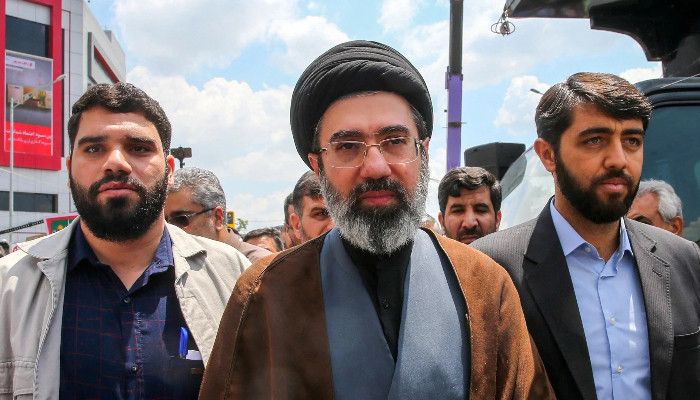
Despite the elder Khamenei’s reservations, Mojtaba Khamenei, 56, was selected as Iran’s supreme leader on March 9 by the country’s Assembly of Experts, after serving as a close aide to his father for years . Crucially, his appointment did not follow traditional procedures .
The powerful Islamic Revolutionary Guard Corps (IRGC) reportedly pressured the Assembly of Experts to approve him, with some clerics allegedly boycotting the vote . Mojtaba reportedly didn’t even win a majority in that vote, but the IRGC ensured his appointment anyway, prompting many clerics to boycott the meeting where the selection was announced .
According to sources, Mojtaba was injured during the airstrikes on Tehran that killed his father and was reportedly transported to Russia for medical treatment. His inaugural message as the nation’s leader was broadcast on state media, but neither his face nor his voice was shown, fueling questions about his health .
U.S. Offers $10 Million Reward
President Trump has publicly cast doubt on Mojtaba’s status. “I don’t know if he’s even alive. So far, nobody’s been able to show him,” Trump said in a telephone interview with NBC News. “I’m hearing he’s not alive, and if he is, he should do something very smart for his country, and that’s surrender” .
The U.S. government has offered a reward of up to $10 million for any information that could lead to the location or capture of Mojtaba, as well as nine other senior Iranian officials .
Meanwhile, Iranian officials have pushed back against these claims. Foreign Minister Abbas Araghchi dismissed reports of injuries, stating: “The leader is completely healthy, in control of the situation and present in the arena. The message he delivered was very strong. Not only the leadership, but all state institutions are stable and everything is under control” .
