
Table of Contents
Ukrainian President Volodymyr Zelenskiy claimed on Friday that a Russian drone had struck a cover built to contain radiation at the Chernobyl nuclear power plant, though he assured that radiation levels remained normal. The alleged attack came as international leaders gathered in Munich for the Security Conference, raising concerns over the potential escalation of the war in Ukraine.
Zelenskiy posted on social media that a Russian drone had caused significant damage to the radiation containment shelter at Chernobyl. He further added that the damage was primarily to the protective cover over the destroyed fourth reactor, but radiation levels inside and outside the plant remained stable. The timing of the accusation coincided with high-level discussions at the Munich Security Conference, which were set to feature key leaders such as US Vice President JD Vance and Ukrainian President Volodymyr Zelensky himself.
Russia Denies Drone Strike, Calls it a “Provocation”
However, Russia swiftly denied the claims, dismissing the accusations as a “provocation” orchestrated by Zelenskiy. Kremlin spokesperson Dmitry Peskov rejected the notion that Russia had targeted any Ukrainian nuclear infrastructure. Peskov stated that no such strikes on nuclear sites had occurred and that the allegations were entirely unfounded.
Maria Zakharova, a spokesperson for the Russian Foreign Ministry, accused Zelenskiy of staging the drone attack as a way to increase Western support for Ukraine. Zakharova suggested that the attack was planned specifically to coincide with the Munich Security Conference and to influence discussions, thereby securing more military aid and weapons from Western allies.
“There was never any doubt that Zelenskiy would not come to the Munich conference empty-handed,” Zakharova told a briefing in Moscow. She labeled the alleged attack as a “performance” aimed at lobbying for more arms and international support, accusing Kyiv of using nuclear plant threats as blackmail.
Footage and Claims from Zelenskiy
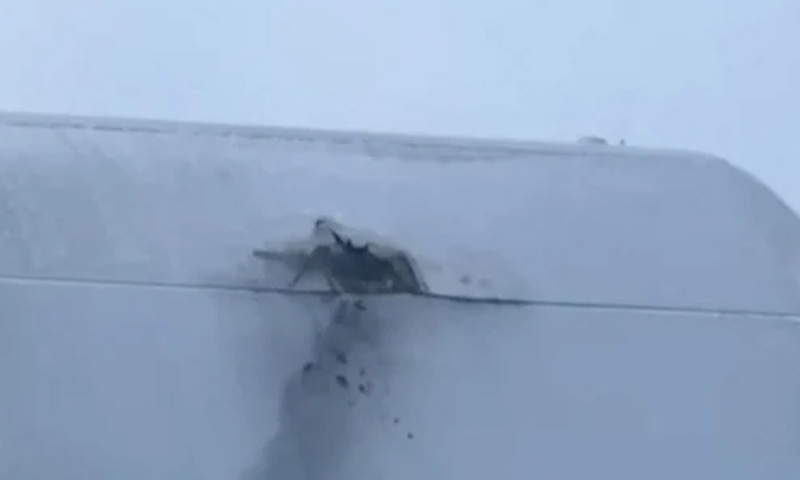
Zelenskiy’s social media post was accompanied by CCTV footage showing a blast on the side of the Chernobyl structure, with a timestamp marking the incident at 02:02 AM local time. The video also displayed a small fire igniting at the site and a hole in the roof, with Ukrainian firefighters attempting to extinguish the blaze.
According to Zelenskiy, the drone had flown at a low altitude of only 85 meters (about 279 feet), making it difficult for radar systems to detect the attack in time. The Ukrainian president argued that this was further evidence of Russia’s ongoing aggression and refusal to engage in meaningful negotiations.
The footage appeared to show a fire on the structure’s protective dome, with Ukrainian emergency services visibly responding to the scene. Despite the damage, radiation levels remained normal, according to both Zelenskiy and the International Atomic Energy Agency (IAEA).
International Atomic Energy Agency Confirms Explosion but No Radiation Threat
The IAEA, which has maintained a team at Chernobyl since the early stages of Russia’s invasion, confirmed an explosion at the site but reassured the public that radiation levels remained stable. The agency’s official statement noted that there was no immediate radiation risk, either inside or outside the plant.
The IAEA has continuously warned about the dangers of military activities near nuclear plants, particularly after Russia’s invasion of Ukraine, given the potentially catastrophic consequences of any damage to such sensitive sites.
The agency also published images of what appeared to be the drone on fire after crashing into the containment cover, supporting Zelenskiy’s claim of an attack. However, the agency’s reports still left questions regarding the precise nature of the incident, with experts calling for further investigation into the full scope of the damage.
Ongoing Tensions and Escalation Concerns
As the claims of a Russian drone attack on Chernobyl continue to unfold, the larger context of the war in Ukraine looms large. The timing of the accusation is particularly significant, as Zelenskiy was preparing to meet with US Vice President JD Vance in Germany at the Munich Security Conference. The attack and the international reactions to it may have an impact on the ongoing discussions about the war’s trajectory and the West’s continued support for Ukraine.
Zelenskiy’s statement added to the growing concerns about the escalation of the conflict, with the Ukrainian president reiterating that Russian President Vladimir Putin’s actions indicate that Russia is not preparing for negotiations but instead continuing its military offensive. Zelenskiy further claimed that the alleged drone strike was part of Russia’s broader strategy of deception and aggression against Ukraine and the international community.
With discussions at the Munich Security Conference expected to focus on the war in Ukraine, the drone attack and its aftermath have provided new fuel for the ongoing debates about security, military aid, and diplomatic efforts to resolve the conflict.
