
Table of Contents
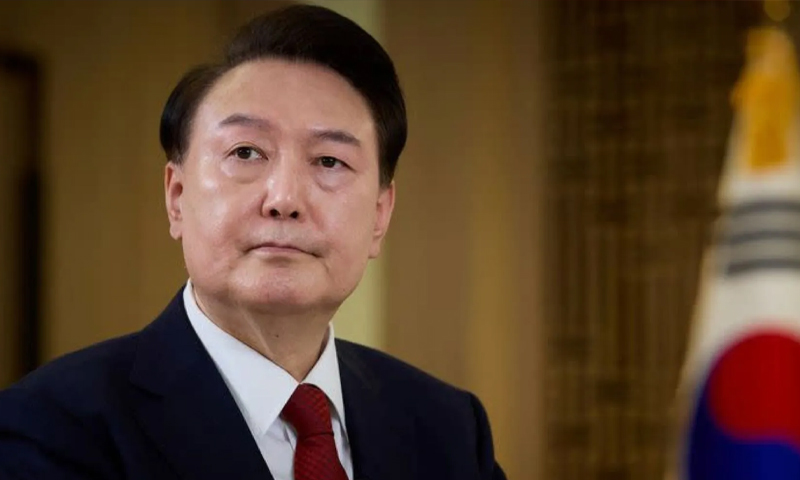
South Korean President Yoon Suk Yeol has been ousted from office following a ruling by the Constitutional Court, which upheld a motion of impeachment passed by the nation’s parliament. This decision, reached on Friday, concluded a period of severe political turmoil, which was set into motion by Yoon’s imposition of martial law in December of the previous year. This move, which sparked widespread protests and unprecedented unrest, is now being regarded as one of the most significant political crises South Korea has faced in recent decades.
With the ruling, Yoon’s presidency comes to an abrupt end, and according to South Korea’s constitution, a presidential election must now be held within 60 days to fill the vacant office. Prime Minister Han Duck-soo will serve as the acting president in the interim, overseeing the nation as it prepares for a new leader amidst both domestic and international challenges.
Impeachment Motion and Martial Law Controversy
Yoon’s downfall traces back to his controversial decision to declare martial law on December 3, 2024, which he claimed was necessary to counter the growing influence of the opposition Democratic Party. Yoon stated that his actions were motivated by an attempt to prevent the opposition from abusing its parliamentary majority, a move he considered dangerous for the country’s future. However, his critics argued that his martial law declaration was a direct violation of South Korea’s democratic principles and constitutional rights.
The martial law decree mobilized the military in an attempt to disrupt the parliamentary process, a move seen as an attempt to quash political opposition. The South Korean military was deployed to forcefully enter parliament, and special operations soldiers arrived by helicopter to break windows and attempt to enter the legislative building. Parliamentary staffers fought back with barricades and fire extinguishers, leading to a chaotic standoff. Although Yoon eventually lifted the martial law decree after just six hours, the damage was already done.
Constitutional Court Ruling: A ‘Serious Challenge to Democracy’
The Constitutional Court, in a unanimous ruling, found that President Yoon’s actions violated his constitutional duty and represented a “serious challenge to democracy.” Acting Chief Justice Moon Hyung-bae, in a statement, noted that Yoon’s martial law decree lacked legal justification and was procedurally defective. He emphasized that Yoon’s actions were not just unconstitutional but also undermined the democratic fabric of the country by attempting to disrupt the balance of powers between the branches of government.
Moon also remarked that Yoon’s declaration of martial law constituted a “grave betrayal” of the trust placed in him by the people. His actions, according to the court, created widespread chaos, affecting not only South Korea’s internal politics but also its economy and foreign relations.
The Public’s Reaction: Divided Responses
The ruling was met with jubilation from those who had campaigned for Yoon’s removal. Thousands of protestors, who had gathered for months to demand his ouster, erupted into cheers upon hearing the court’s decision. They chanted slogans such as “We won!” and celebrated the restoration of democratic principles in South Korea. For these citizens, the ruling marked the end of a political era that had undermined their democratic rights.
Beijing Escalates Pressure with Sanctions Against US Defense Giants
However, Yoon’s supporters, who had gathered near his official residence, expressed their anger and frustration at the decision. The division within South Korean society was evident, with violent clashes breaking out in some areas. In one instance, a protester was arrested for smashing a police bus window. Despite these tensions, the South Korean won showed little immediate reaction to the ruling, remaining largely unchanged in value compared to the dollar.
The Path Forward: Presidential Election and Political Stability
With the ruling now final, South Korea finds itself at a crossroads. The Constitution mandates that a new presidential election be held within 60 days, and the country’s political stability will be tested in the coming weeks. Prime Minister Han Duck-soo, who will serve as acting president, has promised to do all he can to ensure a peaceful and orderly election process.
The financial markets in South Korea have also been put on high alert, with Finance Minister Choi Sang-mok expected to convene an emergency meeting with the Bank of Korea and other financial regulators to discuss the potential impact of the political crisis on the economy. The country’s economy, which has already been facing challenges from a slowing growth rate, will need strong leadership to navigate the turbulent period ahead.
Yoon’s Legal Challenges and Continuing Uncertainty
In addition to his impeachment, President Yoon faces a criminal trial related to his martial law declaration. He is charged with insurrection, and although he was arrested in January 2025, his arrest warrant was canceled in March, and he was released. The legal proceedings will likely continue to cast a shadow over the nation as South Korea moves into its electoral phase.
The political crisis triggered by Yoon’s actions has deepened divisions within the nation. It is not only a test for South Korea’s democracy but also for its ability to maintain stability amid growing external pressures, including threats from North Korea, diplomatic pressure from China, and the economic and trade challenges posed by the administration of US President Donald Trump.
