
Table of Contents
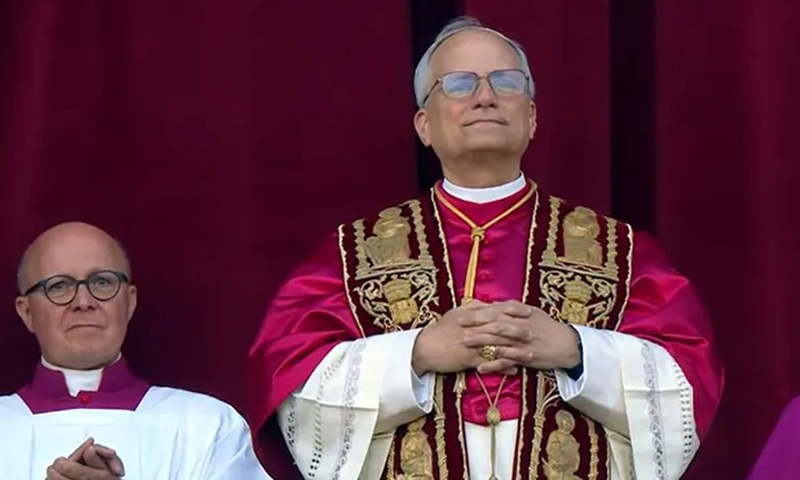
In a groundbreaking development for the global Catholic Church, American Cardinal Robert Prevost has been elected as the new pope, taking the name Leo XIV. The announcement came on Thursday from St. Peter’s Basilica, marking a historic moment as Prevost becomes the first American to ascend to the papacy.
A Historic Election and a Moment of Unity
The announcement of Pope Leo XIV’s election came approximately 70 minutes after white smoke emerged from the Sistine Chapel chimney, signaling that the conclave of 133 cardinal electors had successfully chosen a new leader for the Church’s 1.4 billion faithful worldwide.
French Cardinal Dominique Mamberti made the traditional Latin proclamation, “Habemus Papam” (“We have a pope”), to a jubilant crowd in St. Peter’s Square, as tens of thousands waited to greet the Church’s newest spiritual leader.
Appearing on the central balcony of St. Peter’s Basilica shortly thereafter, Pope Leo XIV offered his first public words as pontiff: “Peace be with you all.”
A Quiet Reformer with Global Experience
At 69 years old, Robert Prevost hails from Chicago, Illinois, but has spent much of his clerical life as a missionary in Peru. He served as bishop in the city of Chiclayo from 2015 to 2023, earning a reputation as a deeply pastoral leader who focused on social justice and service to the marginalized.
In 2023, Pope Francis brought Prevost to Rome to lead the Vatican’s powerful Dicastery for Bishops, the office responsible for overseeing the selection of bishops around the world. This gave Prevost significant influence in shaping the Church’s leadership globally, even before becoming pope.
Prevost was made a cardinal by Pope Francis in 2023—a relatively short time before his election, suggesting that his peers saw in him both a deep humility and a clear commitment to the ongoing reformist vision initiated by his predecessor.
Legacy of Pope Francis and the Road Ahead
Pope Francis, who died on April 21, served for 12 years and was the first Latin American pope. During his time, he worked to open up the Catholic Church to the contemporary world, tackling controversial issues such as the ordination of women, LGBT inclusion, and curial reform.
Francis’ leadership brought both praise and criticism, but there is little doubt he helped usher in an era of greater dialogue and inclusivity within the Church.
Prevost’s election appears to be a vote of confidence in continuing that trajectory. His low-profile yet impactful leadership style, along with his vocal support for widening access to Church life, align with the broader themes of Francis’ papacy.
In a 2023 Vatican press briefing, Prevost said:
“Our work is to enlarge the tent and to let everyone know they are welcome inside the Church.”
This message of inclusivity may well define the early months and years of Pope Leo XIV’s papacy.
A Papacy of Symbolism and Significance
Choosing the name Leo XIV carries significant historical resonance. One of the most well-known previous holders of the name, Pope Leo XIII, was renowned for his progressive stance on social issues and for issuing the groundbreaking encyclical Rerum Novarum, which laid the foundation for modern Catholic social teaching.
By adopting this name, Prevost may be signaling a continued commitment to the Church’s mission of social justice, a theme central to his pastoral career in Latin America and his recent role in the Vatican.
World Leaders Alarmed as India-Pakistan Conflict Escalates
A Diverse Field of Contenders
Prevost’s election was not widely anticipated. Leading up to the conclave, several other cardinals were considered frontrunners, including Italian Cardinal Pietro Parolin, Filipino Cardinal Luis Antonio Tagle, Hungarian Cardinal Peter Erdo, French Cardinal Jean-Marc Aveline, and Filipino Bishop Pablo Virgilio David.
Despite the wide field, Prevost emerged as a unifying figure—seen by many cardinals as capable of bridging divisions between traditionalist and reform-minded factions within the Church.
The First American Pope: A New Chapter
Robert Prevost’s election as the first American pope adds another layer of historical significance. While the U.S. has long played a powerful role economically and diplomatically on the world stage, it has never before provided a leader for the Catholic Church.
This milestone may deepen the Vatican’s engagement with issues facing North and South America alike, and position Pope Leo XIV to address global concerns with a broader and more culturally diverse lens.
As the 267th successor to St. Peter, Pope Leo XIV now carries forward both the burdens and the hopes of a Church in transition—seeking unity, relevance, and renewal in a rapidly changing world.
