
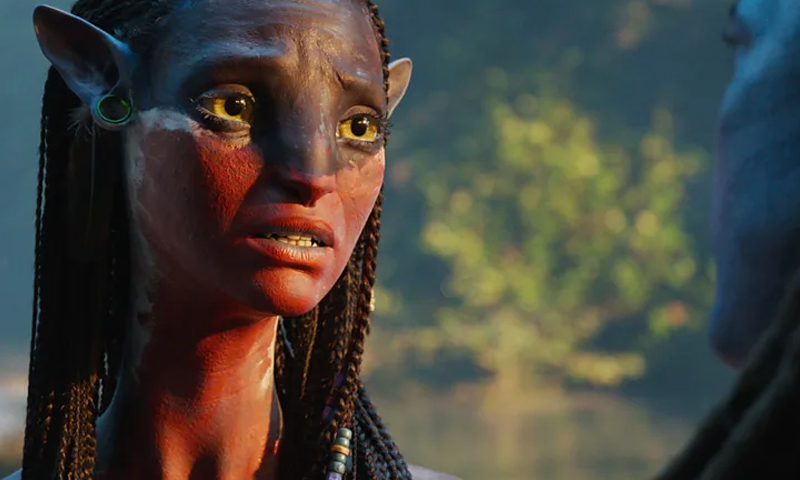
James Cameron’s Avatar franchise has always been built on scale—bigger worlds, longer runtimes and ever more ambitious visual effects. But the third installment, Avatar: Fire and Ash, may finally prove that bigger isn’t always better.
At 197 minutes, the film is a full half-hour longer than the original Avatar and stretches its welcome almost immediately. What unfolds is an exhausting mix of screensaver-worthy visuals, clunky dialogue, meandering plotlines and an overdose of new-age, hippy spirituality. While the first two Avatar films rank among the highest-grossing movies of all time, this latest entry strongly suggests that Cameron may be pushing his luck—especially with two more sequels still planned.
Perhaps the most frustrating aspect of Fire and Ash is that, despite its marathon runtime, it fails to function as a complete, self-contained story. Cameron makes little effort to accommodate viewers who aren’t die-hard fans of the franchise. The film assumes a deep emotional investment in its characters, their relationships and the world of Pandora, treating narrative momentum as optional rather than essential.
The result is a movie that feels strangely hollow. There’s no clear beginning, middle or end—just an extended middle, bloated with side plots and repetitive themes. It’s a far cry from the relative clarity and excitement of the first Avatar, which introduced a simple but effective premise: humanity, having devastated Earth, turns its attention to mining resources on the lush moon Pandora, sparking conflict with its indigenous inhabitants, the Na’vi.
That original film worked because it leaned into its central conflict. Jake Sully (Sam Worthington), a human Marine whose consciousness is transferred into a Na’vi-human hybrid body, infiltrates the local population, falls in love with the warrior princess Neytiri (Zoe Saldaña), and ultimately switches sides. Yes, it was essentially Pocahontas in space—with a splash of Dances with Wolves and blue aliens—but it had urgency, emotional stakes and a clear ecological message.
In Fire and Ash, that sense of focus has largely vanished. The Na’vi are still locked in battle with the human military, but Cameron seems to have lost interest in Jake and Neytiri altogether. Instead, the spotlight shifts to their teenage children—a decision that proves disastrous.
While Worthington may not be cinema’s most charismatic leading man, Jake Sully was at least a defined character. His children, by contrast, blur together into a collection of near-identical, barely clothed adolescents who are difficult to distinguish and even harder to care about. Their personalities are thinly sketched, their dialogue grating, and their endless angst quickly becomes tiresome.
The film lurches awkwardly between set pieces and spiritual monologues. One moment, viewers are treated to a large-scale battle or a visually arresting action sequence. The next, they’re forced to sit through solemn, drawn-out discussions of Na’vi beliefs and cosmic harmony. Occasionally, there are fleeting glimpses of the sharper, more politically charged eco-thriller the film could have been—an empire-versus-rebels narrative with real bite—but those moments are frustratingly brief.
Adding to the disjointed feel are sporadic appearances by human scientists, who vanish for long stretches before suddenly reappearing, as if Cameron remembered they were still part of the story. The pacing is uneven, the structure shapeless, and the emotional beats feel unearned.
Ultimately, Avatar: Fire and Ash resembles less a sci-fi epic and more a glossy Californian soap opera. Dreadlocked, surf-bro Na’vi soar through the skies on dragon-like creatures, exchanging lines such as “That was insane, bro” and “This is sick, cuz!” Any sense of danger or gravitas is undercut by dialogue that sounds more at home in a beachside reality show than an interstellar war.
Visually, the film is undeniably impressive—Pandora has never looked more detailed or immersive—but spectacle alone can’t sustain nearly three and a half hours of cinema. Without compelling characters or a driving narrative, the eye candy quickly loses its impact.
What makes Fire and Ash most alarming is what it signals for the future. If this is the direction the franchise is heading—longer runtimes, weaker storytelling and increasing self-indulgence—it’s hard not to dread what Cameron has planned next. With two more sequels on the way, one question looms large: just how much longer, and more bloated, can Avatar become before audiences finally tune out?
