
Table of Contents
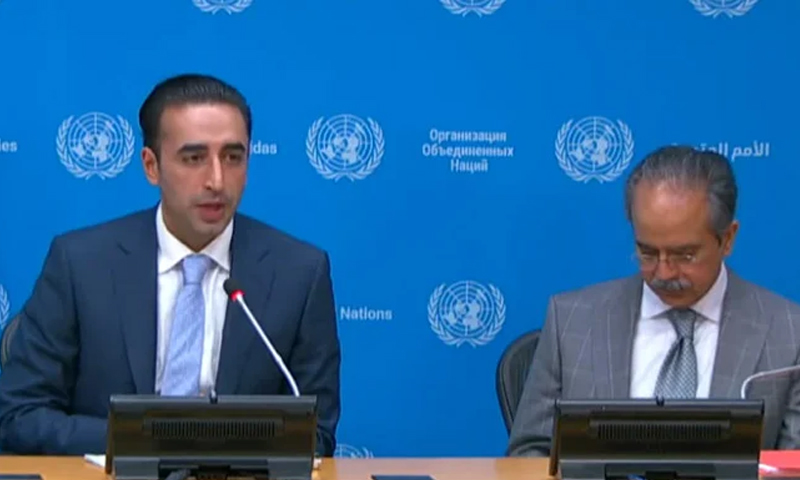
In a high-stakes press conference held at the United Nations Headquarters in New York on Tuesday, Pakistan Peoples Party (PPP) Chairman Bilawal Bhutto-Zardari warned the international community that recent military escalations between Pakistan and India have dangerously lowered the threshold for nuclear conflict in South Asia.
Speaking with a high-level nine-member Pakistani parliamentary delegation, Bilawal urged the global community to push India towards a comprehensive dialogue to resolve long-standing disputes and avoid further military confrontation.
“The ceasefire is a welcome step, but only a first step. The world is less safe today because the threshold for conflict between two nuclear-armed states has dropped,” he said.
Delegation Visits UN to Present Pakistan’s Stance
Bilawal was joined in New York by several prominent political and diplomatic figures including:
- Hina Rabbani Khar
- Sherry Rehman
- Dr Musadik Malik
- Khurram Dastgir Khan
- Jalil Abbas Jilani
- Tehmina Janjua
- Bushra Anjum Butt
- Syed Faisal Subzwari
The group’s objective was to counter India’s narrative, present Pakistan’s version of recent events, and draw global attention to what they described as India’s violations of international law.
Accusations of Illegal Strikes and Civilian Harm
Bilawal strongly criticized India’s military actions on May 7, alleging they violated the UN Charter and targeted civilian and religious infrastructure in Pakistan, leading to the deaths of women and children. According to him, the Pahalgam attack in Indian Illegally Occupied Jammu and Kashmir (IIOJK) was used as a pretext for these cross-border strikes.
He emphasized Pakistan’s willingness to cooperate, noting that Prime Minister Shehbaz Sharif had publicly offered to be part of any international investigation into the attack.
“We made the offer because our hands were clean. India refused and chose to escalate instead,” Bilawal stated.
He said Pakistan’s military response was measured and targeted, bringing down six Indian planes allegedly involved in the attack.
Concerns Over Escalation and Role of Global Powers
Bilawal credited the international community, particularly U.S. President Donald Trump and Secretary of State Marco Rubio, for mediating and preventing a full-scale conflict.
He warned, however, that the next incident might escalate too quickly for diplomacy to work, making dialogue and preventive measures even more critical.
“We need international diplomacy now more than ever. The next time, we may not have time for talks before missiles fly,” he cautioned.
Kashmir Dispute and Terrorism: Core Issues
Bilawal reiterated that Kashmir remains the root cause of conflict, blaming the unresolved status of the region for continued instability. He condemned what he called India’s attempts to weaponize terrorism as a political tool to demonize Muslims and silence dissent in Kashmir and across the region.
“We’ve fought terrorism bravely—our people, our political leadership, and our armed forces have made sacrifices. Yet India tries to paint us as the aggressor.”
He also emphasized Pakistan’s success in tackling terror financing, referencing the country’s removal from the FATF grey list during his time as foreign minister.
Karol Nawrocki Wins Polish Presidential Election, Defeating Trzaskowski
Warning Against “New Normal” and Water Weaponization
Bilawal raised alarm about India’s attempts to create a dangerous “new normal” where any terror incident within India or IIOJK could trigger a military strike on Pakistan.
“This approach is untenable. It risks putting the fate of 1.7 billion people in the hands of terrorists.”
He also accused India of trying to weaponize water by threatening the Indus Waters Treaty, calling it an existential issue for Pakistan.
“Cutting off water for 200 million people is not diplomacy—it’s war. No civilized country should allow such a precedent.”
Appeal for Global Action and U.S. Mediation
Bilawal appealed to the international community, especially the United States, to play a more active role in reviving dialogue between the two nuclear-armed neighbors. He emphasized that true regional stability can only come through bilateral diplomacy.
“India likes to call itself a net security provider. Its recent actions have shown the opposite. True security can only come through peace with Pakistan.”
The delegation is expected to continue engagements in Washington, D.C., with U.S. government officials and lawmakers to press for diplomatic initiatives.
Allegations of Israeli Involvement and Ideological Influence
Responding to a journalist’s question, Bilawal confirmed that Israeli drones were reportedly used by India in its May 7 strikes. He also drew comparisons between India’s Kashmir policy post-2019 and Israel’s settlement tactics in the West Bank.
“Modi is like a poor copy of Netanyahu—unfortunately taking inspiration from the worst example possible.”
Meeting with French Ambassador Emphasizes Need for Restraint
Earlier the same day, the Pakistani delegation met with France’s Permanent Representative to the UN, Ambassador Jerome Bonnafont, to express concerns over India’s military actions and the threat they pose to regional peace.
Bilawal outlined:
- India’s baseless accusations following the Pahalgam attack
- Civilian casualties from cross-border strikes
- Suspension of the Indus Waters Treaty
- The risk of nuclear confrontation without a dispute resolution framework
The French ambassador expressed support for dialogue, restraint, and adherence to international law, highlighting the importance of a peaceful resolution to the Kashmir dispute.
