
Table of Contents
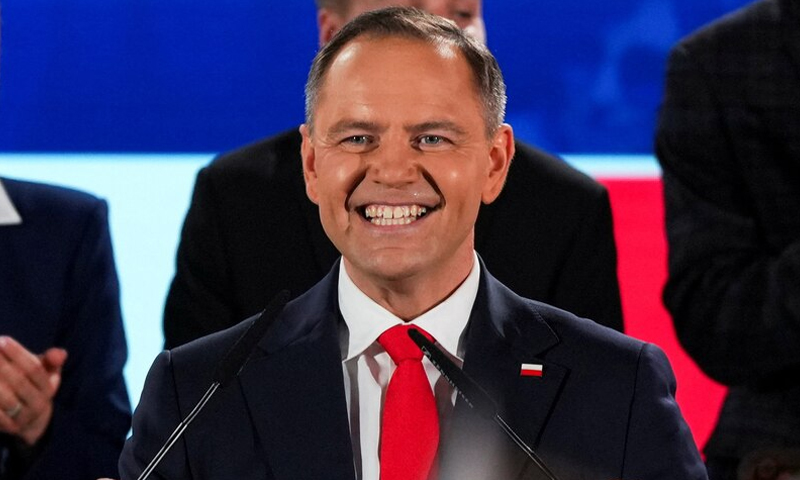
In a highly contested and closely watched race, Karol Nawrocki, the nationalist opposition candidate, emerged victorious in Poland’s presidential election, winning the second round with 50.89% of the vote, according to the country’s electoral commission. This marked a narrow defeat for his rival, Rafal Trzaskowski, the liberal mayor of Warsaw and ally of the pro-European government led by Donald Tusk, who secured 49.11% of the vote.
Despite an exit poll on Sunday that had shown Trzaskowski winning by a razor-thin margin, Nawrocki’s win signifies a blow to the pro-European agenda and a shift towards nationalism in Polish politics.
Nawrocki’s Nationalist Campaign and Eurosceptic Stance
Nawrocki, 42, is a historian with a background in national remembrance and was supported by the Law and Justice Party (PiS). He campaigned on a platform that emphasized economic policies and social issues favoring Polish citizens over non-Polish nationals, particularly in terms of immigration and refugees. His stance on limiting immigration and prioritizing Polish interests resonated strongly with voters, especially as the issue of refugees, including those from neighboring Ukraine, remains a sensitive subject in the country.
Greenpeace Steals Macron Wax Figure to Protest France’s Economic Ties with Russia
Despite some controversies surrounding his past, including questions about his acquisition of a flat from an elderly pensioner and a confession to participating in orchestrated brawls, Nawrocki managed to gain broad support. His campaign was marked by strong nationalist rhetoric and a promise to maintain policies that align closely with the conservative agenda of the Law and Justice Party.
The Impact of Nawrocki’s Victory on Polish Politics
The result of the election has major implications for Poland’s political landscape. While the Polish parliament holds the most power, the presidency plays a key role in blocking or approving legislation, particularly when it comes to vetoing laws or influencing policies on key issues such as abortion and the judiciary. Nawrocki’s victory is expected to continue the political course set by his predecessor, President Andrzej Duda, who aligned with the Law and Justice Party and opposed any attempts by the government to liberalize abortion laws or reform the judiciary.
As a Eurosceptic, Nawrocki’s victory signals that Poland will likely remain resistant to further European Union integration, further challenging the pro-European policies of the Tusk government. His stance on issues such as immigration and national sovereignty will likely continue to define Poland’s domestic and international relations.
A Tightly Contested Race with High Voter Turnout
This presidential election drew significant attention both domestically and internationally, particularly in countries like Ukraine, Russia, and the United States, where the outcome is seen as pivotal for Poland’s foreign policy and its stance within the European Union. Nawrocki’s victory came amid a highly polarized and heated campaign, with many voters seeing the election as a crucial decision regarding the future direction of Poland’s political alignment and economic policies.
The voter turnout was remarkably high, with 71.31% of eligible voters casting their ballots, marking a record high for the second round of a presidential election in Poland. This high level of civic participation underscores the intensity of the race and the public’s desire to influence the country’s future.
President Duda’s Message and Reflection on the Election
Poland’s outgoing president, Andrzej Duda, who supported Nawrocki’s candidacy, thanked Polish citizens for their active participation in the election. On social media platform X, Duda wrote, “Thank you! For participating in the presidential elections. For the turnout. For fulfilling your civic duty. For taking responsibility for Poland. Congratulations to the winner! Stay strong Poland!”
His message reflected the record-breaking turnout and acknowledged the importance of the election as a reflection of Poland’s democratic values and the citizens’ responsibility in shaping the country’s future.
International Reaction and Looking Ahead
Nawrocki’s win is likely to have broad implications for Poland’s relationship with the European Union, particularly regarding the country’s approach to migration, judicial reform, and its position in global affairs. The election results may also impact Poland’s relationship with Russia and its role within NATO, given the ongoing tensions in Eastern Europe.
As Poland enters a new era with Karol Nawrocki at the helm, the focus will shift to how his presidency will address domestic challenges, including economic reform, immigration policy, and foreign relations, particularly with its neighbors. The next steps will be closely watched by international observers, especially as the country’s position on these issues could influence its future within the European Union and its broader geopolitical role.
