
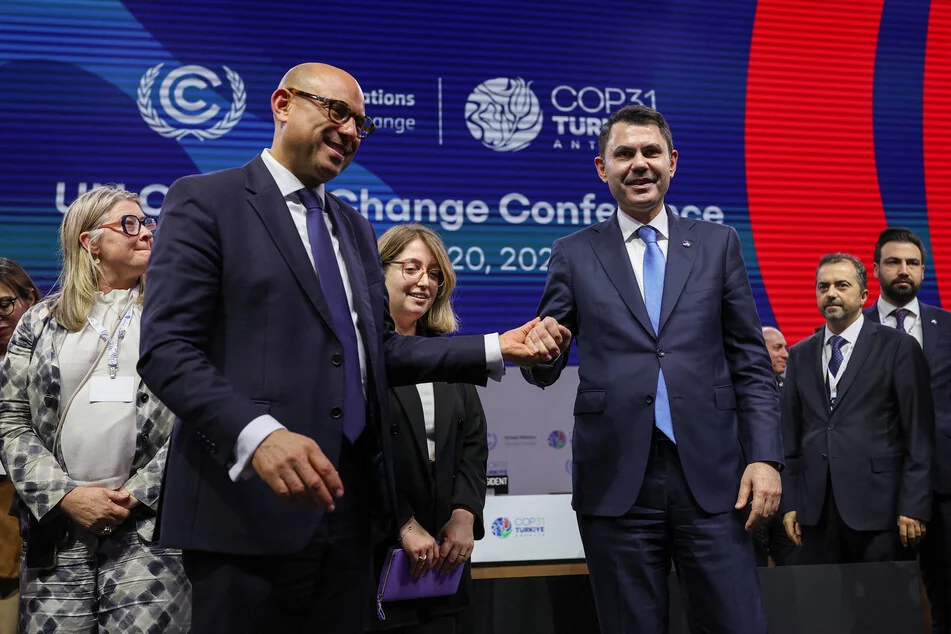
COP31 Collapse in Turkiye Sparks Calls to Reform UN Climate Rules
ANTALYA: The dramatic collapse of marathon UN climate negotiations in Turkiye has reignited fierce debate over reforming the summit’s consensus-based decision-making rules, while fueling momentum for international legal action and ambitious side agreements among willing nations.
The 31st Conference of the Parties, widely known as COP31, ended in deadlock on Sunday—two days past its scheduled conclusion—without a final agreement. Negotiators remained hopelessly divided over fossil fuel phase-out language, climate finance for developing nations, the integration of climate science, and the role of carbon-removal technologies.
The breakdown marked a disappointing conclusion to an unusual dual presidency shared by Australia and host nation Turkiye. Negotiations chair Chris Bowen, Australia’s climate minister, described the outcome as “very disappointing.” For many climate observers, however, the impasse was the predictable result of a system repeatedly paralyzed by its requirement for unanimous approval.
“Decision-making that requires every country to agree on every comma is not fit for a climate emergency,” said Nikki Reisch, director of the climate and energy programme at the Center for International Environmental Law. Bowen echoed that diagnosis, noting that while COP was originally built on consensus for understandable diplomatic reasons, overcoming that hurdle in today’s climate reality has become “a very tough ask.”
Calls for Significant Reform Sunday’s failure has intensified demands to overhaul a rulebook that effectively grants any single nation—or small bloc of countries—veto power over global climate progress. Former US Vice President Al Gore condemned the outcome on social media, calling it an “outrage that a handful of petrostates have veto power over any mention of fossil fuels.”
Gore argued that the Antalya deadlock proves world leaders are no longer willing to settle for the “lowest common denominator,” urging a “reinvigorated multilateral process that reflects the latest science and represents the will of the majority of the world.” Yet, as Bowen pointed out, changing the rules presents a Catch-22: “You also need consensus to change consensus.” While Bowen diplomatically called that a “particular challenge,” critics view unanimity on procedural reform as virtually impossible.
Core Faultlines in Antalya The COP31 talks fractured across several deeply entrenched divides. At the heart of the dispute was whether the summit’s central cover decision would explicitly commit to phasing out planet-warming fossil fuels. While a coalition of countries refused to sign a deal lacking that pledge, major oil producers—including Saudi Arabia—vehemently opposed its inclusion.
Further friction emerged over the timeline for incorporating upcoming scientific assessments from the Intergovernmental Panel on Climate Change (IPCC), as well as disputed language surrounding carbon capture technologies—a solution championed by the fossil fuel sector but dismissed by critics as prohibitively expensive and ineffective.
Equally damaging for developing nations was the complete lack of progress on climate finance, leaving vulnerable countries without the urgent funding required to transition to clean energy and adapt to worsening climate disasters. “The fundamental problem for globally agreed climate policy is more starkly obvious than ever,” said Frank Jotzo, professor of environmental and climate change economics at the Australian National University. “Fossil fuel powers will not agree to have their resource wealth devalued, and rich countries won’t provide enough climate finance to the developing world.”
Looking Beyond the COP Process While COP31 joins past failures—most notably the 2009 Copenhagen summit—few experts advocate abandoning the UN forum entirely, given its unmatched ability to bring nearly every nation to the table on equal footing. Instead, frustration is driving countries toward parallel avenues to accelerate climate action.
International legal pressure is gaining traction, bolstered by a landmark International Court of Justice (ICJ) advisory opinion affirming that states carry binding legal obligations to combat climate change. “If the negotiations are not delivering what individual states need, then they’ll certainly consider turning to the ICJ and other international courts,” said Harj Narulla, an international lawyer who advised the Solomon Islands at COP31.
At the same time, observers anticipate growing reliance on “plurilateral” coalitions operating outside the UN veto trap. Prominent among them is the Santa Marta initiative, launched after COP30 in Brazil to unite countries committed to phasing out fossil fuels, which recently established an expert scientific panel to map transition pathways.
Jotzo noted that similar breakaway alliances are needed for adaptation finance and carbon removal. Even Bowen acknowledged the rising prominence of the Santa Marta process, noting that while it “doesn’t replace COP, it’s just another way of doing it.”
