
Table of Contents
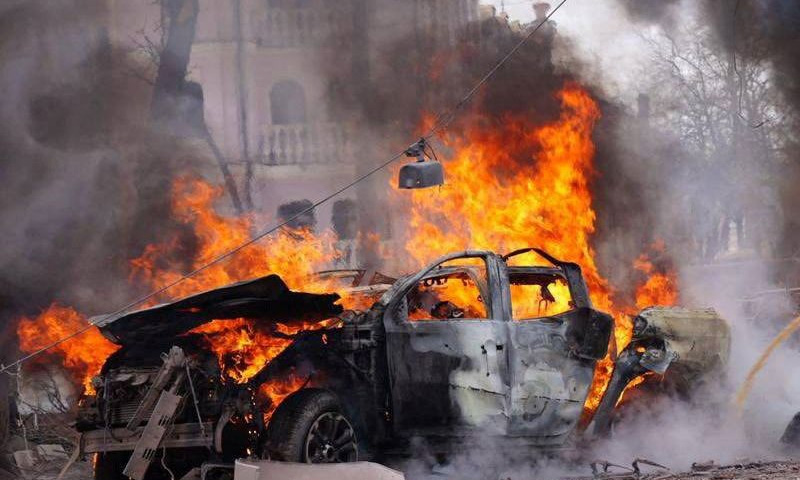
On Sunday, two Russian ballistic missiles struck the heart of Sumy, a northern Ukrainian city near the Russian border, killing at least 32 people and injuring more than 80 others in the most lethal attack on Ukraine this year, Ukrainian officials reported.
The missiles reportedly contained cluster munitions, targeting civilians during a major religious holiday, in what Ukrainian leaders have labeled a deliberate act of terror.
Civilians Caught in the Open
Interior Minister Ihor Klymenko described a scene of horror, saying victims were “out on the street or inside cars, public transport, and buildings” when the missiles struck. The timing, coinciding with a church feast day, has sparked further outrage.
“Deliberate destruction of civilians on an important church feast day,” Klymenko wrote.
Andriy Yermak, President Zelenskiy’s chief of staff, stated that cluster munitions were used — a controversial and widely condemned weapon due to its indiscriminate impact.
Ukraine Accuses Russia of War Crime
Ukraine’s Foreign Minister Andrii Sybiha stated that the government is actively sharing detailed evidence of the attack with international bodies, including the International Criminal Court (ICC), which Ukraine joined earlier this year.
The ICC is already investigating multiple alleged war crimes committed during Russia’s full-scale invasion, which began in February 2022 and has since resulted in Russia seizing nearly 20% of Ukrainian territory.
Security Concerns: Leak Suspected
Ukrainian lawmaker Maryana Bezuhla, known for her criticism of military leadership, suggested the strike may have followed a leak of sensitive information about the location of Ukrainian soldiers.
This raises fears of internal security failures and highlights the complex challenges Ukraine faces in defending its urban areas near the Russian border.
Diplomatic Tensions Amid Ongoing Talks
The missile strike came just days after U.S. envoy Steve Witkoff visited President Vladimir Putin in St. Petersburg, holding talks reportedly aimed at finding a path toward ending hostilities.
However, Andriy Kovalenko, head of Ukraine’s Centre for Countering Disinformation, condemned the timing of the attack, stating:
“Russia is building all this so-called diplomacy around strikes on civilians.”
President Volodymyr Zelenskiy echoed that sentiment, urging a strong response from the U.S. and European allies, while slamming the ineffectiveness of diplomatic efforts in halting Russian aggression.
Eight Pakistani Mechanics Killed in Iran’s Sistan-Baluchestan Province
“Russia wants exactly this kind of terror and is dragging out this war. Without pressure on the aggressor, peace is impossible,” Zelenskiy wrote.
Strained Ceasefire and Energy Infrastructure Attacks
Although Ukraine and Russia agreed last month to avoid striking each other’s energy infrastructure, mutual accusations of violations have persisted. On Saturday, Russia claimed Ukraine had carried out five attacks on its infrastructure — charges Kyiv has neither confirmed nor denied.
This comes as part of a broader breakdown in U.S.-brokered efforts to reduce the intensity of the conflict, despite pressure from former President Donald Trump, who has repeatedly urged both sides to pursue peace talks swiftly.
Sumy: A Strategic and Symbolic Target
With a population of approximately 250,000, Sumy lies just 25 kilometers (15 miles) from the Russian border. It became a key military hub after Ukraine launched an incursion into Russian territory last August — an offensive that has since stalled.
The attack on Sumy not only carries military significance but also symbolic weight, as it underscores the vulnerability of Ukrainian civilians even far from the frontlines.
Global Repercussions Likely
As details of the deadly strike emerge, calls for international accountability are growing louder. With the ICC now fully engaged, and Ukraine pushing its partners to act, the attack may serve as a turning point in global diplomatic pressure on Russia.
Whether this tragedy results in meaningful geopolitical shifts — or is simply added to the growing list of wartime atrocities — remains to be seen.
