
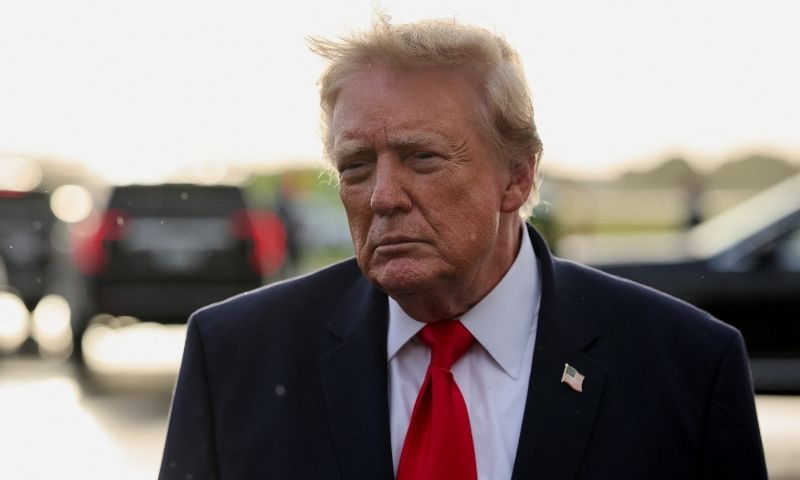
WASHINGTON – Democrats seized control of both chambers of the US Congress in Tuesday’s midterm elections, handing President Donald Trump and his Republican Party a sweeping defeat driven by voter anger over the high cost of living, the war with Iran and the president’s stewardship of the country.
Tens of millions of Americans voted in elections widely seen as a referendum on Trump’s second presidency, delivering Democratic victories not only in traditional battlegrounds but also deep inside Republican territory.
Democrats flipped at least seven Republican-held Senate seats and more than two dozen seats in the House of Representatives, according to projections and results reported by major US and international media. The victories will return divided government to Washington after two years of Republican control of the White House and Congress, giving Democrats the power to investigate Trump’s administration and potentially block parts of his legislative agenda and presidential nominations.
The scale of the Democratic victory represented one of the most dramatic midterm reversals for a sitting president in recent US political history.
Democrats take Senate
With several races still awaiting final calls, major networks projected Democrats had won control of the 100-seat Senate. BBC results showed Democrats on 54 seats and Republicans on 44, with two contests still outstanding, while Fox News also projected a Democratic majority of 54 seats at the time of its latest update. The final composition could change as outstanding races are decided.
The Democratic gains included victories by Roy Cooper in North Carolina, Annie Andrews in South Carolina, Sherrod Brown in Ohio, Adam Hamilton in Kansas, Troy Jackson in Maine, James Talarico in Texas and Josh Turek in Iowa, according to the results cited in the election coverage. The party’s gains produced remarkable breakthroughs in states that had long been Republican strongholds.
In Texas, Democrat James Talarico won a Senate seat, ending a decades-long Democratic losing streak in one of the country’s most important Republican states. Talarico defeated Republican Ken Paxton despite enormous Republican campaign spending and support from billionaire Elon Musk, who contributed heavily to a super PAC supporting Paxton. “Texas is not for sale,” Talarico said after his victory.
In Kansas, Democrats won a Senate seat for the first time since the Great Depression era, underlining the breadth of the political shift. Democrats also scored a major upset in South Carolina, a state Trump won comfortably in the 2024 presidential election, where Annie Andrews defeated Republican Darline Graham, Trump’s preferred candidate. In Maine, Troy Jackson defeated longtime Republican Senator Susan Collins, ending her three-decade Senate career. Michigan Democrat Abdul El-Sayed also won his Senate race, becoming the first Muslim elected to the US Senate.
Mississippi, Alaska races remain unresolved
Two Senate races — in Mississippi and Alaska — remained too close or too early to call in the latest election coverage. In Mississippi, Democrat Scott Colom held an extremely narrow lead over Republican Senator Cindy Hyde-Smith, despite the state being regarded as a strong Republican territory. Mississippi has not elected a Democrat to the US Senate since 1982. In Alaska, Republican Senator Dan Sullivan faced Democrat Mary Peltola in a closely contested race. The state’s voting system means the final result could take longer to determine.
The outstanding contests mean the final Senate balance may differ from early projections, though Democratic control of the chamber had already been secured.
Democrats win House majority
Democrats also won control of the 435-member House of Representatives, crossing the 218-seat threshold needed for a majority. The party flipped more than two dozen Republican-held seats and won virtually all of the most closely watched House contests decided so far.
BBC’s latest results showed Democrats with well over the 218 seats required for control, although dozens of races remained to be called. The Democratic gains were particularly significant because Republicans had attempted an aggressive redistricting strategy in several states to create additional favourable House districts. That effort largely failed to prevent the Democratic wave. Reuters reported that Democrats won all 20 of the House contests regarded as especially competitive among the races decided at the time.
The result is expected to put House Democratic Leader Hakeem Jeffries in line to become House speaker and potentially the first Black person to hold the position, according to AP’s assessment of the election outcome.
Affordability becomes Democrats’ winning message
Democrats made the cost of living and affordability central to their campaign, blaming Trump’s economic policies, tariffs and the war with Iran for increasing costs for American households. The party also focused on healthcare costs and allegations of corruption.
House Democratic Leader Hakeem Jeffries said voters had delivered a clear verdict. “We ran on affordability. We won on affordability,” he said, adding that Democrats would now be expected to govern with a focus on reducing costs. Jeffries also said the war with Iran had been a major issue for voters and urged Trump to end the conflict.
Reuters reported that voters consistently showed greater concern about economic and pocketbook issues than the cultural issues emphasised by Trump and Republican candidates.
Iran war and rising fuel prices hurt Republicans
The war with Iran emerged as one of the defining issues of the campaign. The conflict contributed to higher energy prices and intensified concerns about the cost of living, with voters holding the Trump administration responsible for its economic consequences.
Exit polling cited by Reuters showed that half of voters viewed the midterm election as an opportunity to rebuke Trump, while around 70 per cent wanted Congress to provide stronger checks and balances on the president. The results reflected frustration not only with inflation and energy prices but also with Trump’s broader approach to governing. Approximately three-quarters of voters surveyed said they were angry or dissatisfied with the direction of the country, Reuters reported.
Trump accepts results but blames absence from ballot
Trump said he would accept the election results, easing fears that he might challenge the outcome as he did after his defeat in the 2020 presidential election. However, he sought to distance himself from the Republican losses, arguing that the results would have been different had his name been on the ballot.
“I wasn’t on the ballot and if I was, we would have won IN A LANDSLIDE!” Trump wrote on social media.
In interviews following the results, Trump also acknowledged that the war with Iran and higher fuel prices had been factors in the Republican defeat. He said he was willing to work with Democrats on some issues, including immigration, while warning that he would veto legislation he considered extreme.
Republican blame game begins
The scale of the defeat triggered immediate criticism within Republican ranks, with some party figures openly questioning Trump’s influence over the party. Utah Senator John Curtis said Republicans needed to return to the “principled conservative values” that had previously defined the party.
Kentucky Representative Thomas Massie, a longtime Trump critic who had clashed with the president over the Iran war and other issues, said Republicans needed to accept responsibility for the outcome. “Tonight’s outcome isn’t about placing faith in Democrats or socialist principles; it’s about holding Republicans accountable for betraying their promises,” Massie said.
Other Republicans defended Trump. Senate Republican Leader John Thune said the party had built a strong record during the previous two years and vowed to work with Trump to resist what he described as Democratic extremism. The election also created uncertainty over Republican leadership in the House. House Speaker Mike Johnson was not expected to seek the position of minority leader, according to reports, potentially setting off a contest for the top Republican position in the chamber.
Historic victories across the country
The election produced a series of historic firsts beyond the fight for Congress. In Georgia, Democrat Keisha Lance Bottoms became the first Black woman elected governor of a US state. In Texas, Democrat Gina Hinojosa became the state’s first Latina governor after defeating three-term Republican Governor Greg Abbott. Democrat Xavier Becerra was elected California’s first Latino governor.
The Senate results also included a number of historic breakthroughs, including the election of the first Muslim senator. Republican Byron Donalds, meanwhile, won Florida’s gubernatorial election, becoming the first Black Republican elected governor of a US state.
A new era of divided government
The Democratic takeover will significantly reshape Washington when the new Congress takes office in January. For two years, the Republican-controlled Congress had generally given Trump wide latitude. Democratic control of both chambers will now provide a far greater check on his administration.
The House will have the authority to launch investigations into Trump’s administration, his family and his allies, while the Democratic Senate will have the power to block presidential nominees. The outcome could also complicate Trump’s legislative plans and force the White House to negotiate with Democratic leaders.
With Trump constitutionally barred from seeking another term, the election results could also accelerate the political battle over the future of the Republican Party and the 2028 presidential race. For Democrats, however, the sweeping victory brings its own challenge: translating an election built around affordability and frustration with Trump into tangible policy gains.
As Jeffries put it, voters had not elected Democrats simply to retaliate against the president. “The American people don’t want us to get even,” he said. “They want us to get things done on their behalf.”
The final seat totals remain subject to outstanding races and official certification, but the central political verdict was unmistakable: American voters returned control of Congress to Democrats and handed Trump his most significant electoral setback since returning to the White House.
