
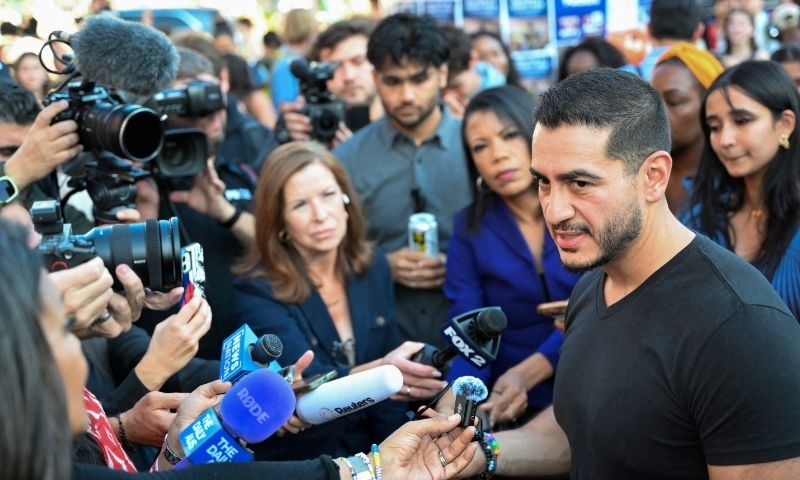
WASHINGTON – Democrat Abdul El-Sayed has defeated Republican Mike Rogers in the race for Michigan’s Democratic-held US Senate seat, as the party made sweeping gains in Tuesday’s midterm elections, capturing control of both chambers of Congress and dealing a setback to President Donald Trump’s legislative agenda. He is the first ever Muslim to become a Senator.
According to the results on X, El-Sayed won the Michigan Senate race with 50.7 per cent of the vote, with Rogers securing 47.3 per cent, a margin of 3.4 percentage points. AP is yet to call this race.
Earlier today, Trump acknowledged that the war in Iran had contributed to Republican setbacks, as Democrats made significant gains in states that had strongly supported him in the 2024 presidential election.
The results reflected voter frustration over the administration’s handling of the economy, rising living costs and the decision to launch military action against Iran in February, which drove fuel prices sharply higher.
Prominent House Democrats re-elected
Democrats also held on to several prominent House seats. Representatives Rashida Tlaib, Hakeem Jeffries and Alexandria Ocasio-Cortez were re-elected, according to the Associated Press (AP). The AP projected Tlaib as the winner in Michigan, where she defeated Republican challenger James D. Hooper.
The House Democratic caucus also celebrated the victories, with the party securing at least eight seats previously held by Republicans, including in Kentucky, New Jersey and North Carolina. The gains put Democrats on course to take control of the lower chamber.
The party’s Senate victories were equally significant. Democrats captured six Republican-held seats, securing a majority even if they failed to retain their own seats in the competitive states of Michigan and Minnesota.
Breakthroughs in Republican strongholds
The results marked a striking shift in several states that had been considered Republican strongholds. In Kansas, megachurch pastor Adam Hamilton became the first Democrat in nearly a century to win a Senate seat, a breakthrough dating back to the Great Depression.
In Ohio, Democrat Sherrod Brown reclaimed a Senate seat previously held by Vice President JD Vance. In Texas, state Representative James Talarico defeated Republican Attorney General Ken Paxton, despite a substantial campaign spending effort against him. Trump had carried both states by double-digit margins in 2024.
South Carolina also saw a major upset, with Democrat Annie Andrews, a paediatrician, defeating Republican Senator Darline Graham in a state Trump won by nearly 18 percentage points in the last presidential election. Graham had been appointed to the Senate following the death of her brother, longtime Republican Senator Lindsey Graham, and was seeking a full six-year term.
Trump had endorsed Graham and Paxton, as well as Ohio Republican Jon Husted, and made an extensive final push for Republican candidates. He held more than two dozen rallies and repeatedly urged supporters to treat the midterms as a referendum on his presidency, telling them to “pretend I’m on the ballot”.
As the scale of the Republican losses became apparent, Trump took to social media to argue that his absence from the ballot had made the difference. “I wasn’t on the Ballot and if I was, we would have won IN A LANDSLIDE! Thank you for your attention to this matter,” he wrote.
Democrats make gains in Republican strongholds
The Democratic gains extended beyond congressional contests. Texas Governor Greg Abbott, a three-term Republican incumbent, lost to Democrat Gina Hinojosa, while Democrats also won governorships in traditionally conservative Iowa and Ohio.
Republicans also struggled to maintain their previous margins in states where they retained seats. In Florida, Republican Senator Ashley Moody defeated Democrat Angie Nixon by around three percentage points, according to a vote count compiled by Reuters and USA Today. Trump had won the state by 13 points in 2024. Democrats also held three Florida House districts that Republican lawmakers had redrawn earlier this year. Trump had carried all three constituencies by at least nine percentage points in the presidential election.
In Georgia, Democratic Senator Jon Ossoff, who was projected to win re-election, described the results as a decisive rejection of Trump and his administration. “In sweeping and decisive victories, the American people have rebuked the depravity, corruption and incompetence of the man named President Donald J. Trump,” Ossoff told supporters at a victory gathering.
Voters seek stronger checks on presidential power
Exit polls conducted by SSRS on behalf of a consortium of US media organisations, including major television networks and the Associated Press, offered further insight into the factors shaping the vote. Half of voters nationwide said they viewed the midterm elections as an opportunity to rebuke Trump, while three-quarters described themselves as either angry or dissatisfied with the direction of the country. The surveys also found that 70 per cent of voters wanted Congress to impose stronger checks and balances on the president.
With Democrats set to control both chambers of Congress, the results are expected to reshape the political landscape for the remainder of Trump’s term. The party’s congressional majorities will give it greater influence over legislation and oversight, posing a significant challenge to the administration’s domestic and foreign policy agenda.
