
Table of Contents
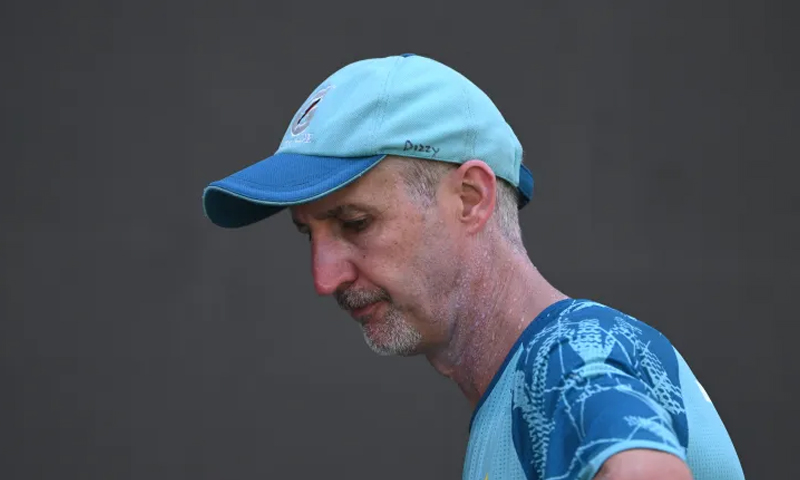
Former Australian cricketer Jason Gillespie has opened up about his decision to step down as Pakistan’s red-ball head coach, attributing it to a lack of clarity surrounding his role within the team’s structure. In a recent interview, Gillespie highlighted his concerns about communication breakdowns and important decisions made without his knowledge as key factors in his resignation.
Lack of Communication and Uncertainty Over Coaching Roles
One of the main reasons behind Gillespie’s decision was his surprise over the Pakistan Cricket Board’s (PCB) choice not to renew the contract of High-Performance Coach Tim Nielsen, a move he was completely unaware of. Gillespie explained, “I was completely unaware of the decision not to retain Tim Nielsen. This situation, along with past incidents, made me question whether I was truly needed. Not informing the head coach about such a major decision compelled me to think this way.”
Gillespie, who had been with Pakistan’s cricket team for several months, expressed his growing frustration as his role seemed to lose its purpose. “The purpose of my coaching stint in Pakistan was fading away,” he said. According to the 49-year-old former cricketer, his duties had been reduced to basic tasks, such as giving catching practice to players on match mornings, which he felt was not aligned with the responsibilities of a head coach.
Issues with Decision-Making and Lack of Coordination
One of the major issues that further exacerbated the situation was the absence of communication regarding significant decisions, including changes to the selection committee. Gillespie revealed that he had learned about the new selection committee via a text message in a group chat after the first Test match against England. “No one discussed the selection committee issue with me,” he stated, adding that such a lack of consultation made his role even more difficult.
The lack of coordination within the selection process was further highlighted by the controversial decision to drop Pakistan’s star batter, Babar Azam, from the second match of the recent Test series against England. Gillespie felt that this move illustrated a larger problem within the team’s management. “The decision to drop Babar Azam was made by the new selection committee,” he pointed out, underscoring the disjointed decision-making process that was part of his frustrations.
Tim Nielsen’s Departure and Gillespie’s Resignation
The Pakistan Cricket Board had opted not to renew the contract of Tim Nielsen as the red-ball assistant coach, which added to the instability in the team’s management. Nielsen, who had been appointed in August 2024, had his contract expire following Pakistan’s recent tour of Australia. Although Nielsen had expressed his intent to continue coaching the team for the upcoming series against South Africa and the West Indies, he was informed by the PCB that his services were no longer required.
Gillespie’s resignation came shortly after these developments, and he was succeeded by former cricketer Aqib Javed, who was appointed as the interim head coach for Pakistan’s two-match Test series against South Africa, set to take place from December 20, 2024, to January 7, 2025, in Centurion and Cape Town.
Gillespie’s Time with Pakistan Cricket
Gillespie was appointed as Pakistan’s red-ball head coach in April 2024, with his first assignment being a two-match Test series against Bangladesh. Unfortunately, Pakistan suffered a 2-0 whitewash defeat. However, under his leadership, Pakistan managed a 2-1 victory over England in a three-match home Test series, marking a positive turn in his brief tenure as head coach.
Despite the challenges he faced during his short stint, Gillespie’s time with Pakistan’s cricket team highlighted the importance of clear communication, coordination, and a defined role for the head coach in team management decisions. His resignation brings to light the issues faced by the PCB in terms of leadership structure and decision-making.
