
Table of Contents
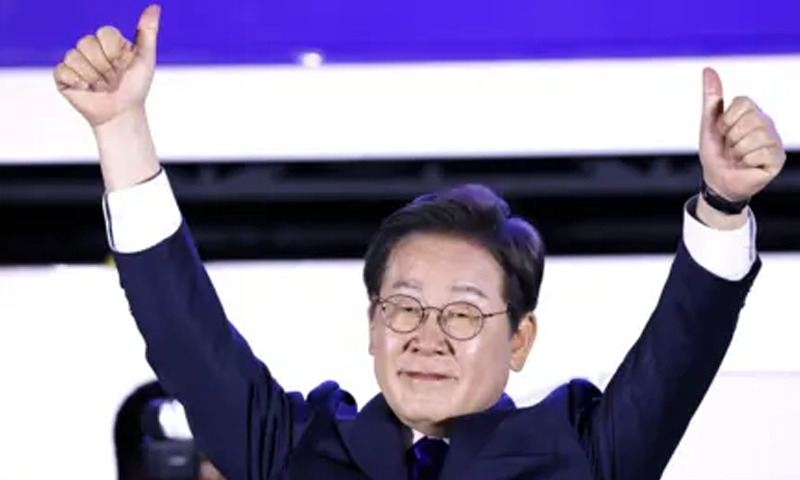
South Korea’s centre-left leader Lee Jae-myung has been declared the winner of a snap presidential election, bringing an end to six tumultuous months of political crisis following former President Yoon Suk Yeol’s declaration of martial law.
Official results released early Wednesday by the National Election Commission confirmed Lee’s victory over conservative rival Kim Moon-soo, who had conceded the race even before the final count was completed.
Record Voter Turnout and a National Reckoning
With 79.4% voter turnout, the highest since 1997, the election marked a dramatic turning point in South Korean political history. Voters turned out in force, viewing the race as a referendum on Yoon’s authoritarian overreach and the broader direction of democracy in the country.
“I will humbly accept the choice of the people. Congratulations to the elected candidate Lee Jae-myung,” Kim said, as 96.74% of ballots had been counted, making a comeback mathematically impossible.
Lee Promises Unity, Peace, and Democratic Renewal
In his victory remarks, Lee thanked the South Korean people for their trust and vowed not to betray their expectations. He acknowledged the deep political divide left in the wake of recent turmoil and struck a conciliatory tone:
“Even those who did not support me are still fellow citizens. From this moment on, we move forward together with hope.”
Lee also signaled a potential shift in regional diplomacy, pledging to pursue dialogue and cooperation with North Korea, in contrast to the hawkish stance of his predecessor. Under Yoon, relations with Pyongyang had deteriorated sharply, reaching their lowest point in years.
Yoon’s Martial Law Bid and Collapse of Conservatism
The election was triggered by Yoon Suk Yeol’s stunning and ultimately disastrous declaration of martial law six months ago — a move that involved deploying armed soldiers to parliament during a standoff with opposition lawmakers. The decision led to his rapid impeachment and removal from office, making him the second consecutive conservative president to be ousted, after Park Geun-hye in 2017.
US Investigates Adani Group for Potential Sanctions Evasion with Iranian LPG
Yoon’s fall also threw the ruling conservative camp into disarray. Kim Moon-soo, his labor minister and party successor, failed to rally support, struggling with internal party divisions and an inability to consolidate the right-wing vote.
Exit Polls, Street Celebrations, and Relief
Exit polls by South Korea’s three major broadcasters had pointed to a Lee victory early in the night, sparking celebrations among his supporters outside the National Assembly. Inside the building, party officials broke into chants of “Lee Jae-myung!”
For many, Lee’s win represents a symbolic triumph over authoritarianism.
“It’s been a tough road. I’m happy because it feels like we’ve seized the opportunity that so many people fought for,” said Noh Min-young, a 20-year-old protester who has demonstrated daily since Yoon’s martial law decree.
Challenges Ahead for Lee
Though Lee takes office immediately upon validation of the vote, he inherits a daunting to-do list:
- A stalled economy highly dependent on exports
- One of the lowest birth rates globally
- An increasingly aggressive North Korea
- Deep political polarization following months of leadership vacuums
Experts say the public’s choice of Lee reflects both hope for democratic stability and disillusionment with the conservative bloc’s recent performance.
“Lee’s victory signals that the Korean public rejects illiberal and undemocratic measures such as martial law,” said Gi-Wook Shin, a sociology professor at Stanford University.
A Controversial President-Elect
Lee Jae-myung is no stranger to controversy. Though now president, he carries a criminal record and has been embroiled in multiple personal and political scandals over the years. His rise, analysts argue, is as much a reflection of voter frustration as it is of his own popularity.
“Lee’s success is due as much to his rivals’ failings as his own strengths,” noted Minseon Ku, a postdoctoral researcher at the William & Mary Global Research Institute.
Tight Security for Inauguration
Given recent unrest and a 2024 assassination attempt on Lee, police have issued a top-level security alert ahead of Wednesday’s inauguration. Thousands of officers have been deployed, and Lee has been campaigning in a bulletproof vest, delivering speeches behind protective glass.
A Turning Point for South Korea
Lee’s inauguration is expected to be swift, with the National Election Commission set to validate the final count within hours. With a single five-year term ahead, Lee has promised a new chapter for a weary nation.
This election — defined by a dramatic return to democratic norms — may well go down as a watershed moment in South Korea’s political evolution.
