

ISLAMABAD: Amidst reports of a heated exchange during Pakistan Tehreek-e-Insaf’s (PTI) core committee meeting, newly elected lawmaker Sher Afzal Marwat has vehemently denied any internal strife within the party.
Marwat countered allegations of bitter confrontations with party leader Shamim Naqvi and others, dismissing them as “false and malicious.” He stressed that debates within a party forum should not be interpreted as signs of division, asserting PTI’s unity and its members’ commitment to collective efforts.
During the meeting, the main point of disagreement was about the issue of the ‘batsman’. Marwat questioned its introduction and believed that it led to setbacks for the party. However, the disagreement escalated between Marwat and Niazullah Niazi, which led to Ali Muhammad Khan intervening to diffuse the tension.
While some members supported Marwat’s criticisms of past decisions, particularly regarding the ‘batsman’ concept, others, like Firdous Shamim Naqvi, urged for guidance to avoid internal discord.
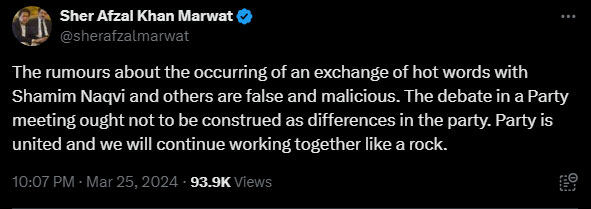
Marwat expressed frustration, alleging a smear campaign against him and highlighting internal dissent within PTI. Criticism was directed at Marwat for potentially undermining PTI’s established narrative with his comments.
The core committee meeting, attended by figures like Chairman Barrister Gohar Ali Khan and Ali Muhammad Khan, ended on a discordant note, reflecting underlying tensions within the party. Shahbaz Gill and Mian Aslam Iqbal participated via video link, although the meeting concluded without resolving all issues satisfactorily.
Despite internal disagreements, PTI aims to present a united front, emphasizing collective efforts towards achieving the party’s objectives. The aftermath of the meeting underscores the challenges of managing internal dynamics within a political organization, especially amidst critical junctures such as the upcoming Senate election.
