
Table of Contents
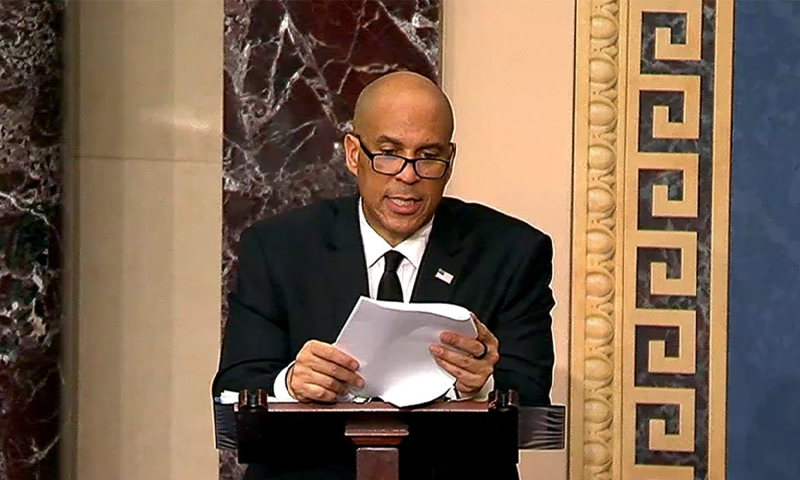
Senator Cory Booker of New Jersey made history by delivering the longest speech in U.S. Senate history, lasting over 25 hours. The speech, a passionate protest against President Donald Trump’s actions and policies, was a remarkable demonstration of both physical endurance and political conviction. Booker, the fourth Black senator to be popularly elected to the U.S. Senate, surpassed the previous record set by South Carolina Senator Strom Thurmond, who held the record for a 24-hour, 18-minute filibuster in 1957 against the Civil Rights Act.
Booker’s lengthy oration was not a typical filibuster aimed at preventing votes in the Senate; instead, it was a protest against what he described as the unconstitutional overreach of President Trump’s executive powers and his radical cost-cutting policies. While Republicans largely stayed away during the marathon session, several Democratic senators joined Booker in the chamber, offering their support as the historic moment approached.
A Moral Stand Against Trump’s Actions
In his speech, Booker repeatedly emphasized the moral dimension of his protest, stating, “This is a moral moment. It’s not left or right. It’s right or wrong.” His message was clear: he believed that the actions of President Trump were not only damaging to the country but were also a threat to the very fabric of American democracy. Booker criticized Trump’s policies that he claimed put American citizens in harm’s way, from slashing government programs without congressional consent to undermining essential democratic institutions.
He drew a direct line between Trump’s executive actions and the erosion of the nation’s core values, asserting, “Unnecessary hardships are being borne by Americans of all backgrounds. And institutions which are special in America, which are precious and which are unique in our country, are being recklessly — and I would say even unconstitutionally — affected, attacked, even shattered.”
Booker’s protest wasn’t just about criticizing Trump’s administration; it was also about rallying people to take action. Quoting his mentor, civil rights leader John Lewis, Booker invoked the idea of “good trouble,” urging Americans to stand up against injustice and fight for a better future.
Breaking the Record and Maintaining Focus
At 7 PM on Monday, Booker began his speech, and by 8:05 PM on Tuesday, he had broken the record for the longest speech in Senate history, clocking in at 25 hours and 5 minutes. Despite the physical toll, Booker remained strong and focused throughout. He joked about his discomfort, saying, “I want to go a little bit past this and then I’m going to deal with some of the biological urgencies I’m feeling.” But his humor didn’t take away from the serious political message he was delivering.
Booker also described how he managed the physical challenges of staying on his feet for so long, saying he stopped eating and drinking in the days leading up to the speech. While his strategy helped him stay focused, it also resulted in significant physical strain, including muscle cramps and dehydration.
Democratic Defiance and Public Support
While Booker’s speech wasn’t a traditional filibuster that blocked Senate votes, it still served as a powerful moment of defiance against President Trump’s agenda. Many Democrats, disheartened by their minority status in both the Senate and House of Representatives, viewed Booker’s speech as a significant rallying point. The event brought attention to the Democratic opposition to Trump’s policies, especially those that aimed to reduce government programs and ramp up deportations.
Senator Raphael Warnock, another Democratic lawmaker, expressed gratitude to Booker for his unwavering commitment. “I just want to thank you for holding vigil for this country all night,” Warnock said on the Senate floor. This moment resonated with many Democratic lawmakers who have felt powerless in the face of a Republican-controlled Senate and White House.
The public also took notice of Booker’s act of defiance. Outside the U.S. Capitol, a small group of people gathered, holding signs that expressed their appreciation for the senator’s effort. “Thank you, Senator Booker,” one sign read. This public show of support reflected a broader sentiment among those who are opposed to Trump’s policies and actions, especially as they affect vulnerable communities and democratic norms.
Booker’s Call to Action and the Power of the People
As Booker concluded his speech, he reiterated the importance of collective action. “The power of the people is greater than the people in power,” he declared, signaling that despite the difficulties Democrats face in Congress, the voice of the people could still drive change.
Booker dedicated much of his speech to criticizing Trump’s policies, but he also took time to entertain his colleagues and the public with poetry, sports references, and lighthearted moments. This helped keep the momentum going and gave the speech a sense of dynamism that many found engaging. Booker’s defiance wasn’t just about making a political point; it was about connecting with the American people and urging them to stand up for what they believe is right.
A Defining Moment in Senate History
Senator Cory Booker’s 25-hour speech will go down in history as a defining moment in Senate history, not just because of the physical feat involved but because of the political statement it made. By breaking the record and engaging in such an extraordinary protest, Booker showed that even in times of political division and gridlock, one individual’s voice can make a powerful impact.
In the end, Booker’s speech was a call to action for all Americans to resist authoritarianism, stand up for democracy, and fight for the values that make the nation strong. It was a reminder that while the people in power may have the ability to enact policies, the power of the people, when united, can shape the course of history.
