
Table of Contents
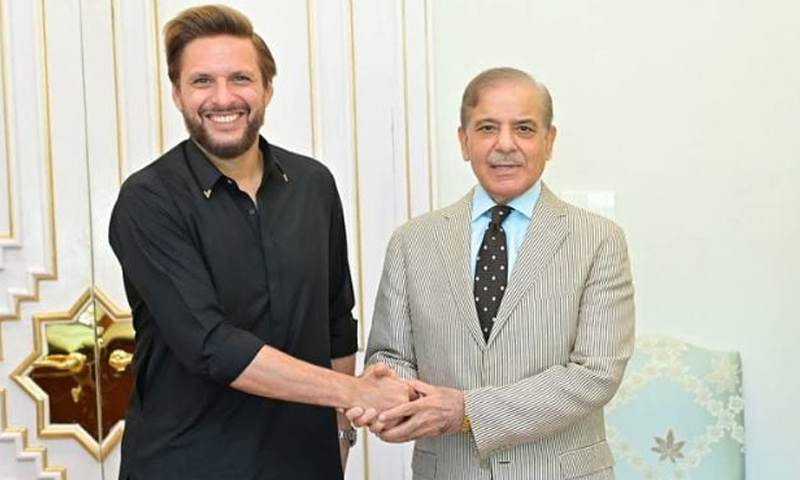
Former Pakistan cricket captain Shahid Khan Afridi met Prime Minister Shehbaz Sharif at the Prime Minister’s House in Islamabad to commend the government’s and armed forces’ handling of recent tensions with India, particularly Operation Bunyan Marsoos.
The meeting, also attended by Federal Minister for Information Attaullah Tarar, took place amid a national wave of solidarity following the military operation launched in response to Indian aggression. Afridi congratulated the Prime Minister and praised the armed forces’ swift and forceful actions against what he described as unprovoked Indian attacks.
At the meeting, Prime Minister Shehbaz Sharif thanked Afridi for standing with the nation during a critical time and lauded the former cricketer’s active participation in national unity efforts, particularly his leadership during the recent public rally.
Nationwide Solidarity on Display During ‘Youm-e-Tashakur’
Shahid Afridi played a prominent role during the government-declared Youm-e-Tashakur (Day of Gratitude), held to honor the sacrifices and successes of Pakistan’s armed forces in the wake of Operation Bunyan Marsoos. A massive rally in Karachi, attended by thousands, became a focal point of national unity.
Speaking at the rally, Afridi criticized India for escalating conflict without provocation and accused its forces of targeting civilians and religious sites. “India underestimated the cost of provoking Pakistan,” he stated, adding that Pakistan’s military had demonstrated both discipline and deterrence in their response.
Afridi’s passionate speech resonated with the public and was widely circulated on social media, contributing to his emerging role as a vocal advocate for national resilience.
Afridi’s Criticism of Indian Media and Government Sparks Controversy
In the wake of heightened India-Pakistan tensions, Afridi made several strong public statements condemning India’s actions, particularly blaming the Modi government for warmongering and labeling the Pahalgam incident a “false flag operation” orchestrated to deflect domestic failures.
He dismissed Indian military threats as hollow, declaring that Pakistan’s armed forces were “highly trained and not easily intimidated.” In a particularly sharp rebuke, he referred to Indian media as “Cartoon Network journalism,” accusing it of sensationalizing war coverage instead of promoting peace and accountability.
PM Shehbaz Declares Victory Over India, Urges Peace and Dialogue
Afridi’s comments drew ire in India, leading to punitive action against his digital presence. His YouTube channel, along with those of other former Pakistani cricketers including Rashid Latif, Shoaib Akhtar, and Basit Ali, were reportedly blocked by Indian authorities for allegedly spreading “anti-India propaganda.”
Backdrop: India-Pakistan Conflict Over Pahalgam Attack
Tensions reached a boiling point after a deadly attack in Pahalgam, Indian Illegally Occupied Jammu and Kashmir (IIOJK), killed 26 people. India promptly blamed Pakistan without offering verifiable evidence, leading to a series of aggressive actions: suspension of the Indus Waters Treaty, cancellation of visas, and the scaling back of diplomatic relations.
Pakistan denied any involvement and retaliated with equivalent diplomatic and economic measures, including halting bilateral trade and closing its airspace to Indian aircraft.
On May 7, India escalated the situation further by launching missile strikes on civilian and strategic targets in Punjab and Azad Jammu and Kashmir (AJK), reportedly killing dozens of civilians. Pakistan responded swiftly, shooting down several Indian fighter jets, intercepting drones, and initiating Operation Bunyan Marsoos, which successfully targeted Indian military installations.
Ceasefire Achieved Through Diplomatic Pressure
The conflict, which had risked spiraling into full-scale war, was halted on May 11, following urgent diplomatic intervention by former U.S. President Donald Trump. Through backchannel efforts and pressure on both sides, a ceasefire was brokered and later confirmed by officials in Islamabad and New Delhi.
Trump later called the ceasefire one of his “biggest successes,” highlighting his use of trade diplomacy to defuse a potentially nuclear confrontation. He praised both India and Pakistan for responding to diplomatic overtures and urged further trade-based engagement in the region.
Afridi Urges Continued Unity and Focus on National Interests
Afridi’s meeting with the Prime Minister and his fiery public rhetoric underscore the broader role that cultural and sports figures can play in national affairs, especially during times of crisis. With his massive public following, Afridi’s stance carries weight in shaping public sentiment and reinforcing narratives of unity and resilience.
He reiterated that now is the time for Pakistan to consolidate its diplomatic and military gains, strengthen its trade relationships — especially with allies like the United States — and ensure that provocations do not derail long-term national progress.
