
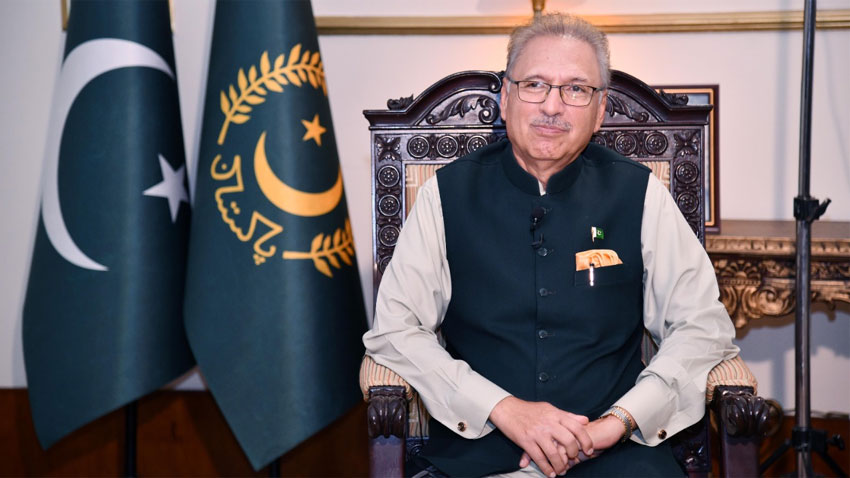
President Arif Alvi has yet to call a session of the National Assembly despite receiving a summary from the Ministry of Parliamentary Affairs, according to sources cited by Private News Channel.
The delay is attributed to the president’s stance that the assembly remains incomplete because some reserved seats have not been allocated. The Election Commission of Pakistan (ECP) has distributed reserved seats among political parties but has not extended this to the Sunni Ittehad Council (SIC), which gained members from the Pakistan Tehreek-e-Insaf (PTI)-backed independents. The ECP considers the issue of SIC’s reserved seats as “pending.”
The president has reportedly not made a formal decision on the summary, providing only a verbal response. Despite this, the interim government insists that the National Assembly session will convene on February 29, as mandated by Article 91 of the Constitution, regardless of the president’s action on the summary.
Shame on those who are saying that Nawaz Sharif is being favoured: Maryam Nawaz
Ishaq Dar, a senior leader of the Pakistan Muslim League-Nawaz (PML-N), stated that the National Assembly speaker has the authority to summon the session on February 29 if the president fails to do so, by the Constitution. The caretaker federal government emphasizes that holding the National Assembly session within 21 days of the general elections is compulsory under Article 91 (2) of the Constitution.
Caretaker Minister for Information, Broadcasting, and Parliamentary Affairs Murtaza Solangi indicated earlier that the first session of the new National Assembly is expected to be scheduled between February 22 and February 29, in line with constitutional requirements.
He further clarified that the formation of a government requires a simple majority and that the president, post the 18th Constitutional Amendment, signifies the Federation and lacks the authority to call upon an individual or party to form a government.
The Constitution mandates the president to convene the National Assembly session within 21 days following the election, setting the stage for the swearing-in of newly-elected members, and the subsequent election of the speaker, deputy speaker, and prime minister.
