
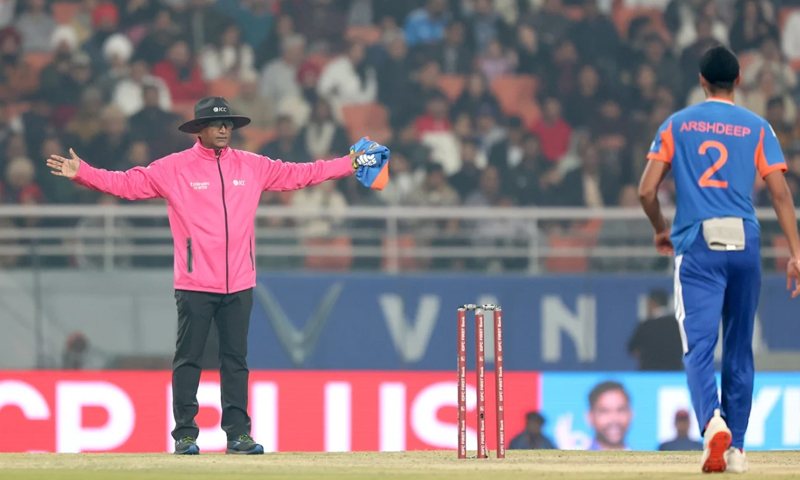
Indian fast bowler Arshdeep Singh found himself at the centre of an unwanted record during India’s 2nd T20I against South Africa at Mullanpur on Thursday—one that will be remembered for all the wrong reasons. The left-arm pacer became the first bowler in T20 International history to deliver seven wides in a single over, a statistic that stunned fans, commentators, and experts alike.
Playing in his home state of Punjab, Arshdeep was expected to bring energy and control into India’s bowling attack. Instead, he walked away with an over that spiraled beyond his control and became symbolic of India’s unusually poor bowling performance on the night. The moment the umpire signalled wide after wide, social media erupted, with fans expressing disbelief at how quickly the over unravelled.
The incident unfolded in the 11th over of the South African chase. Arshdeep began the over under immediate pressure, conceding a towering six to Quinton de Kock on the very first ball. That shot seemed to rattle the speedster, as he struggled with his line throughout the remainder of the over. What was expected to be a routine six-ball over stretched into a marathon 13 deliveries—making it one of the longest overs ever bowled by a full-member nation fast bowler.
In total, the over leaked 18 runs, with wides doing most of the damage. Each wide added to Arshdeep’s frustration, and the momentum swung heavily in South Africa’s favour. The over also equalled the record for the joint-longest over bowled by a full-member nation bowler, previously set by Afghanistan’s Naveen-ul-Haq. Naveen had bowled a similarly wayward 13-ball over against Zimbabwe in 2024, which included six wides of his own. Before them, South Africa’s Sisanda Magala had produced a 12-ball over against Pakistan in 2021, putting Arshdeep in unwelcome company among bowlers who have lost complete control of the over.
For India, the over came at the worst possible time. South Africa’s experienced pair of Quinton de Kock and Aiden Markram was already building momentum, and Arshdeep’s chaotic over allowed the Proteas to accelerate freely. De Kock in particular took full advantage of the free runs and loose deliveries, pushing the scoring rate beyond India’s comfort zone.
The Indian bowlers struggled collectively throughout the innings, failing to apply pressure or build dot-ball phases. Their lines and lengths were inconsistent, allowing the South African batters to dictate the tempo. Arshdeep’s record-breaking over only further exposed the cracks in India’s bowling plans and execution.
Despite the overall poor performance, spinner Varun Chakravarthy emerged as the lone bright spot for India. His tight spells and crucial breakthroughs brought some control back into the innings. Chakravarthy’s impressive discipline stood in stark contrast to the erratic spells from the pace bowlers, underscoring his growing value as a wicket-taking option in the middle overs.
However, Chakravarthy’s efforts were not enough to undo the damage caused earlier. South Africa capitalised on every scoring opportunity, with de Kock and Markram keeping the scoreboard ticking at a rapid pace. Their confident stroke-making reflected the ease with which they handled the Indian attack on a pitch that offered little assistance to seamers.
For Arshdeep, the over will be a moment he will want to forget as quickly as possible. He has been one of India’s promising young pacers in recent years, known for his cool temperament and ability to deliver at the death. But cricket, especially T20 cricket, is unforgiving, and even the most skilled bowlers can experience unexpected meltdowns. Thursday’s performance will serve as a learning moment for the Punjab pacer, who will undoubtedly work on regaining his rhythm and confidence.
Such unusual records often linger in the public memory, but they do not define a player’s entire career. Many world-class bowlers have had similarly tough days on the field. What matters most is how they respond. With India’s workload increasing and the T20 calendar getting busier, Arshdeep will have many opportunities to bounce back, refine his control, and reaffirm his place as a dependable component of the pace unit.
As India reflects on the match, the management will be keen to address the inconsistencies in their bowling attack. While individual off-days are natural, collective lapses can cost matches—especially against a team like South Africa, who rarely miss opportunities to exploit weak moments.
In the end, Arshdeep Singh’s 13-ball over will be remembered as one of the rare instances of extreme waywardness in international cricket. But it will also serve as a reminder of the unpredictable nature of T20 cricket, where a single over can dramatically shift momentum. For the young pacer, the challenge now is to regroup, focus on the basics, and convert this difficult chapter into motivation for stronger performances in the future.
