
Table of Contents
South Korea is currently in the midst of a seven-day national mourning period following the tragic crash of Jeju Air Flight 2216, which killed 179 people on board. Investigators are working to determine the cause of the deadly incident, which involved a Boeing 737-800 aircraft that was carrying passengers from Thailand to South Korea.
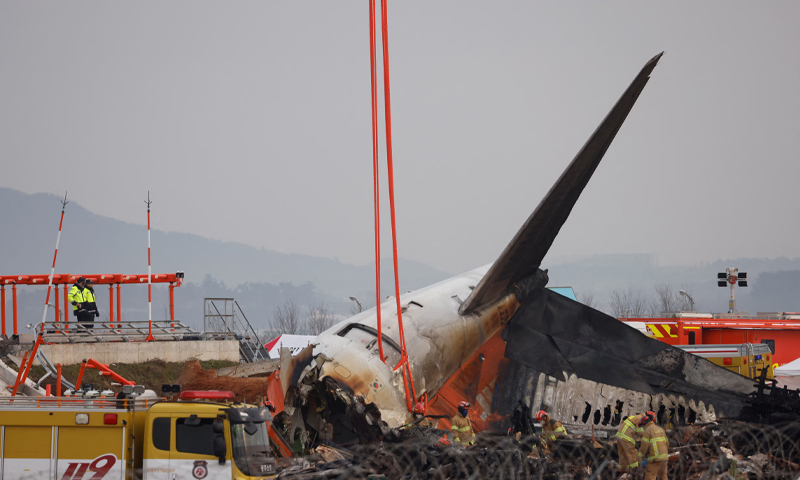
The plane was attempting to land at Muan Airport when it experienced a critical failure. After issuing a mayday call, the aircraft made a belly landing, skidding along the runway before crashing into a barrier and bursting into flames. Here’s a detailed overview of the crash, the aftermath, and the ongoing investigation.
What Happened on Jeju Air Flight 2216?
The Boeing 737-800 aircraft, operated by the low-cost carrier Jeju Air, was en route from Bangkok, Thailand to Muan Airport in South Korea. Shortly after 9:00 AM, during its first landing attempt, the aircraft was warned about a potential bird strike by air traffic control. Minutes later, the pilot issued a mayday call and attempted to land again.
Video footage from the scene shows the plane attempting a belly landing, its landing gear still retracted. The plane skidded along the runway with smoke trailing behind before crashing into a wall at the runway’s end. The collision sparked a massive fire.
Casualties and Survivors
Tragically, 175 passengers and four of the six crew members lost their lives in the crash. The passengers, who ranged in age from three to 78, were mostly South Korean nationals, with two Thai citizens also among the victims.
Despite the devastating loss of life, two flight attendants, aged 25 and 33, survived the crash. They were rescued from the wreckage in critical condition and were immediately taken to the hospital for treatment.
Investigations Underway: Causes of the Crash
As authorities begin their investigation, the primary focus is on the possible causes of the crash. The plane was reportedly warned of a bird strike before its final attempt to land. Bird strikes, where birds collide with aircraft, can be hazardous, potentially causing damage to engines or other critical parts. The International Civil Aviation Organization (ICAO) has acknowledged the danger bird strikes pose, especially when large birds are involved.
Aviation consultant Philip Butterworth-Hayes suggested that the crash was likely the result of multiple catastrophic failures. He emphasized that crash protection systems on modern aircraft are extremely robust, making this crash one of the most serious incidents in recent years.
Preliminary reports indicate that the runway at Muan Airport, measuring 2,800 meters (9,200 feet) in length, was not a contributing factor, as it has been used without issue by similar-sized aircraft in the past.
What is a Bird Strike?
A bird strike occurs when an aircraft collides with a bird or birds during flight. This can lead to various issues, such as engine failure or significant damage to the aircraft’s structure. While bird strikes are rare, they can be catastrophic when large birds hit sensitive areas like engines. The famous 2009 “Miracle on the Hudson” incident, in which a US Airways flight ditched in the Hudson River after a bird strike, is one of the most well-known examples of such a failure.
In this case, authorities are considering the possibility that a substantial bird strike caused a loss of engine power, contributing to the crash.
Rescue Efforts and Response
Upon receiving the mayday call, emergency responders, including firefighters and military personnel, were quickly deployed to the scene. Hundreds of rescue workers were involved in trying to extricate survivors from the wreckage. The crash site was designated a special disaster zone by South Korea’s acting president, who also visited the area to assess the damage and oversee the recovery efforts.
South Korea Reacts: A Nation in Mourning
This devastating crash has taken place amid a tumultuous political climate in South Korea. Following the impeachment of President Yoon Suk Yeol earlier in December, the country’s acting president, Choi Sang-mok, convened an emergency meeting and visited the crash site.
The nation is now in the midst of a seven-day mourning period as citizens reflect on the lives lost in the disaster. Many family members of the victims, who were mostly passengers returning from a wedding ceremony, have been left grieving the untimely deaths of loved ones.
South Korea’s Aviation Safety Record
South Korea has a strong aviation safety record, and this crash marks the first fatal accident for Jeju Air. Jeju Air previously had a close call in 2007 when strong winds caused one of its aircraft to veer off the runway, injuring a dozen people.
The deadliest air disaster on South Korean soil occurred on April 15, 2002, when an Air China Boeing 767 crashed near Busan-Gimhae, killing 129 people. The most recent fatal crash involving a South Korean airline took place on July 6, 2013, when Asiana Airlines’ Boeing 777 crashed in San Francisco, killing three and injuring 182.
