
Table of Contents
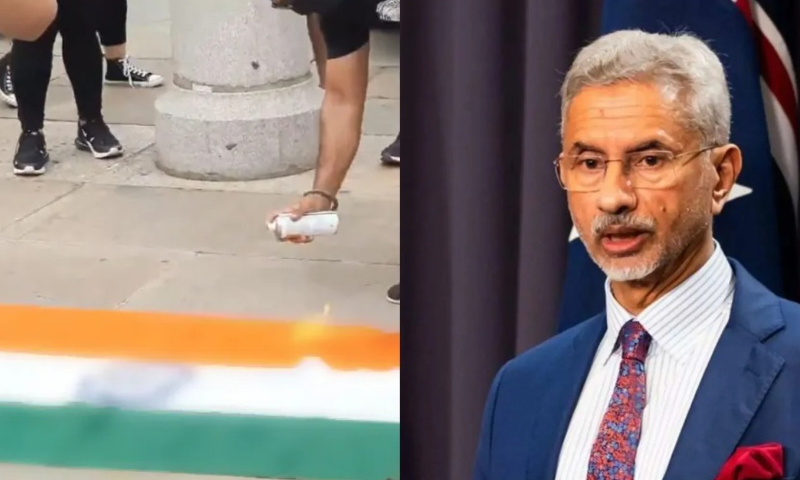
On Thursday, India strongly condemned a security breach that occurred during Foreign Minister Subrahmanyam Jaishankar’s ongoing visit to London. A protester broke through a police cordon and stood in front of the minister’s car, where they tore the Indian flag before being quickly apprehended by the police. The incident took place outside Chatham House, a renowned think tank, where Jaishankar had been speaking earlier that day.
The Indian Ministry of External Affairs expressed its dissatisfaction with the event, calling it a direct violation of diplomatic norms. The ministry’s spokesperson, Randhir Jaiswal, stated, “We deplore the misuse of democratic freedoms by such elements” and further emphasized that India expects the British government to uphold its diplomatic obligations, especially in ensuring the security of visiting foreign dignitaries.
Protesters from the Khalistan Movement
The protest was organized by a small group of individuals associated with the Khalistan movement, a Sikh separatist movement that advocates for the creation of a separate Sikh homeland within India. The protestors were seen waving Khalistan flags and shouting slogans, a display that has been a source of tension between India and various countries, including Canada and the UK, where supporters of the movement have been active.
Trump’s Bold Greenland Statement: A Strategic Push for Control
Videos posted on social media showed the protesters gathered outside Chatham House, where Jaishankar was delivering a speech. The protest became more intense as one of the demonstrators managed to breach the police lines, disrupting the foreign minister’s departure. The individual was swiftly detained by the police, and the situation was brought under control.
Diplomatic Tensions and India’s Stance on Khalistan Movement
The Khalistan movement remains a significant point of contention between India and some of its diaspora communities, particularly in countries with large Sikh populations like the UK and Canada. India views the Khalistan movement as a security threat and a challenge to its sovereignty, often leading to diplomatic strains when protests or demonstrations take place in foreign countries.
In April 2023, following a similar incident in which Khalistan supporters removed the Indian flag from India’s diplomatic mission in London, India requested that the British government increase monitoring of the Khalistan movement’s supporters in the UK. India has consistently pushed for stronger action against groups advocating separatism and violence related to the Khalistan cause.
Jaishankar’s Visit and Its Significance
Jaishankar is currently on a six-day trip to the United Kingdom and Ireland, where he is engaging in diplomatic talks on various issues. The security breach in London comes as part of his broader visit, which has already seen discussions on important topics such as bilateral relations, trade, and international security.
While the protest incident has captured attention, the Indian government is also focused on the broader goals of strengthening ties with the UK. As Jaishankar continues his tour, India will likely press for stronger diplomatic cooperation on countering separatist movements that threaten India’s internal stability.
UK Response and Diplomatic Obligations
The British Foreign Office has not yet issued a public statement in response to India’s condemnation. However, such incidents of security breaches involving foreign dignitaries are rare and typically prompt reviews of security arrangements by the host government. India’s call for Britain to “fully live up to their diplomatic obligations” reflects growing concerns over the treatment of Indian diplomatic personnel and the security of foreign officials in the UK.
The Broader Context of India-Khalistan Relations
The Khalistan movement has long been a source of tension for India, especially given its violent history in the 1980s and the continuing efforts by some factions to rekindle the movement. While the majority of Sikhs in India and abroad do not support the movement, the presence of vocal supporters in countries like the UK and Canada has led to diplomatic challenges. The Indian government has frequently voiced concerns about the activities of Khalistani separatists in foreign nations and has called for stronger actions against them.
The incident in London adds to the diplomatic pressure India faces in dealing with the separatist movement while also trying to maintain good relations with countries that have significant Sikh populations. The challenge for both India and the UK is finding a balance between respecting freedom of speech and assembly while ensuring the safety and security of visiting diplomats.
