
Table of Contents
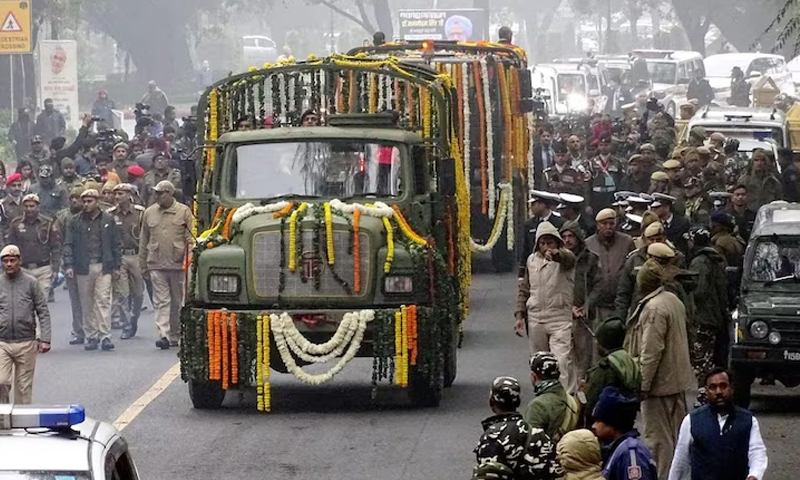
The mortal remains of Manmohan Singh, former Prime Minister of India, were cremated with full state honours on Saturday at the Nigambodh Ghat, located along the banks of the Yamuna River in New Delhi. Singh’s funeral followed Sikh traditions, with priests chanting hymns as his body, draped in the Indian flag, was carried through the city in a flower-decked carriage. The flag was removed, and his body was covered with saffron cloth before being placed on the pyre.
A Life Marked by Wisdom and Service
Manmohan Singh, who passed away on Thursday at the age of 92, was remembered for his distinguished tenure as Prime Minister of India from 2004 to 2014. He led the country through a period of significant economic growth, including liberalizing India’s economy in the early 1990s, which earned him the title of the architect of India’s economic reforms. However, despite his achievements, Singh’s leadership was often perceived as weak, particularly during his second term, leading him to remark in 2014, “history will be kinder to me than the contemporary media.”
Singh was also known for his quiet, unassuming demeanor and commitment to integrity and public service. His contributions spanned not only the national economic landscape but also international diplomacy, especially with his role in securing a historic nuclear deal with the United States.
Political and Global Tributes
Prime Minister Narendra Modi, who succeeded Singh in 2014, attended the funeral and described the former Prime Minister as one of India’s “most distinguished leaders.” President Droupadi Murmu also paid her respects, and both leaders expressed deep admiration for Singh’s service to the nation.
Representatives from various nations, including the United States, Canada, France, Sri Lanka, China, and Pakistan, sent condolences, highlighting Singh’s international contributions. U.S. President Joe Biden lauded Singh as a “true statesman” who charted “pathbreaking progress” that will continue to benefit India and the world.
A Legacy of Education and Economic Reform
Born in 1932 in the village of Gah, now in Pakistan, Singh’s early life was marked by his pursuit of education. He earned scholarships to Cambridge and Oxford, where he studied economics. Throughout his career, Singh held significant roles, including as Governor of the Reserve Bank of India and various posts with international organizations such as the United Nations. In 1991, he was appointed India’s Finance Minister, where he played a pivotal role in steering the nation through an economic crisis and initiating market reforms that set the stage for India’s future growth.
Though Singh had never been elected to office before being appointed as the Congress Party’s candidate for Prime Minister in 2004, he led India to its highest growth rate in nearly a decade, with the economy expanding at an average of 9% per year during his tenure. His efforts to liberalize the economy, implement critical reforms, and enhance India’s global standing marked him as one of the key figures in India’s modern history.
Personal Losses and Family Support
Singh is survived by his wife, Gursharan Kaur, and three daughters. Congress leader Rahul Gandhi, who referred to Singh as a “mentor and guide,” accompanied Singh’s family during the funeral procession. Gandhi praised Singh’s leadership and integrity, reflecting the deep respect he had earned across party lines.
A Mark of Humility and Service
President Droupadi Murmu encapsulated the nation’s view of Singh’s legacy, saying that he would “always be remembered for his service to the nation, his unblemished political life, and his utmost humility.” Manmohan Singh’s passing marks the end of an era in Indian politics, but his contributions to the nation’s economic and political landscape will continue to shape India for generations to come.
