
Table of Contents
NEW DELHI/ISLAMABAD – Indian Prime Minister Narendra Modi has granted the country’s military “complete operational freedom” to respond to the Pahalgam attack that killed 26 civilians in Indian Illegally Occupied Jammu and Kashmir (IIOJK) on April 22. The order was confirmed by a senior Indian government official to AFP on Tuesday.
The development comes as tensions between nuclear-armed India and Pakistan surge to alarming levels. Despite not presenting any public evidence, India has blamed Pakistan for orchestrating the deadly assault, prompting an aggressive shift in posture from New Delhi.
Military Given Go-Ahead to Decide Targets and Timing
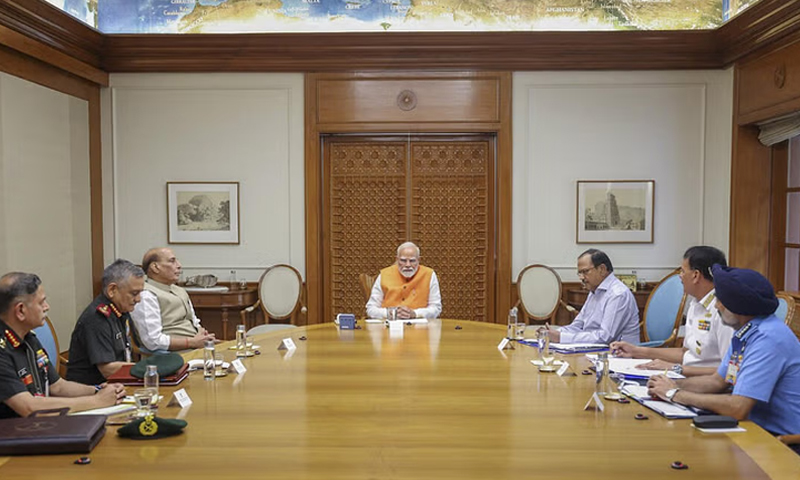
In a high-level closed-door meeting, Modi instructed top military and security chiefs to decide independently the “mode, targets, and timing” of a retaliatory response. The Indian government later released footage of the meeting, showing a resolute Modi alongside Defence Minister Rajnath Singh and senior military officials.
Meanwhile, cross-border firing has continued nightly along the Line of Control (LoC), with India accusing Pakistan of initiating “unprovoked” fire. In response, Pakistan’s military shot down two Indian drones allegedly violating its airspace — an incident that had yet to draw an official response from India at the time of writing.
UN Urges Restraint Amid Fears of Escalation
Amid rising regional alarm, UN Secretary-General António Guterres made separate calls to Pakistan Prime Minister Shehbaz Sharif and Indian Foreign Minister S. Jaishankar to express “deep concern” over the deteriorating situation.
During his conversation, Shehbaz Sharif condemned terrorism in all forms, but categorically rejected India’s accusations as “baseless.” He demanded an independent and transparent investigation into the Pahalgam attack, warning against India’s “pattern of blaming Pakistan without evidence.”
Sharif also criticized what he called India’s weaponisation of water resources, stating it poses an existential threat to the 240 million Pakistanis who depend on shared rivers. “Pakistan will defend its sovereignty with full force against any Indian misadventure,” he said, urging the UN chief to counsel India toward restraint.
CCI Rejects New Canal Construction Plan, Seeks Consensus Among Provinces
Guterres praised Pakistan’s calls for peace and warned of the grave global consequences should a military escalation between the two nuclear-armed states occur.
DG ISPR Presents “Irrefutable” Evidence of Indian-Backed Terrorism
In Islamabad, DG ISPR Lieutenant General Ahmed Sharif Chaudhry held a press conference presenting what he described as “irrefutable evidence” of Indian-sponsored terrorism inside Pakistan. According to Chaudhry, Indian military officers have been directing cross-border terror operations, supplying explosives, and funding militants.
He claimed the Indian army was directly involved in a terror network operating within Pakistan, and accused India of trying to portray Pakistan as a global hub of terrorism while engaging in covert attacks on Pakistani soil.
Chaudhry emphasized that despite India’s accusations over the Pahalgam attack, no evidence had been presented even after a full week. “This is one small part of India’s state-sponsored terrorism,” he said.
Fears of a 2019 Pulwama-Like Crisis
The current situation echoes the 2019 Pulwama crisis, where a deadly bombing in Kashmir led to retaliatory airstrikes by both nations and brought them close to war. Modi’s recent rhetoric, including vows to “pursue terrorists to the ends of the Earth,” has raised fears of a similar or even more dangerous confrontation.
India Issues Wanted Posters, Makes Arrests
Indian authorities have released wanted posters for three suspects in connection with the Pahalgam attack — two Pakistanis and one Indian. A bounty of ₹2 million ($23,500) has been placed on each of them. Security forces have also begun a sweeping crackdown in Kashmir, making numerous arrests and conducting extensive raids.
As the standoff intensifies, the region — and the world — watches with concern, wary of missteps that could trigger a wider and potentially catastrophic conflict between two of the world’s most heavily armed neighbors.
