
Table of Contents
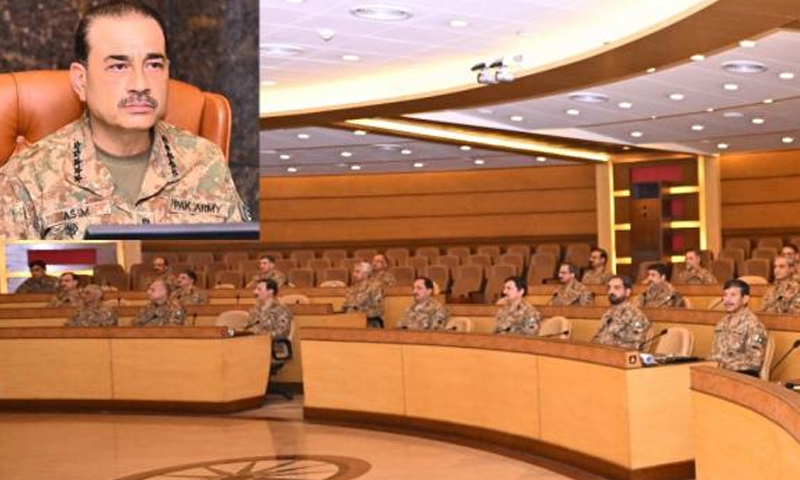
In the wake of a devastating terrorist attack in Khuzdar, Balochistan, that killed six civilians—four of them children—Pakistan’s military leadership has issued a powerful response. During the 270th Corps Commanders’ Conference (CCC) held at the General Headquarters in Rawalpindi, Chief of Army Staff Field Marshal Syed Asim Munir and the military’s top brass pledged to “dismantle and decimate” all terrorist proxies and facilitators, particularly those allegedly supported by India.
Condemnation of a “Barbaric Act”
The Inter-Services Public Relations (ISPR), the military’s media wing, confirmed that the conference began with Fateha (prayers) for the victims of the Khuzdar attack as well as martyrs of Operation Bunyan-um-Marsoos. The statement unequivocally condemned the deliberate targeting of civilians, especially children, calling it a “reprehensible violation” of international laws and human decency.
The ISPR asserted that the attack was conducted by India-sponsored elements, trained and financed to create chaos in Pakistan’s restive regions.
India Accused of Escalating Regional Instability
The military forum pointed directly at India’s intelligence and covert operations, blaming New Delhi for sponsoring non-state actors and terrorist proxies in Balochistan and Khyber Pakhtunkhwa (KP). It described India as the “epicenter of regional instability,” particularly in the aftermath of its military failures following the Pahalgam incident in Indian Illegally Occupied Jammu and Kashmir (IIOJK).
India has continued to portray itself as a victim of terrorism, the forum noted, while it actively engages in subversive operations beyond its borders. The statement said such dual-faced diplomacy aims to destabilize Pakistan from within.
Aftermath of the Pahalgam Incident and Retaliatory Strikes
Last month’s Pahalgam attack, which left 26 Indian tourists dead, significantly escalated tensions. India immediately blamed Pakistan without presenting evidence and proceeded to launch missile and drone attacks that killed 53 people in Pakistan, including 13 armed forces personnel and 40 civilians.
In response, Pakistan initiated a powerful counteroffensive, Operation Bunyan-um-Marsoos, which saw:
- Over 80 Indian drones shot down,
- Six Indian Air Force jets, including three Rafales, destroyed,
- Precision strikes on multiple Indian military installations.
These actions were described by Pakistani officials as “proportionate and strategic,” aimed at neutralizing Indian aggression while avoiding harm to civilians.
Ceasefire and Recognition of Sacrifices
The conflict between the two nuclear-armed neighbors raged for nearly 87 hours, finally ceasing on May 10 following mediation by the United States. During the CCC, the military leadership paid tribute to the martyrs of the recent clashes, calling the operation part of “Marka-e-Haq”—a decisive campaign to uphold Pakistan’s territorial integrity.
Field Marshal Asim Munir gets Baton of Field Marshal
“The sacred blood of our martyrs shall not go in vain,” the statement read. “We will not allow externally-sponsored terrorism to sabotage the peace and stability of our homeland.”
Strategic Review and Regional Security
The forum conducted an in-depth assessment of Pakistan’s security posture along the Line of Control (LoC), the Working Boundary, and the Eastern Border. Commanders reviewed regional dynamics and expressed grave concern over continued human rights violations in IIOJK.
The army leadership called for urgent international attention to India’s actions in Kashmir, warning that prolonged repression will only lead to further unrest and backlash. It reiterated Pakistan’s full diplomatic and moral support to the Kashmiri people’s struggle for self-determination.
Tribute to National Institutions and Unity
The military leadership commended the:
- Operational readiness and high morale of Pakistan’s armed forces,
- Support from the public, media, and political leadership during the conflict,
- Role of youth in energizing national unity,
- Contributions of Pakistan’s information warriors in countering Indian propaganda.
The forum extended special congratulations to Field Marshal Asim Munir on his elevation, lauding his strategic foresight and leadership during a critical phase in national defence.
Reaffirming National Sovereignty and Deterrence
In a strong message to the international community and regional adversaries, the CCC declared:
“No one can coerce Pakistan through the use or threat of force. The nation will take all measures necessary to safeguard its vital interests.”
The leadership emphasized that Pakistan’s sovereignty is non-negotiable and that any aggression will be met with strategic clarity and operational decisiveness.
Field Marshal Munir directed all commanders to maintain heightened vigilance, citing evolving hybrid threats and the need for constant readiness. He reaffirmed the army’s role as a pillar of national stability and protector of public trust.
