
Table of Contents
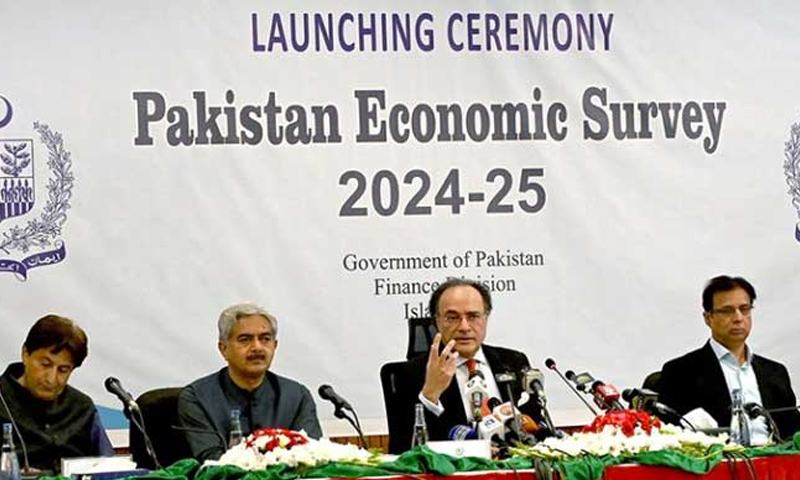
Federal Finance Minister Muhammad Aurangzeb on Monday presented the Pakistan Economic Survey 2024–25, revealing that the Gross Domestic Product (GDP) grew by 2.7%, while inflation eased significantly to 4.6% over the outgoing fiscal year. The announcement, made on the eve of the federal budget presentation, provides critical insights into the country’s socio-economic health.
Aurangzeb outlined that Pakistan is “moving in a better direction” and highlighted broad progress in multiple sectors, from agriculture and IT exports to tax revenue and remittances.
Survey Offers Strategic Insight Ahead of Federal Budget
The economic survey offers a consolidated snapshot of Pakistan’s fiscal and macroeconomic landscape, including data on trade, public debt, tax revenues, employment, population growth, and climate change impact. This document is key in guiding budgetary decisions and influencing policy planning.
“This survey provides a roadmap of where we are and where we need to go,” Aurangzeb said, stressing the importance of structural reforms.
Monetary Policy Eases as Inflation Recedes
Pakistan’s headline CPI inflation averaged 4.7% from July 2024 to April 2025, with April inflation dipping to a historic 0.3%, marking one of the lowest readings in recent decades.
The State Bank of Pakistan (SBP), responding to easing price pressures, cut the policy rate sharply from 22% in June 2024 to 11%, marking a reduction of 1,100 basis points. The KIBOR (Karachi Interbank Offered Rate) also fell to 11.3%.
This policy easing reflects controlled price dynamics, a sharp contrast to the global inflation trend, which Aurangzeb said averaged 6.8% in the past two years.
Revenue Growth and Deficit Management
The fiscal front showed promising signs of recovery. Total revenues surged 36.7% to Rs13,367 billion during July–March FY2025. Of this:
- Tax revenues rose by 26.3% to Rs9,300.2 billion
- Non-tax revenues soared by 68% to Rs4,229.7 billion
Notably, the Federal Board of Revenue (FBR) matched the overall tax collection figure at Rs9,300.2 billion. The fiscal deficit narrowed to 2.6% of GDP, while the primary balance posted a surplus of Rs3,468.7 billion, equating to 3% of GDP.
Eidul Azha: Experts Urge Red Meat Moderation for a Healthier Celebration
The finance minister commended the FBR’s reforms and remarked that while economic transformation takes time, significant steps have been taken.
Remittances and Current Account Strengthen
Remittance inflows proved a major contributor to economic stability. From July 2024 to April 2025, remittances rose to $31.2 billion, a 31% increase year-on-year from $23.8 billion.
This helped push the current account into a surplus of $1.9 billion, reversing a longstanding deficit trend. Aurangzeb noted that in just two years, remittances grew by $10 billion, reflecting stronger inflows from overseas Pakistanis and improved formal banking channels.
Trade and IT Sector Expansion
Pakistan’s exports grew by 7%, while imports increased by 11.7%, indicating rising trade activity. While this widened the trade gap slightly, the current account remained in surplus due to record remittances and improved services exports.
The Information Technology (IT) sector continued to flourish. Aurangzeb stated that IT exports reached $2.8 billion, and freelancers earned $400 million independently—showing growing digital entrepreneurship and services exports potential.
Agriculture and Livestock Mixed Performance
The agriculture sector posted modest growth of 0.56%, but performance varied widely within sub-sectors:
- Important crops declined by 13.49%
- Cotton ginning fell by 19.03%
- However, livestock grew by 4.72%
- Other crops increased by 4.78%
This suggests that while traditional crop production struggled, livestock and diversified crops offered some resilience in the face of climate-related challenges.
Long-Term Outlook and Reform Agenda
Looking ahead, Finance Minister Aurangzeb projected a GDP growth of 5.7% over the medium term, aligning Pakistan’s trajectory with global recovery trends. He praised the caretaker government for maintaining the IMF programme, which provided fiscal discipline and external financing stability.
He reiterated the government’s commitment to “changing the DNA” of Pakistan’s economy through structural reforms, especially targeting tax net expansion and digital transformation.
“Economic transformation requires two to three years. We’re laying the foundation now,” Aurangzeb stated.
