
Table of Contents
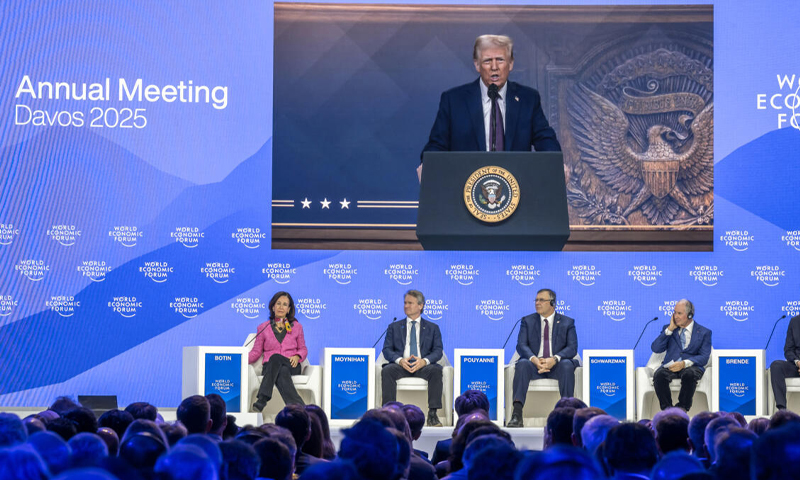
At the World Economic Forum in Davos, Switzerland, on Thursday, U.S. President Donald Trump made his first address to global business and political leaders since his presidency began. His video conference speech, delivered at the onset of his four-day presidency, centered around his economic vision and policy agenda, focusing on lowering global oil prices, cutting interest rates, and reducing taxes. Trump also renewed his threats of tariffs on products imported from abroad, highlighting concerns about the U.S. trade deficit with allies such as Canada and the European Union.
Trump Calls for Lower Oil Prices and Interest Rates
Trump was unequivocal in his demands for both global oil prices and interest rates to be reduced. “I’ll demand that interest rates drop immediately. And likewise, they should be dropping all over the world,” he declared. In a bold move, he also expressed intentions to ask Saudi Arabia and OPEC to lower oil prices, which he suggested would benefit global economic stability. His comments came amid market volatility, as oil prices turned negative and the euro dipped, with the U.S. dollar fluctuating between gains and losses.
This speech was viewed as Trump’s opening salvo in addressing the economic strategies he intends to pursue, which could potentially influence the global economy. His call for interest rate cuts and oil price reductions represents a significant shift in U.S. economic policy, reflecting his ongoing efforts to push for more aggressive measures to lower costs for American consumers and businesses alike.
Tensions with Allies and Trade Deficit Concerns
Trump directed some of his sharpest criticism toward traditional U.S. allies, notably Canada and the European Union. He threatened both nations with new tariffs, specifically pointing to the trade imbalance between the U.S. and Canada. “We have a tremendous deficit with Canada. We’re not going to have that anywhere,” he said, signaling his intent to take action on trade issues. This rhetoric is part of Trump’s broader strategy to address the U.S. trade deficit and to demand that other nations respect American economic interests.
His remarks regarding trade imbalances are part of his ongoing stance that the U.S. has been treated unfairly in global trade deals. The prospect of tariffs being imposed on allies has created uncertainty in international markets, especially as Trump’s administration appears poised to enact broad tariffs on imported goods, potentially starting as soon as February 1.
A Commitment to U.S. Energy and Manufacturing Supremacy
Trump’s speech also focused heavily on U.S. energy policies. He reaffirmed his administration’s commitment to expanding domestic oil and gas production, declaring that the U.S. has the largest reserves of fossil fuels globally. “We’re going to use it,” Trump said, referring to these resources as a key element in strengthening the U.S. economy. He argued that tapping into domestic energy resources would not only reduce costs for consumers but also make the U.S. a dominant player in global manufacturing.
The president’s remarks on energy reflected his broader vision of American economic resurgence, one that emphasizes deregulation, tax cuts, and an energy policy that prioritizes domestic production. Trump’s approach stands in contrast to global climate change policies, which he has consistently criticized and opposed during his presidency.
Criticism of Predecessor Joe Biden and Davos Policies
As expected, Trump used the Davos platform to criticize the policies of his predecessor, Joe Biden, and the global consensus on issues like climate change. He rejected climate-related policies that have dominated discussions at Davos for years, including efforts to reduce carbon emissions. Former U.S. Secretary of State John Kerry, who served under Biden, visibly reacted to Trump’s criticism, underscoring the tension between the two leaders on environmental issues.
Trump’s skepticism of climate change initiatives was just one aspect of his broader critique of global policies, which he framed as harmful to U.S. interests. He also dismissed the so-called “Green New Deal” in the U.S., claiming that it had been repealed under his administration, despite the fact that such a proposal has never been enacted.
Global Business Leaders React to Trump’s Speech
The speech drew attention from influential business leaders in attendance, including Bank of America CEO Brian Moynihan, Blackstone Group CEO Stephen Schwarzman, and TotalEnergies CEO Patrick Pouyanne. Executives from various industries were eager to hear more about Trump’s concrete plans on tariffs, especially given his earlier threats of broad import duties on goods from China, Mexico, Canada, and the European Union.
The World Economic Forum’s annual gathering allowed Trump to directly address some of the most influential figures in business and politics. His comments, particularly on tariffs and energy production, were met with both interest and concern, as these policies could reshape global trade relations.
Trump’s Other Bold Actions and Controversies
Trump also touched on a variety of other issues during his speech, including his administration’s stance on immigration, tax policies, and technology. His efforts to deregulate industries, combined with his push for the U.S. to become a global leader in artificial intelligence and cryptocurrencies, suggest a broader economic agenda aimed at reshaping both domestic and international markets.
However, Trump’s remarks were not without controversy. He repeated some false claims from his first term, including his assertion that the U.S. had the cleanest air and water during his administration, a claim that has been widely debunked. Additionally, his decision to pardon over 1,500 individuals involved in the January 6th Capitol attack has sparked outrage among lawmakers and law enforcement officials.
Trump’s Future Plans and Challenges Ahead
As Trump continues to lay out his vision for the U.S. economy, business leaders and global political figures are keenly watching for more concrete details on his tariff plans and the direction of U.S. economic policy. The president’s aggressive stance on trade and energy production will undoubtedly shape the economic landscape in the coming months. However, his confrontational approach to global trade, coupled with his controversial domestic policies, raises significant questions about the future of international relations and the U.S.’s role on the world stage.
