
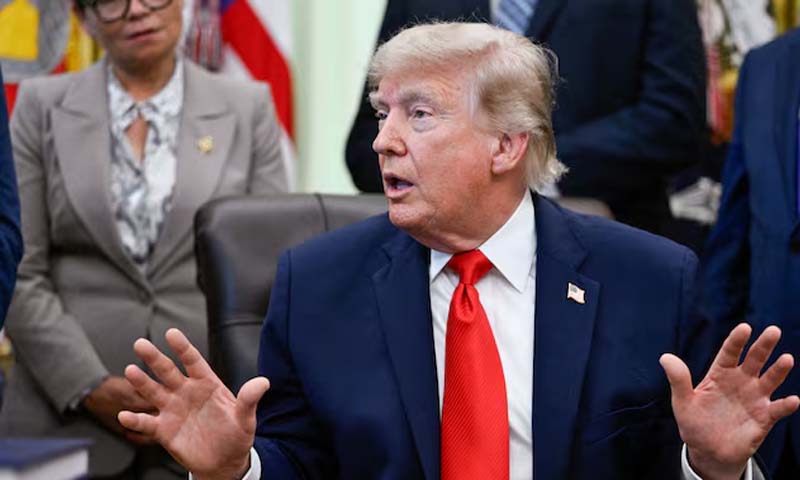
EVIAN-LES-BAINS: US President Donald Trump on Tuesday reiterated that the interim understanding reached with Iran sends an unequivocal message that Tehran will not be permitted to develop nuclear weapons, as diplomatic preparations continue for formal negotiations in Switzerland later this week.
Speaking to reporters on the sidelines of the G7 summit in France, where he met Qatar’s Emir Sheikh Tamim bin Hamad Al Thani, Trump strongly defended the 14-point memorandum of understanding with Iran, the details of which have not yet been made public.
“The only thing that really matters to me is Iran will never have a nuclear weapon, and it says it loud and clear,” Trump said, warning that “all hell will rain down” if Tehran attempted to pursue nuclear arms capability.
He said the agreement acts as a “firm barrier” against nuclear proliferation, contrasting it with earlier international arrangements. “This deal is a wall to a nuclear weapon. The previous deal was a road to a nuclear weapon,” he said, referring to the 2015 accord negotiated under former president Barack Obama, which the US later exited during Trump’s first term.
Trump added that under the current framework, Iran would be prevented from achieving nuclear weapons capability, saying, “They can’t have a nuclear weapon. If they try, they get blown up,” underscoring his administration’s hardline stance.
US and Iranian negotiators are scheduled to meet in Switzerland on Friday, marking the beginning of a 60-day period of detailed technical discussions. The talks are expected to focus on key issues including Iran’s stockpile of highly enriched uranium, sanctions relief, and verification mechanisms.
European allies have reportedly expressed concern over the US negotiating team’s experience level, warning that insufficient diplomatic depth could complicate efforts to reach a durable agreement. Analysts note that Iran’s negotiating strategy in past nuclear talks has often involved prolonged bargaining tactics aimed at gaining leverage and time.
Beyond the nuclear file, Trump also commented on wider Middle East tensions, particularly in Lebanon. He criticized aspects of Israel’s current approach and suggested that Syria could play a more effective role in addressing Hezbollah’s presence.
“I suggested to Israel to let Syria take care of Hezbollah because to be honest, I think they do a better job of doing it,” he said.
Diplomatic observers say the success of the interim agreement will depend not only on nuclear-related commitments but also on broader regional tensions. With negotiations about to enter a critical phase in Switzerland, officials on both sides face the challenge of translating a broad political understanding into a detailed and enforceable agreement within a limited timeframe.
