
Table of Contents
In a move that has sparked legal and human rights concerns, hundreds of immigrants, allegedly linked to the Venezuelan Tren de Aragua gang, have been deported from the United States to El Salvador’s notorious Terrorism Confinement Center (CECOT). This action, despite a federal judge’s temporary order halting the deportations, marks a significant escalation of President Donald Trump’s immigration crackdown.
The deportees, detained under Trump’s invocation of the Alien Enemies Act of 1798, were transferred as part of a $6 million agreement between the US government and El Salvador. While this arrangement was hailed by the Trump administration as a way to tackle gang violence, it has drawn significant criticism for its legal justification and the conditions faced by the detainees upon their arrival.
Why Were the Immigrants Deported?
The mass deportations of immigrants, many of whom were allegedly associated with the Tren de Aragua gang, took place under the invocation of the Alien Enemies Act. This 18th-century wartime law allows the president to expel or detain foreign nationals if the country is considered to be at war. Historically, this law has been used only three times in US history, and its use in this context raises questions about its legal application.
Trump defended the deportations, claiming that the Tren de Aragua gang was “invading” the United States and that the deportations were necessary to protect the country. However, critics argue that no substantial evidence has been provided linking the detained immigrants to the criminal organization. Furthermore, the US government has not disclosed any specific crimes committed by the deported individuals, leading to widespread concerns about the fairness and transparency of the deportation process.
The Tren de Aragua gang, which originated in Venezuela’s lawless prison system, has expanded its operations throughout Latin America and is believed to be involved in a range of criminal activities, including extortion, drug trafficking, and human trafficking. However, the vast majority of Venezuelans who have migrated to the United States in recent years have been fleeing the country’s economic collapse and political instability, not engaging in criminal activity.
Why El Salvador?
The deported immigrants were sent to El Salvador, where they are being held in CECOT, a mega-prison with a capacity of up to 40,000 inmates. This prison, part of President Nayib Bukele’s harsh anti-crime strategy, is known for its brutal conditions, and the decision to send the detainees there, rather than back to Venezuela, has sparked controversy.
Under the agreement between the US and El Salvador, the detainees will remain in CECOT for one year, after which their fate remains unclear. Critics argue that deporting individuals to a country where they have no legal ties is both morally and legally questionable. Many believe that deporting them back to Venezuela, where they hold citizenship, would have been more appropriate.
Inside CECOT: Harsh Conditions Await the Detainees
CECOT, located in Tecoluca, El Salvador, has garnered international criticism due to its harsh treatment of inmates. The prison is known for its severe conditions, including overcrowding, lack of basic services, and no access to rehabilitation programs. Detainees at CECOT are not allowed visitors, cannot leave their cells for outdoor activities, and are denied any form of educational or vocational training.
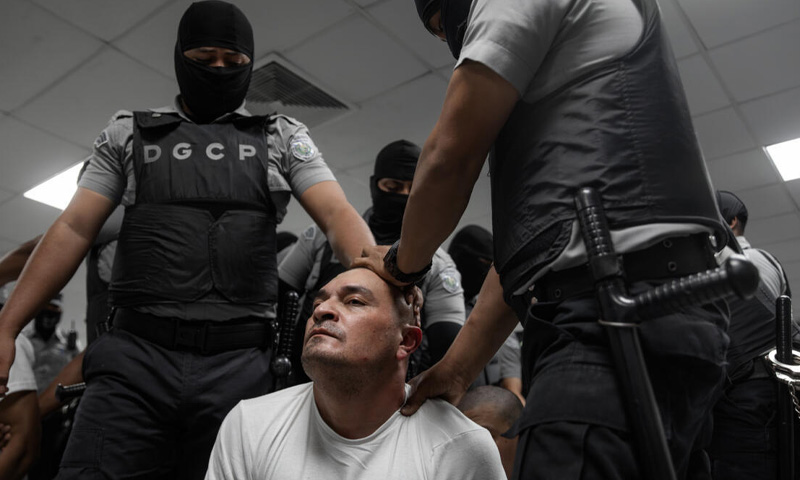
Footage released by the El Salvador government showed the new arrivals at CECOT shackled and escorted by riot police. Upon their arrival, the detainees were forced to kneel, had their heads shaved, and were given identical white uniforms. These images, along with reports of overcrowded cells—where up to 70 prisoners may be confined in a single unit—underscore the extreme conditions the detainees face.
The government of El Salvador, under President Bukele, has defended the prison’s operation, claiming that it is a necessary measure to combat the country’s gang violence. However, human rights groups have raised alarms about the potential for abuse, torture, and neglect of detainees in the facility.
The Transport of Detainees: A Military Operation
The transfer of the detainees to El Salvador was conducted under heavy security, with a large convoy of buses, military vehicles, and helicopters accompanying the prisoners to the prison. Footage released by the El Salvador government showed the detainees being escorted in shackles, forced to walk bent forward with their heads pushed down by officers.
Tragic Fire at North Macedonia Nightclub Kills 59, Injures 155
This display of force has drawn criticism for its harshness, with human rights advocates calling it a violation of the dignity of the individuals involved. The images have sparked a broader debate about the ethical implications of forcibly deporting people under such conditions, particularly when their alleged crimes have not been substantiated.
Human Rights Concerns and Legal Questions
The mass deportations have ignited a firestorm of controversy, with human rights organizations warning that the detainees may be subjected to inhumane treatment in El Salvador’s prison system. Critics argue that the deportations are a violation of international human rights standards, particularly because the detainees have not been provided with clear evidence of their criminal activity.
Furthermore, the legality of invoking the Alien Enemies Act to deport individuals who are not engaged in war remains questionable. Legal experts have pointed out that the Venezuelan migration crisis, while serious, does not constitute a state of war between the US and Venezuela, raising concerns about the overreach of the Trump administration’s immigration policies.
What’s Next for the Detainees?
The one-year detention agreement between the US and El Salvador leaves many unanswered questions about what will happen to the detainees once the year is up. Human rights groups have expressed concerns that the detainees may face indefinite detention, with no clear pathway for release or reintegration into society.
As the situation continues to unfold, it remains to be seen whether other countries will enter similar agreements with the US to hold foreign detainees. The move to deport individuals to foreign prisons, rather than repatriating them to their home countries, could set a troubling precedent for future immigration policies.
