
Table of Contents
China has made a bold move in the global race to dominate the robotics sector by launching RoboBrain 2.0, a next-generation open-source artificial intelligence model. Developed by the Beijing Academy of Artificial Intelligence (BAAI), the model was unveiled at the organization’s annual conference in the capital city, drawing attention from AI and robotics leaders worldwide.
Described by BAAI Director Wang Zhongyuan as “the world’s most powerful open-source AI model designed specifically for robotics,” RoboBrain 2.0 is poised to transform the field of embodied intelligence — the emerging domain where AI meets physical machines.
Major Technical Upgrades: Smarter, Faster, and More Accurate
RoboBrain 2.0 represents a dramatic improvement over its predecessor released just three months prior. According to BAAI, the new version offers:
- 17% faster processing speed, ensuring quicker decision-making for real-time applications.
- 74% higher task accuracy, enhancing reliability across dynamic, real-world environments.
- Advanced spatial perception, enabling robots to interpret surroundings, gauge distances, and move more intelligently.
- Sophisticated task decomposition, allowing robots to break down complex instructions into smaller, manageable steps for autonomous execution.
These improvements could drastically improve performance in tasks ranging from household assistance to industrial automation and elderly care.
Part of the Broader Wujie AI Ecosystem
RoboBrain 2.0 is not a standalone achievement. It is part of BAAI’s ambitious Wujie model suite, a comprehensive framework aimed at revolutionizing robotic intelligence. Key components of the suite include:
- RoboOS 2.0: A cloud-based operating system that allows seamless deployment and scaling of AI capabilities across robotic platforms.
- Emu3: A powerful multimodal model that integrates text, images, and video for broader human-like understanding and interaction.
Together, these tools create a unified platform that supports development, training, deployment, and real-world application of robotics AI at scale.
Collaboration Across Industry and Investment Sectors
At the conference, Wang revealed that BAAI is already collaborating with over 20 leading Chinese robotics and tech companies, with open invitations for additional partners globally. The goal: to build a vibrant ecosystem that fosters rapid development and deployment of intelligent robots.
In a strategic push for cross-border innovation, BAAI also announced a new partnership with the Hong Kong Investment Corporation, aimed at:
- Accelerating talent development in robotics and AI.
- Enabling technology exchange between research institutions and industry.
- Fueling venture capital to support start-ups and commercial applications.
Resilience Amid Geopolitical Challenges
Despite being added to the U.S. Entity List in March, which restricts access to certain American technologies, BAAI continues to push forward. Director Wang called the decision “a mistake” and urged for reconsideration, emphasizing that open collaboration is key to global progress in AI.
The organization’s resilience is also reflected in its rising influence within China’s burgeoning generative AI sector. BAAI has become a talent hub, with many alumni founding successful start-ups that are now contributing to the nation’s technological ambitions.
China’s Broader Robotics Momentum
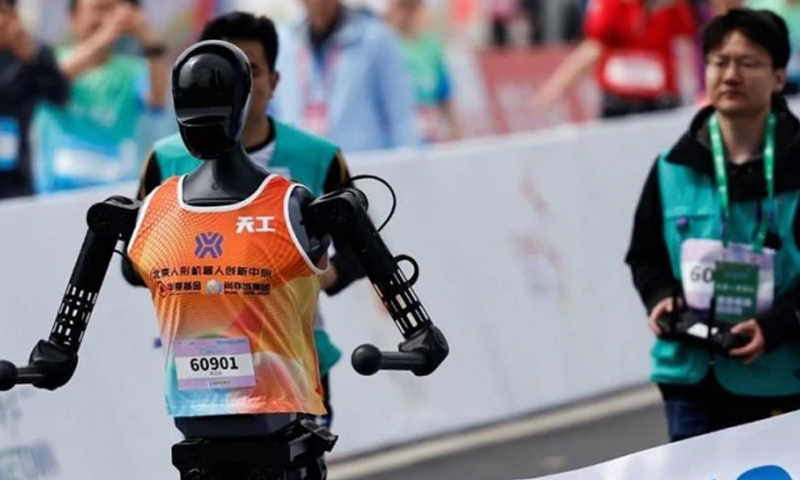
The release of RoboBrain 2.0 follows another high-profile achievement in China’s humanoid robotics sector. In April, the Beijing Humanoid Robot Innovation Centre gained attention when its robot Tien Kung completed a half-marathon in Beijing. The centre’s “Hui Si Kai Wu” project, meanwhile, is positioning itself as an Android-like general platform for future robots — an ecosystem comparable to what Android has done for smartphones.
Carney Invites Modi to G7 as Canada, India Begin Diplomatic Reset
China is actively investing in developing commercially viable humanoid robots that can perform real-world functions with autonomy. The open-source nature of RoboBrain 2.0 may democratize access to high-performing AI systems and reduce the barrier to entry for smaller players and start-ups.
A Pivotal Moment in Global Robotics Development
This year’s BAAI Conference attracted over 100 global AI researchers and 200+ industry experts, including representatives from major Chinese tech giants like Baidu, Huawei, Tencent, and fast-growing robotics start-ups such as Unitree Robotics, Zhipu AI, and Shengshu AI.
By releasing RoboBrain 2.0 under an open-source framework, BAAI is sending a clear message: the future of robotics lies in collaborative innovation, openness, and shared technological progress.
As the international competition in AI intensifies, China is signaling that it intends not only to keep pace but to lead — and RoboBrain 2.0 is a major step in that direction.
